Get Full Government Meeting Transcripts, Videos, & Alerts Forever!
Get email alerts on the School Finance topic
No spam. Unsubscribe anytime.
Oconee County committee presses school district to consider using reserves so taxpayers avoid a new millage
Summary
Members of the Budget, Finance and Administration Committee asked the school district to explore using part of its fund balance and reducing capital borrowing so the county can return 1.4 mills it transferred last year rather than raise property tax rates.
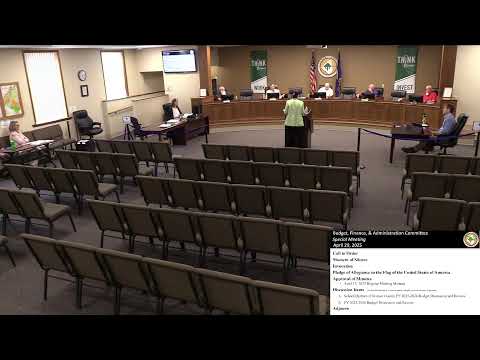
Members of the Oconee County Budget, Finance and Administration Committee pressed the school district on April 29 to consider using part of its large fund balance and to discuss reducing planned capital borrowing so the county could return a 1.4-mill transfer made last year rather than impose a tax increase.
The committee chair and several members told school officials they were concerned the district’s roughly $37,000,000 fund balance — described in the meeting as “over 27% of [the district’s] operating budget” — reduced the case for passing a millage increase on county taxpayers. The committee asked district leaders to take a proposal to the school board to borrow about $1 million less in capital this year and report back to county officials after the board’s May meeting.
School district representatives said the district develops a dollar-based budget request and does not control the millage the county sets. “We bring that dollar figure, and then it’s outside of our control what the millage levy is and how much is collected,” a district official told the committee. The district noted some of the recent year-to-year variance reflected one-time capital spending—buses and other one-time items—and said the board had approved the operating request on first reading.
District presenters described steps they had built into this budget to limit recurring costs: reclassifying several monitor positions from administrative to instructional accounts, pricing in about 3% salary growth rather than larger raises, and planning modest staff reductions by attrition, including nine certified positions and two operational positions. The district’s associate superintendent was cited as the official who runs class‑size staffing formulas used to set classroom allocations.
Officials warned against budgeting a planned operating deficit. They said a $2–3 million planned deficit could strain the district’s fund balance, risk Moody’s bond‑rating metrics by eroding surpluses relative to expenditures, and lead to compounding future requests to cover the gap. The district also told the committee it may under‑collect this year and that investment income that recently boosted revenues is likely to decline if Federal Reserve cuts materialize.
Committee members pressed for specifics about how the district treated recent “over-collections,” which the county characterized as roughly $28 million in state and local receipts over the past three years. The district acknowledged it had both over‑collected in some years and overspent in others; it said some past overages were used for one‑time capital items and that expenditure levels sometimes exceeded earlier projections.
The committee asked the district to consider using portions of its fund balance for capital — the district noted a proposed $2.25 million pledge toward a YMCA phase‑2 capital project as an example of an intended one‑time use of reserves — and to discuss whether the capital millage could be reduced while still meeting capital needs. School officials said any change to capital borrowing or millage would require action by the school board in a published meeting.
The committee requested a report back from the district after the school board’s May meeting so the county could consider changes before its own second-reading budget action.
Less central details discussed included a state law requiring teachers a minimum 30 minutes of unassigned time (the district said that led to hiring non‑certified “monitors” used in lunch/recess duty) and a projection that overall student population in the county remains near 9,900–10,500 students, though attendance zones are shifting among high schools.
The committee took no formal county vote on the district budget during the April 29 meeting; it recorded the exchange and asked district leaders to return with a decision from their board.