Get Full Government Meeting Transcripts, Videos, & Alerts Forever!
Get email alerts on the Private Roads Rights Of Way topic
No spam. Unsubscribe anytime.
Oconee planning commission moves to cut language, tighten drainage rules and lower private‑drive width amid sharp public debate
Summary
OCONEE COUNTY — The Oconee County Planning Commission on April 21 approved changes to county private‑road rules, removing the word “dwellings” from a private‑drive standard, adding a drainage requirement and lowering the minimum private‑drive right‑of‑way from 50 feet to 20 feet.
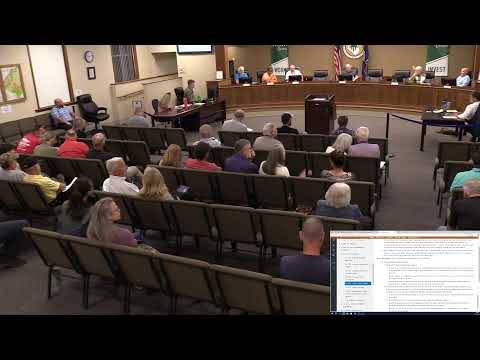
OCONEE COUNTY — The Oconee County Planning Commission on April 21 approved several changes to county rules for private roads and drives, drawing dozens of public speakers who warned the moves could reduce safety and benefit developers.
The commission voted to remove the word “dwellings” from the private‑drive standard in chapter 26 of the county code, approved added language requiring adequate drainage for private drives, and changed the minimum right‑of‑way for private drives from 50 feet to 20 feet. Commissioners then paused broader revisions and asked county staff to invite the South Carolina Department of Transportation to the next meeting for technical input.
The changes came after more than two hours of public comment and a lengthy staff and commissioner discussion that touched on local case law, Board of Zoning Appeals variances, and complaints about how the amendments were introduced. Supporters said the revisions clarify conflicting language between chapter 26 (roads and bridges) and chapter 32 (development standards) and give rural landowners more flexibility. Opponents said the proposals would endanger emergency access and utility installation and questioned the timing and motivations behind the effort.
"Private property is private, period," said Tom Markovich, a resident who spoke during the public comment period, arguing against treating private roads like public streets. In contrast, several speakers, including Serena Brown Richardson, presented a petition of hundreds of signatures urging the commission to keep the 50‑foot standard for safety and maintenance.
Why it matters
The dispute centers on longstanding county standards for rights‑of‑way on private roads and private drives: chapter 26 requires certain minimum widths for private access serving multiple lots, while chapter 32 uses slightly different language. The planning staff and several commissioners said the sections conflict and need harmonizing. Critics warned that reducing the right‑of‑way could make it harder for fire, EMS and utility crews to access properties and could shift long‑term costs to neighbors and taxpayers.
What the commission did
- Remove the word "dwellings" from the private‑drive provision of chapter 26 (motion approved). The commission said the change aligns the definition used in chapter 26 with chapter 32, which refers to lots. Commissioners described this as a housekeeping change intended to resolve an internal inconsistency.
- Add a requirement that private drives "accommodate proper drainage to shed water from driving surfaces" (motion approved). Kyle Reed, Oconee County director of Roads and Bridges, told commissioners, "it is always a good idea to run water away from the road," supporting the drainage insertion as a practical safety measure.
- Reduce the minimum right‑of‑way for private drives (the provision addressing 4–10 lots) from 50 feet to 20 feet (motion approved). Commissioners said the 20‑foot minimum aligns with the International Fire Code's minimum travel width for emergency apparatus on private access drives, while leaving additional easement options for utilities or drainage to be established where needed.
- Delay further discussion of other private‑road standards and request technical participation from S.C. Department of Transportation at the next meeting (motion approved). The commission asked staff to provide a marked‑up draft of proposed changes and supporting engineering references before continuing debate.
Public reaction and ethics questions
More than a dozen speakers addressed the commission. Many cited emergency access, vegetation management and utility installation as reasons to retain wider rights‑of‑way. Several speakers described petitions: the meeting record included 11 emailed comments submitted for the hearing and at least one speaker said she carried a petition with nearly 500 signatures opposing changes; an Oak Point neighborhood petition of 23 names also was mentioned.
Public commenters also raised conflicts‑of‑interest concerns. Multiple speakers suggested that proximity to a pending variance and litigation involving Arrowhead Point Subdivision and the fact that the planning commission chair works as a real estate agent created the appearance of a personal interest. The chair, identified in the record as Chairman Mike Johnson, responded that he is a realtor and that state ethics guidance previously provided to him indicated the planning matter as drafted was a general rule change applying to many properties, not a single development.
Legal and procedural context
County staff and the county attorney repeatedly cautioned that the planning commission provides recommendations and that legislative changes would go to County Council for public hearings and three readings. Staff also noted an ongoing appeal related to Arrowhead Point: a Board of Zoning Appeals variance was granted, that decision was affirmed on appeal, and an application to the state Supreme Court may still be possible. Planning staff and the county attorney warned that the outcome of court proceedings is independent but could become moot if an ordinance were later changed by the council.
Planning staff emphasized that deeded easements and recorded surveys — not the ordinance alone — determine many property access and utility rights. The commission’s changes modify county minimums; they do not automatically alter recorded deeds or prescriptive easements.
What happens next
Commissioners instructed staff to prepare a marked‑up version of the ordinance changes, to gather technical references (including SCDOT and engineering guidance cited from SCDOT road design), and to invite S.C. Department of Transportation staff to the next meeting. The commission will resume consideration after that packet is circulated.
Ending
The meeting closed after the commission read a series of public emails into the public record and agreed to continue the ordinance work at a future meeting. No final action by County Council took place; any code amendment would need to follow the council’s legislative process.