Get Full Government Meeting Transcripts, Videos, & Alerts Forever!
Get email alerts on the State Legislation topic
No spam. Unsubscribe anytime.
City receives $13.8M in capital outlay; lawmakers pass behavioral‑health funding and omnibus crime package
Summary
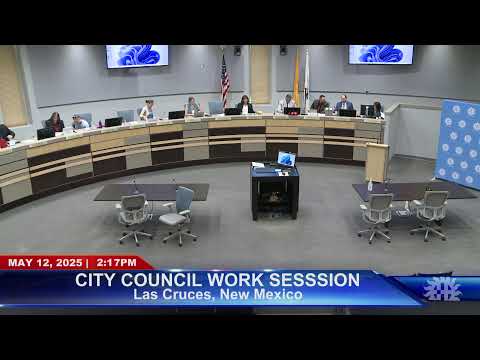
City staff and the city’s lobbyist briefed the council on May 12 about 2025 legislative outcomes affecting Las Cruces, saying the city will receive just over $13.8 million in capital‑outlay funding and summarizing several enacted state measures on criminal justice, behavioral health, housing and grants.
Barbara Bencomo, the city’s chief administrative officer, and lobbyist Larry Horan briefed the Las Cruces City Council work session on May 12 about outcomes from the 2025 New Mexico legislative session, including capital‑outlay awards to the city totaling just over $13,800,000 and several statewide bills that affect housing, public safety and behavioral health.
The update matters because state legislation and appropriations determine whether the city can advance capital projects, obtain program funding and rely on statewide policy changes that affect local services. “This year was a 60‑day legislative session, began on January 21, and ended on March 22,” Larry Horan said, summarizing the session timeline and the scale of bills introduced.
Horan described major enacted measures: House Bill 8 — described to the council as an omnibus crime package — included criminal‑competency restoration provisions, changes to civil commitment and additional penalties for fentanyl trafficking and motor‑vehicle theft. Horan also described changes to the state’s extreme‑risk (red‑flag) firearm protection law in House Bill 12 that allow law enforcement to petition for orders and require relinquishment after service.
On behavioral health, Horan said the legislature created a Behavioral Health Trust Fund with a $100,000,000 appropriation and passed the Behavioral Health Reform and Investment Act (Senate Bill 3), which establishes regional planning and funding strategies and appropriated roughly $200,000,000 to state agencies for behavioral‑health programs.
Horan summarized the state budget: “They passed a $10,650,000,000 budget with 30% reserves,” he told the council, and said an omnibus tax reform package (House Bill 14) that included earned‑income tax credits and other measures was vetoed by the governor post‑session.
On housing, the briefing explained that the legislature put $110,000,000 into housing initiatives in the overall budget, and the Department of Finance and Administration (DFA) has contact with city staff; language that would have earmarked $10,000,000 specifically to Las Cruces and $80,000,000 to Albuquerque was removed by line‑item veto, but Horan and Bencomo said the appropriation remains in the budget and DFA staff have engaged with the city. Bencomo said DFA Secretary Sarita Nair has already met with city staff about housing plans.
Horan highlighted the Essential Services Development Act — enabling legislation to allow an exception to the anti‑donation clause for spending state dollars on private property to deliver essential household services — as a multi‑year priority carried by Senator Carrie Hamblin. Horan said the measure progressed with strong legislative support and credited the local delegation for carrying the legislation.
Several other items noted in the briefing: - Senate Bill 267 (sponsored by Senator Hamblin) passed; it addresses housing application fees and tenant protections. Senate Bill 205 (an Office of Housing bill) failed in Senate Finance. - The legislature appropriated $12,000,000 for rural air service grants and $1,000,000 to support the Las Cruces air show through the Department of Tourism. - The legislature put $131,000,000 into the state employee group health plan deficit. - Three separate bills to amend the Inspection of Public Records Act were debated but none passed; the discussion is expected to continue. - The legislature created or funded an animal‑welfare trust (Animal Welfare Trust Fund) with a $5,000,000 appropriation to support shelters and related services. - Paid family and medical leave proposals were considered but did not pass; a version that reduced leave to six weeks for certain uses failed in the Senate Finance Committee. - House Bill 6, which requires prevailing wages when a private entity receives an industrial revenue bond and establishes a local solar‑access fund, was signed into law; $20,000,000 was designated under the solar fund program.
On capital outlay, Bencomo explained the city’s capital‑project process and listed the city allocations the delegation helped secure: $5,500,000 for the mobile integrated health (MIH) building (the city had requested $2,500,000), $1,800,000 for a police real‑time crime center (requested $1,000,000), nearly $2,000,000 combined for Paseos Verdes and Amador Crossing housing projects (city requested just over $4,000,000 for both), and nearly $1,000,000 for improvements to the Thomas Branigan Memorial Library (city requested $5,600,000). Bencomo said the total from the session to the city is “just over $13,800,000.”
Councilors asked how the city will use funding that exceeded initial requests; Chief Daniels confirmed additional appropriation will allow completion of furnishings and relieve pressure on other grant funds. Horan and Bencomo explained the capital‑outlay process timeline: the city adopts a CIP, meets with legislators to prioritize projects, submits priorities through the legislative portal in January, and typically receives funding agreements from the state in the fall.
Bencomo said the city will host a capital‑outlay workshop on July 8 to help nonprofits and partners learn how to access legislative capital funding. Horan encouraged continued engagement with the delegation and noted the value of councilors and staff meeting legislators in Santa Fe.
No council votes or new ordinances were taken during the presentation; the briefing was an informational update and included Q&A and direction to continue coordination with DFA and the local legislative delegation.