Get Full Government Meeting Transcripts, Videos, & Alerts Forever!
Get email alerts on the Parks And Recreation topic
No spam. Unsubscribe anytime.
Golf Manor Executive Committee reviews two park master-plan proposals, asks staff to solicit engineer scope
Summary
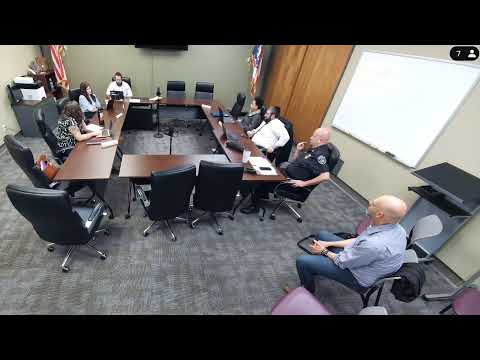
The Golf Manor Village executive committee reviewed two revised park master-plan proposals and debated whether to hire park designers or rely on the village engineer to produce lower-cost concept options; the group asked staff to request written proposals and to revisit the items at the June meeting.
The Golf Manor Village Executive Committee reviewed two revised proposals for a park master plan and asked staff to request proposals from the village engineer and the firms that responded to the original RFP so the committee can compare scopes and costs.
Committee members discussed two written proposals summarized on the April agenda: one from MSP that included community engagement for $2,500, a master plan for $26,500 and a cost analysis for $6,000 (total about $35,000), and another from MKSK with a smaller engagement line item and $27,000 for alternative concept plans. A committee member said the two professional proposals are “basically the same” in scope and references, but differed in line-item presentation.
The matter drew sustained debate about purpose and scale. Several committee members said the primary purpose of a plan is to produce something that can support grant applications; others urged caution because Golf Manor is a small village with limited construction funds. One committee member noted typical planning fees are between 7% and 14% of a total project budget and said, “If you take $35,000 and divide that by 14%, you’re talking about a $250,000 park,” calling into question whether the village can afford a full build-out at that scale.
An engineer’s estimate to complete the walking path was cited at about $110,000. Committee members discussed potential funding sources discussed during the meeting: a $35,000 planning grant, roughly $25,000 from a tower-related source, and $50,000 from ARPA funds were identified as a possible mix that would cover the walking-path cost if those amounts are all available and approved. A committee member said completing the walking path “completes the walking path, which I believe is not controversial” and urged focusing limited funds on that item.
Members disagreed about whether the village should pay for a professional park designer or have the village engineer produce concept options to save money. One committee member cautioned that engineers are not “experiential designers” and that a professional designer can avoid short-term, inefficient decisions; another said the engineer has worked with designers previously and could produce usable concepts for a lower cost. A staff member said the engineer had offered to produce a concept for $5,000–$10,000 with deliverables in 60–90 days.
After discussion the committee asked staff to send the original RFP and the two firms’ responses to the village engineer and to ask the engineer to submit a written proposal for concept options the committee can review. The committee agreed to place the engineer’s proposal and the two existing proposals side-by-side for review at the committee’s June meeting.
No vote to select a vendor or to approve contract funds was taken during the meeting; the committee’s action was a request for proposals and a direction to staff to return comparative proposals for the committee’s next meeting.
Background: committee members said the original $35,000 grant application to Hamilton County had initially included funds for ADA access and planning; the village later resubmitted the request and Hamilton County approved a change allowing the funds to be used for planning. Committee members emphasized that a plan’s purpose—whether to generate a modest concept for a walking path or to support larger grant applications and a broader streetscape/business-district strategy at the Losantiville intersection—should drive the scope and budget.
The committee set a procedural next step: staff will request written proposals from the village engineer based on the RFP and bring those proposals back for review at the June meeting so members can compare costs and deliverables before deciding whether to hire a design firm or proceed with engineer-produced concepts.