Get Full Government Meeting Transcripts, Videos, & Alerts Forever!
Get email alerts on the Fire Safety Exemption topic
No spam. Unsubscribe anytime.
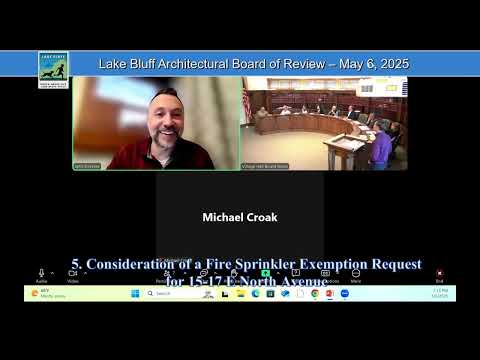
Lake Bluff panel grants sprinkler exemption for two multifamily buildings, requires monitored alarm system
Summary
Members granted an exemption from Lake Bluff's sprinkler requirement for two six-unit buildings but required a wireless monitored alarm system and staff verification of smoke and carbon-monoxide detectors after hearing that retrofitting sprinklers would be complex, costly and displace tenants.
Members of the Lake Bluff review body voted to grant an exemption from the village's sprinkler requirement for two adjacent multifamily buildings but added conditions that the owner install a wireless, centrally monitored alarm system and allow staff to inspect and verify required smoke and carbon-monoxide detectors.
The decision follows a consultant's presentation showing the properties are two buildings of three units each (six units total), that retrofitting a full residential sprinkler system would require new water service and a riser room and would force temporary relocation of occupants, and that contractors had proposed a monitored wireless alarm approach as a lower-impact alternative.
Consultant Seth Sommer summarized the technical tradeoffs for the panel. "The code itself would require sprinkler systems if these units were built today," Sommer said, adding that retrofitting would likely require a new water service, a riser room and substantial interior work that would displace residents. Sommer also described contractor estimates and options the board could consider.
The owner's representative, Brady, described alarm bids from two local companies and the vendors' recommendation for a panel in each unit with detectors wirelessly interconnected inside each unit. "They would be wirelessly interconnected to one another," Brady said, describing how the suggested system would notify a central monitoring station.
The board considered three main options presented at the meeting: leave the buildings as-is (complete exemption), grant an exemption but require a monitored alarm system, or require full sprinkler installation (the ordinance-required option). Board discussion emphasized the practical difficulties of retrofitting: cutting open walls, running new plumbing and electrical, moving occupants and the additional cost beyond contractors' basic estimates.
A contractor estimate discussed at the meeting showed a residential NFPA 13D sprinkler install quote of about $104,000 per building as an order-of-magnitude figure, and staff and the consultant said connecting a full sprinkler system as required for a multifamily structure could require enlarging water service from the existing 1-inch branch up to an inch-and-a-half service line and installing backflow and a riser room, which would increase the cost and disruption.
After discussion and a motion to grant the exemption conditioned on installation of a wireless monitored alarm system and staff confirmation that each unit has working smoke and carbon-monoxide detectors meeting code, the review body took a roll call vote. Member Stratus, Member Degan, Member Dolman, Member Cottrell and Chair Hunter voted in favor; Member Wicks voted no. The motion passed by a 5-to-1 vote with one member recorded as recused/abstained.
The approval is limited to the exemption and the conditions specified by the board; the decision document requires the owner to supply specifications for the alarm system from the selected contractor and to permit staff inspections to verify detection devices in each sleeping room, hall and on each floor meet Lake Bluff and state requirements. The board noted it could require a monitored system as a condition of any exemption but that Lake Bluff's ordinance (Title 9 Chapter 2, Section 907.2) does not itself require monitoring for units treated as townhomes.
Next steps identified at the meeting include the owner providing final alarm specifications from their chosen vendor, staff scheduling inspections to verify smoke and carbon-monoxide devices, and the village recording the exemption with the stated conditions. The board did not change the underlying ordinance during this action; the exemption applies only to this property and is tied to the monitoring and verification conditions the board adopted.