Get Full Government Meeting Transcripts, Videos, & Alerts Forever!
Get email alerts on the Bulky Items Reuse topic
No spam. Unsubscribe anytime.
MassDEP reviews midway progress on bulky‑item reuse, plans statewide network
Summary
The Massachusetts Department of Environmental Protection reviewed progress on its Reduce and Reuse Action Plan’s bulky‑item work, highlighted grants and pilot projects, and proposed a stakeholder network to tackle storage, market development and procurement barriers.
The Massachusetts Department of Environmental Protection (MassDEP) held an online midpoint review of its Reduce and Reuse Action Plan focused on bulky items, describing current efforts, grant awards and next steps including a proposed “bulky items” network to start this summer or fall.
MassDEP presenters said the work is intended to increase reuse of household durable goods and commercial and institutional furniture, fixtures and equipment to reduce waste disposal, lower municipal costs and expand material access for nonprofits, schools and small businesses.
The plan matters because bulky materials account for a large share of recoverable material: MassDEP staff said more than 40% of waste generated in Massachusetts is exported out of state and cited a statewide figure of about 1,400,000 tons; a 2022 statewide bulky waste characterization study found as much as 30% of discarded bulky items were recoverable for reuse or recycling.
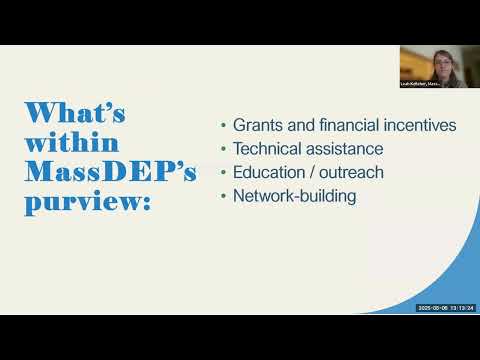
Leah Kelleher, a MassDEP staff member leading the presentation, summarized the agency’s role and the action‑plan strategies supporting bulky‑item reuse, saying, "we provide grants and financial incentives, we provide technical assistance, education and outreach, and then we help build networks." Janice (MassDEP) said MassDEP is treating residential and commercial bulky items together for now but asked meeting participants whether those streams should remain combined as the agency forms the new network.
MassDEP told attendees it has organized action items under strategy categories in the plan — education and behavior change; tools, resources and technical assistance; grants and financial incentives; job training and workforce development; legislation and policy; networking; and procurement. Examples offered at the webinar included:
- Education/outreach: RecycleSmart MA posts and partner spotlights; a recommendation to amplify partner media and case studies. - Technical assistance: Recycling Works guidance for K–12 school furniture reuse and best management practices for commercial furniture and construction projects; references to the Division of Capital Asset Management and Maintenance (DCAM) reuse of cubicle partitions during office consolidation. - Grants: Microgrants totaling "almost $78,000" since 2019 for bulky‑item projects (recipients cited during the meeting included FreshStart Furniture Bank, Urban Missionaries of Our Lady of Hope, HandUp and Buzzards Bay Area Habitat for Humanity). MassDEP also awarded swap‑shed grants to 16 communities (totaling $96,000) and reported approximately $182,000 allocated through Recycling Dividends Program points tied to bulky‑item actions. MassDEP said a Recycling Business Development Grant awarded about $80,000 for furniture dismantling at an Earth Day event. - Procurement: MassDEP is working with the state Office of Supplier Diversity and the state surplus property program to encourage procurement policies favoring durable, repairable, refurbished or remanufactured goods; MassDEP said participating municipalities in its Smart Grant program will need an updated Environmentally Preferable Procurement (EPP) policy by 2026.
Speakers from the field described operational barriers. An operator identified as "Eric," who described his organization as a mattress recycler, said deconstructing upholstered furniture is significantly more complex and labor‑intensive than dismantling mattresses: "when you start to look at furniture, it's very, very complex, and a lot of time... it takes a ton of labor." Janice and others noted at least one vendor on the state contract (FAC‑90) will take upholstered furniture for deconstruction, but pricing and processes differ from mattress recycling.
Participants raised storage and market challenges repeatedly. Andrew of Boston Building Resources described a persistent mismatch between nearly endless supply and limited market demand and storage: "the supply of this stuff is endless... The problem is the market is very small... storage remains like the constant problem." Multiple attendees called for shared, temporary storage or staging space and for an online reuse directory or marketplace to connect donors and buyers.
On legal and policy matters, presenters referenced the Solid Waste Master Plan and the Reduce and Reuse Action Plan (published December 2021) as the guiding documents for targets and implementation; MassDEP staff also noted Chapter 30B procurement rules and the Environmental Crimes Strike Force as existing authorities or tools that intersect with reuse and illegal‑dumping issues. MassDEP staff said they will coordinate with other agencies and stakeholders as the network develops.
MassDEP asked attendees whether to group residential and commercial bulky items together in the new network. Opinions differed: some nonprofit reuse organizations favored keeping the streams combined to enable cross‑sector coordination and shared learning; others urged separating them because commercial reuse often involves different timelines, stakeholders and logistics. MassDEP said combining the topics initially would allow broader context and that it could divide workstreams later where specific tools or procurement guidance differ.
Next steps and deadlines flagged during the webinar included forthcoming launches of the bulky‑item network (MassDEP suggested late summer or fall), a deconstruction workgroup meeting scheduled for the following week, the microgrant deadline (next Thursday from the meeting date), a Sustainable Materials Recovery Program municipal grant deadline on June 2, and an innovations grant deadline on July 15. MassDEP said it will share resources and case studies and invited attendees to join the new network and to submit ideas and examples for MassDEP to amplify.
There were no formal motions or votes recorded during the webinar; the meeting functioned as a status review and stakeholder consultation.