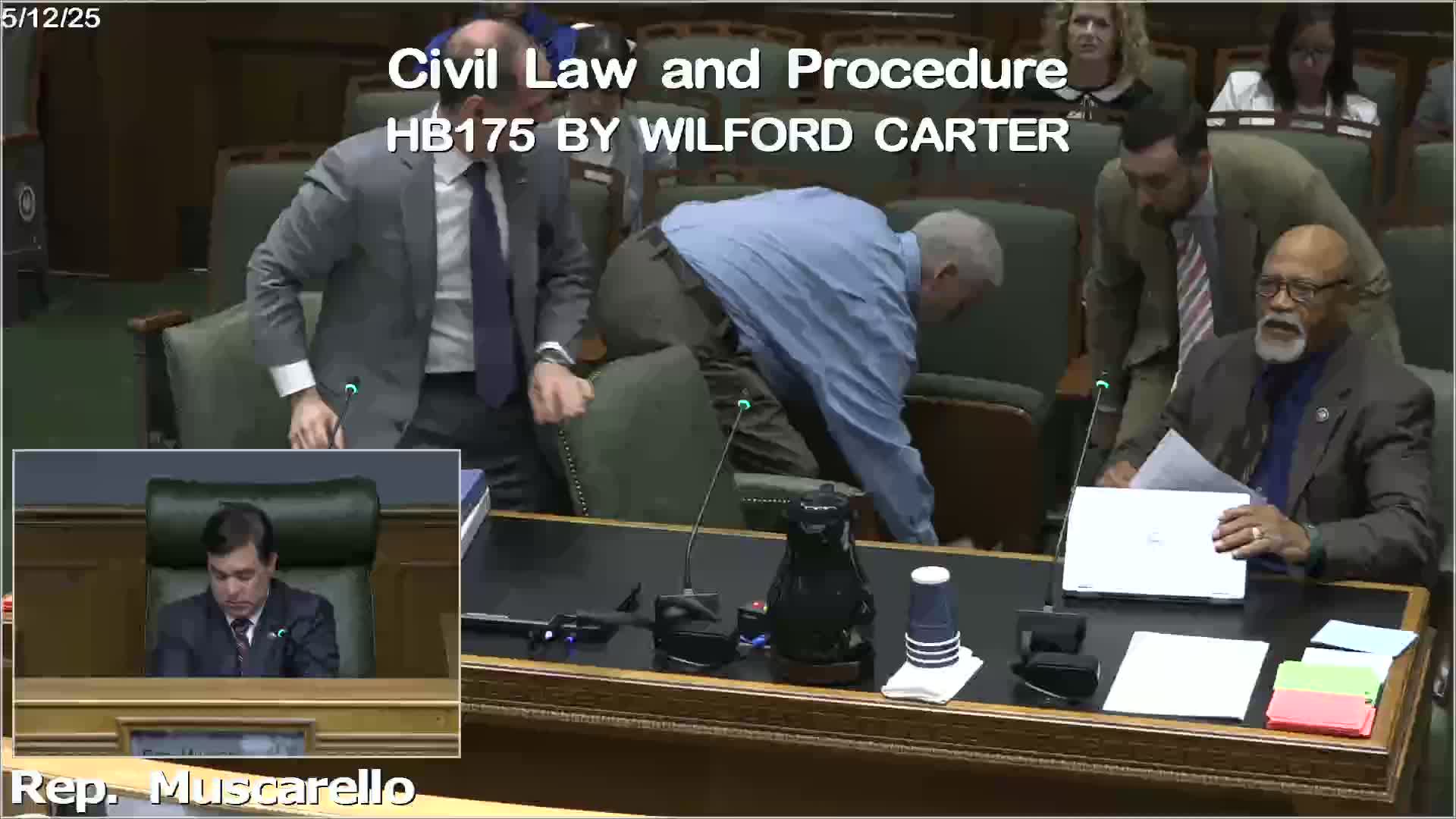
Committee pauses Uniform Partition of Heirs’ Property proposal after extensive testimony; sponsor seeks more stakeholder work
Loading...
Summary
Representative Carter presented a draft based on the Uniform Partition of Heirs' Property Act to protect heirs from forced sales; committee members heard multiple family testimonies and stakeholders on both sides, and the sponsor offered to voluntarily defer the bill to refine consensus language.
Representative Carter introduced HB 175, a bill modeled on the Uniform Partition of Heirs' Property Act (UPHPA) intended to help families retain generational property when co-owners with fractional interests force partitions that can result in sales to third-party speculators.
Professor Ron Scalise, reporter for the Successions and Donations Committee at the Louisiana State Law Institute, framed the bill as an attempt to align Louisiana with a 25-state trend adopting UPHPA provisions that require fair-market appraisals, provide a right of first refusal for co-owners, and otherwise reduce incentives for opportunistic partitions. He said Louisiana already has tools (R.S. 9:11.13 and Civil Code Article 811) but that those provisions do not go far enough, and that the draft borrows key safeguards from the uniform act.
Multiple descendants and heirs testified about family properties lost or nearly lost to partition sales, describing how the pandemic complicated timely notice and fundraising. Toya Avery of New Orleans described raising roughly $400,000 to try to save 27 acres she said her family lost in a 2020 sale. Adrienne Wheeler of Louisiana Appleseed said the group had mapped approximately 175,000 likely heirs-property parcels statewide and that the proposed law could provide mediation and a legal framework to keep property in family use.
Opponents from the Louisiana Land Title Association and private practitioners urged caution. They said the proposal could prolong litigation, add costs (appraisals, broker commissions), and change long-standing public policy that gives each co-owner the right to demand partition. LLTA representatives said prior reforms — including partition by private sale with appraisal — already address some concerns and warned the new approach could disadvantage some co-owners.
Representative Carter moved a substitute motion to voluntarily defer the bill to allow further stakeholder work. After a roll-call, the committee recorded an outcome on the substitute motion (roll-call result recorded as 8 yes, 4 no); the sponsor characterized the deferral as an opportunity to continue negotiations among stakeholders and legislative leadership pledged to assist in refining workable language.
Why it matters: Supporters described the bill as a tool to preserve family wealth and prevent predatory purchasers from extinguishing long-held family land; opponents flagged procedural, cost and legal-policy trade-offs that the sponsor agreed to address through additional stakeholder outreach.