
Committee adopts substitute and reports SB151 setting default head lice and pink eye policies for school districts
Get AI-powered insights, summaries, and transcripts
Subscribe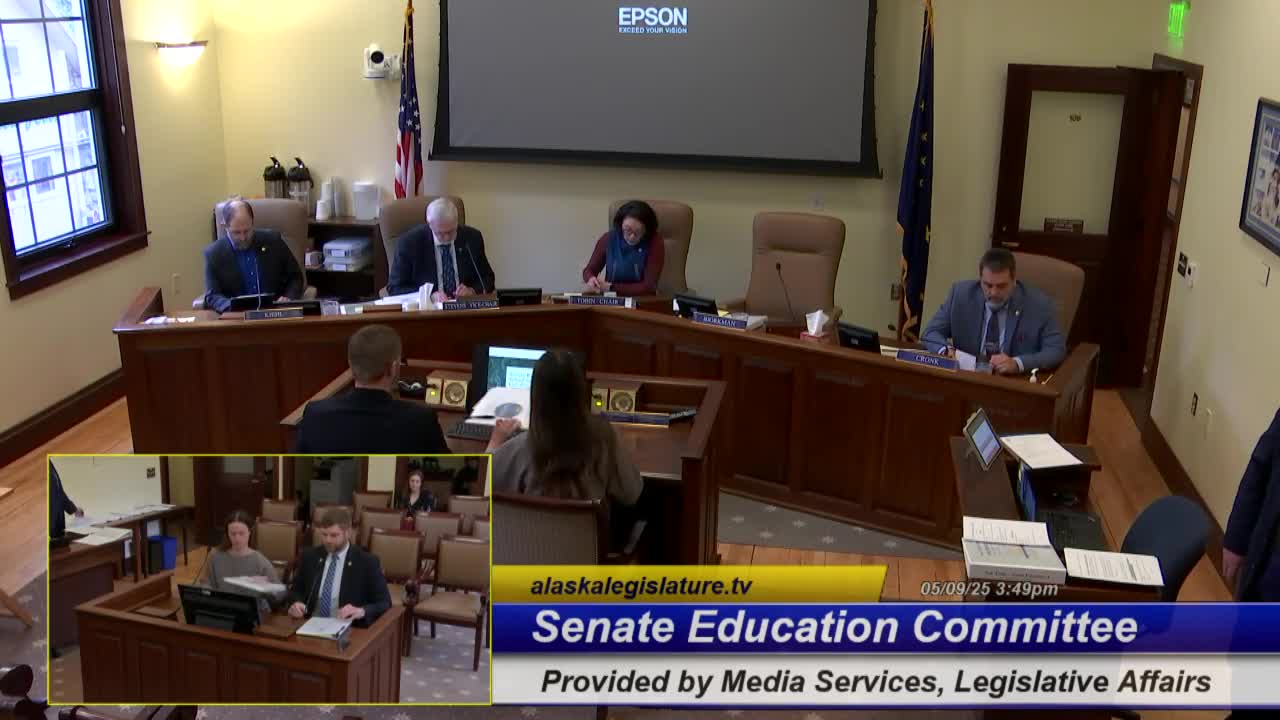
Summary
The Senate Education Committee adopted a committee substitute for SB151 requiring school districts to adopt policies on head lice and bacterial conjunctivitis (pink eye), providing a statutory default where districts do not act and specifying return-to-school conditions.
The Senate Education Committee on May 9 adopted a committee substitute for Senate Bill 151 and reported the bill with individual recommendations and an attached fiscal note. The substitute requires school districts to adopt policies addressing head lice and bacterial conjunctivitis; if a district does not adopt a policy within six months, the bill’s default policy applies.
Senator Jesse Bjorkman, sponsor of SB151, and his legislative aide Seveah Bieber presented the substitute and described changes from the original draft, including removal of district reimbursement and reporting requirements. Bieber told the committee the substitute “deleted the whole bill and redid it. So now the bill requires districts to adopt a policy regarding head lice and bacterial conjunctivitis, also known as pink eye. Those who have not adopted a policy shall follow the default policy established in this bill.”
Under the substitute, “students found with lice may finish the school day, but may not return until a school nurse or a designee has confirmed the absence of live head lice,” Bieber said. For bacterial conjunctivitis, the substitute requires students who are found with the condition to “leave the class immediately and may return at least 24 hours after starting their pink eye treatment,” she said. The substitute also requires schools to notify parents that a student in their child’s class was found to have lice or pink eye; notifications must protect student privacy, the presentation said.
Bieber said the substitute was intended as a “backstop policy” that encourages districts to adopt locally tailored approaches. She told the committee the substitute excludes correspondence programs and requires separate policies for boarding or residential schools. She also explained that initial plans to include funding for school nurses were removed because of “fiscal realities,” leaving the bill streamlined to avoid imposing new fiscal liabilities on districts.
During questions, Senator Peter Stevens asked why students with lice would be allowed to remain in class given its contagiousness. Bieber responded that federal Centers for Disease Control guidance indicates a child with lice “does not have to leave immediately. They can go home at the end of the day and then get treatment and come back when they don't have any live lice.” Senator Kiel asked about balancing send-home policies against learning loss and access to care; Bieber noted existing resources including regional health services and programs such as Denali Kid Care and mentioned telehealth and expanded pharmacist-prescription authority as routes to treatment.
Senator Bjorkman said ringworm was not included in the substitute because it is most commonly spread through middle- and high-school wrestling and affects a smaller subset of students. The committee adopted the substitute by unanimous consent and then reported SB151 with individual recommendations and an attached fiscal note; members were asked to remain after adjournment to sign the report.
The bill gives districts six months to adopt a local policy with public input; if they do not, the default rules in the substitute apply. The committee record identifies the working document as work order 34-ls0709 backslash o.