
Committee advances constitutional amendment to unify Permanent Fund accounts, limit withdrawals to 5%
Get AI-powered insights, summaries, and transcripts
Subscribe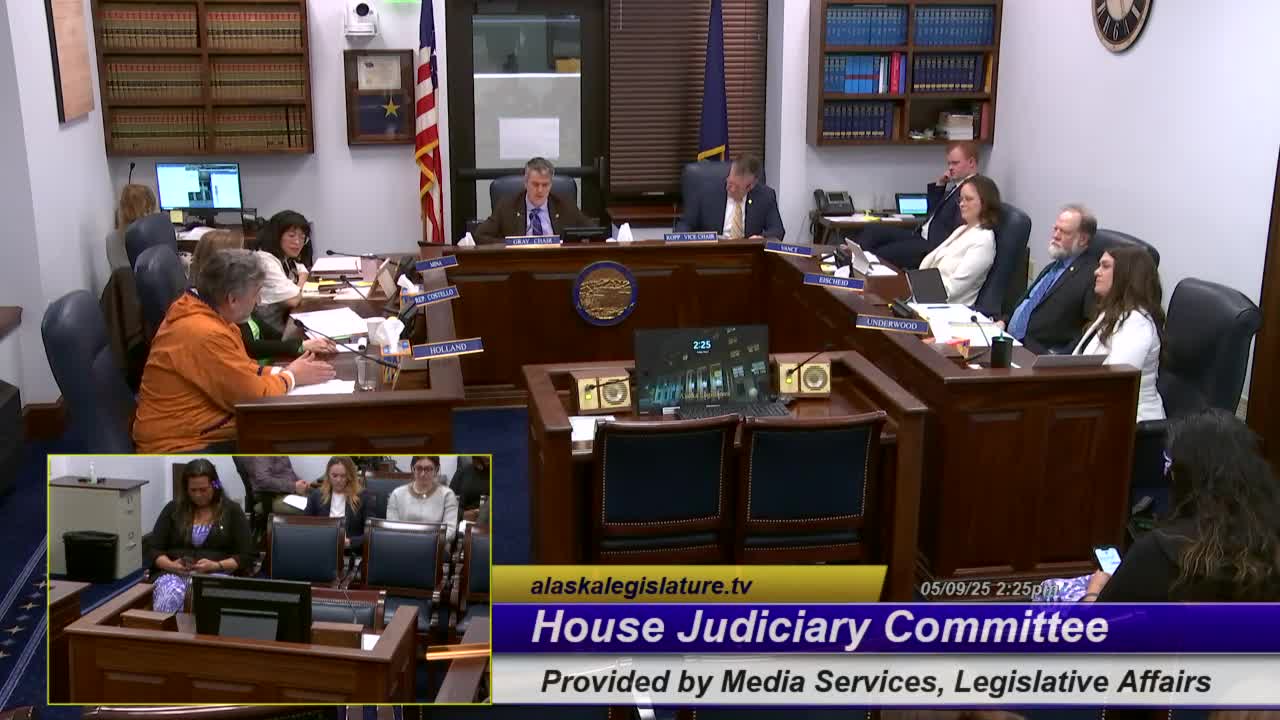
Summary
The House Judiciary Committee voted May 9 to move House Joint Resolution 10 — a proposed constitutional amendment that would combine the Permanent Fund’s accounts into a single account with a maximum 5% draw — out of committee with fiscal notes. Two floor amendments to change deposit and expense provisions were defeated in committee votes.
The Alaska House Judiciary Committee on May 9 advanced House Joint Resolution 10 (HJR10), a proposed constitutional amendment that would combine the Alaska Permanent Fund’s two-account structure into one account and cap annual withdrawals at 5 percent based on a five-year average of the preceding six years. The committee forwarded the resolution to the full House with attached fiscal notes.
Why it matters: HJR10 would change how the state protects and withdraws earnings from the Permanent Fund — a central fiscal policy issue in Alaska that affects dividends and state services. The proposal prompted debate over constitutional protections for mineral royalties, the fund’s management costs and how much flexibility the Legislature should retain for annual budgets.
What the resolution would do
Sponsor Representative Schraghi described HJR10 as a constitutional change to "combine the 2 account structure of the permanent fund into 1 single account structure with a maximum 5% draw." He said the 5 percent cap would be calculated using a five-year average of the six preceding years.
Two amendments defeated in committee
Representative Vance offered two amendments that the committee debated and rejected by roll-call votes.
- Amendment A.3 (Vance) would have increased the constitutionally protected share of mineral-related revenues deposited into the Permanent Fund from a statutory practice the sponsor described as roughly 25–35 percent up to 50 percent. After debate on the fiscal impacts, the committee voted 2 yeas and 4 nays; yes votes were recorded for Representatives Underwood and Vance, and no votes were recorded for Representatives Mina, Eisheid, Copp and Chair Gray. The amendment was not adopted.
- Amendment A.4 (Vance) would have removed a provision in HJR10 that authorizes legislative appropriations from the Permanent Fund to cover the fund corporation’s investment and operating expenses. Vance argued that investment-management expenses should be subject to ordinary legislative appropriation and scrutiny rather than implicitly exempted. The committee again voted 2 yeas and 4 nays and did not adopt the amendment.
Corporation testimony and budget context
Devin Mitchell, executive director and CEO of the Alaska Permanent Fund Corporation, urged the committee to consider practical budget implications and the corporation’s existing appropriation process. He said the corporation had an "authorized budget of 221,300,000.0" for fiscal year 2024 and expended about "150,100,000.0," leaving a difference of roughly $71 million that year. Mitchell said netting management costs from fund returns is consistent with common trust management practice and helps avoid large supplemental budget requests in strong-performance years.
Committee discussion and final action
Members expressed differing priorities: some argued constitutional protection would preserve the fund for future dividends and services, while others warned the change could reduce near‑term general-fund revenue and limit legislative flexibility during tight fiscal periods. Representative Kopp noted the language in HJR10 would allow — but not require — the Legislature to appropriate amounts for fund operations and that the change would not bind future legislatures to specific appropriation amounts.
By unanimous consent and without objection, the committee moved HJR10 out of the House Judiciary Committee with attached fiscal notes and authorized legislative legal services to make technical and conforming changes.
Ending note
Committee members said HJR10 is part of an ongoing discussion about Alaska’s long-term fiscal plan; the resolution will proceed to further legislative consideration, where additional debate and amendments are possible.