Committee hears support for occupational therapy licensure compact to ease interstate practice
Summary
Senate Bill 172 would enact the Occupational Therapy Licensure Compact to enable licensed occupational therapists and assistants to practice across compact states via a compact privilege; licensing board, providers and compact experts testified in support to address workforce shortages.
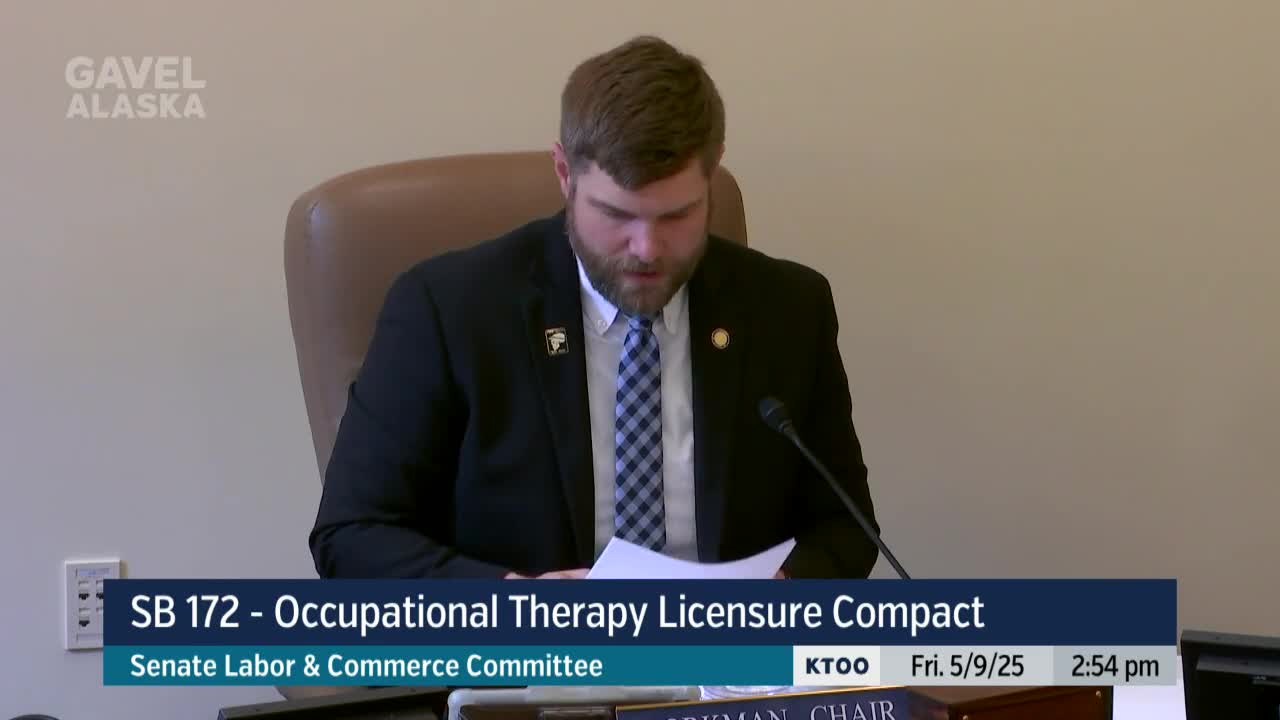
Senate Bill 172, presented to the Senate Labor and Commerce Committee, would enact the Occupational Therapy Licensure Compact in Alaska to ease interstate practice for occupational therapists and occupational therapy assistants and improve access to services in the state.
Matt Churchill, committee staff, explained the shortage of occupational therapists in Alaska and said the compact would make it easier for therapists from other compact member states to provide services in Alaska via a compact privilege. "There's only one training program in the entire state, and we simply don't have enough occupational therapists for the many Alaskans who are in need of this life changing service," Churchill said.
Keith Buckout, policy analyst with the Council of State Governments' National Center for Interstate Compacts, described how the compact establishes a uniform pathway for practitioners to practice in other member states subject to the receiving state's laws and possible jurisprudence exams, while also requiring background checks and enabling sharing disciplinary information across states. Buckout said the compact already has 32 member states and is becoming operational.
Local health‑care and licensing officials expressed support. Brianna Oswald, president of the Alaska Occupational Therapy Association, said the organization represents about 73 occupational therapy practitioners and supports the bill as a means to reduce bureaucratic burdens and increase access. Kathleen Hansen, system director of rehabilitation for the Southeast Alaska Regional Health Consortium, testified that licensure delays hinder hiring and access to care. Rebecca Dean, public board member of the Alaska Physical Therapy and Occupational Therapy Licensing Board, testified the board unanimously supports SB 172 and HB 173 and is prepared to administer the compact privilege process; the board also highlighted that the PT compact recently launched and that the licensing board has experience with similar operational changes.
Committee action: The committee received invited testimony and recorded support from the licensing board and provider groups. The committee did not complete final action on the bill during this session; it scheduled further committee work and will consider the measure again at a future date per the committee calendar noted at adjournment.