
House committee examines voter eligibility, prosecutions of American Samoans in Whittier
Get AI-powered insights, summaries, and transcripts
Subscribe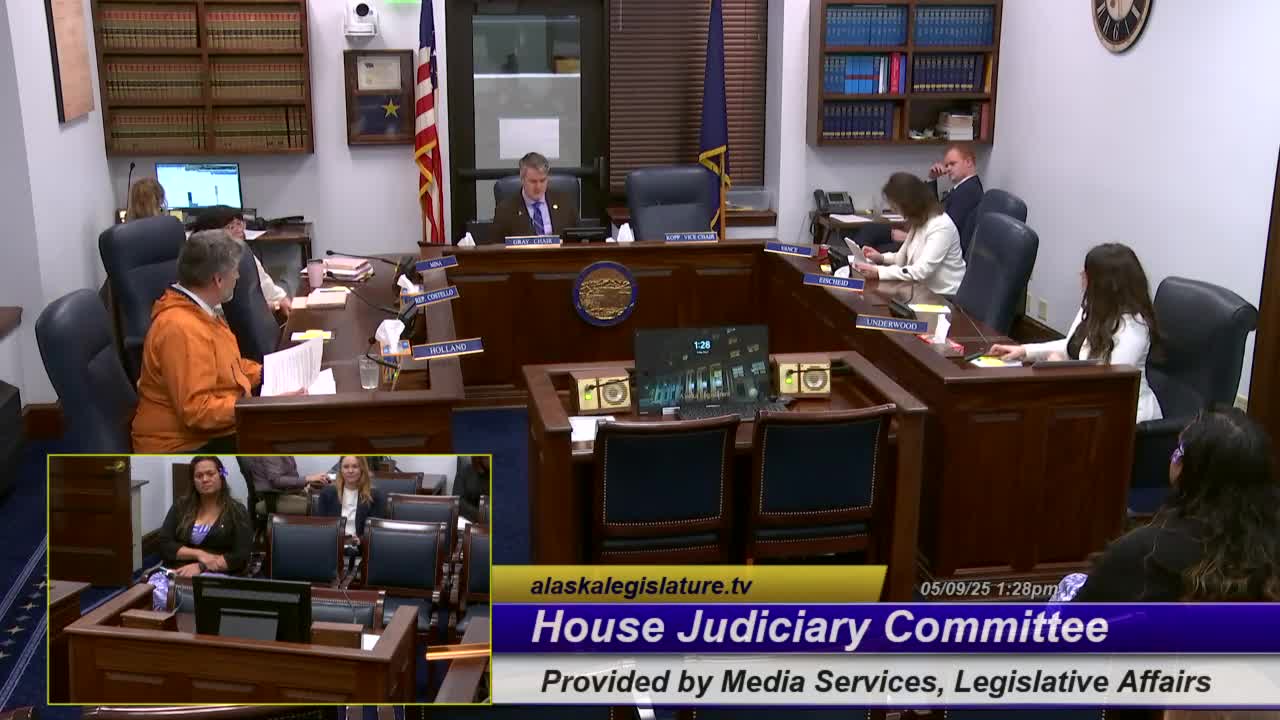
Summary
The Alaska House Judiciary Committee heard legal and administrative testimony May 9 about the legal status of American Samoans, how DMV and the Division of Elections handle voter registration, and the standards prosecutors use in recent Whittier-related voter-misconduct charges involving 10 American Samoan residents.
The House Judiciary Committee on May 9 examined how Alaska law and state agencies treat U.S. nationals from American Samoa after prosecutions involving 10 American Samoan residents of Whittier prompted questions about voter registration and criminal intent.
The hearing focused on three practical questions the committee chair said the panel wanted answered: how state agencies handle registration for U.S. nationals, what legal obligations American Samoans have under state and federal law, and how the Legislature can ensure election laws are applied fairly and clearly.
Why it matters: American Samoans are U.S. nationals — a federal status distinct from U.S. citizenship — and the distinction has produced confusion in agency forms and in the public. Committee members said the issue has immediate consequences for whether people who move to Alaska can lawfully register and vote, and for how prosecutors determine criminal intent in alleged voter-misconduct cases.
State DMV and Division of Elections processes
Kathy Wallace, director of the Alaska Division of Motor Vehicles, told the committee the DMV is “statutorily required to offer voter registration” when people apply for a driver’s license or ID, and that the DMV form now asks applicants whether they are a “U.S. citizen, a U.S. national, or a non-U.S. citizen.” She said the national option was added in February 2022. "If they mark yes to that, do you meet the requirements below," she said, describing the form flow that sends registration data nightly to the Division of Elections for final review.
Carol Beecher, director of the Division of Elections, said Alaska’s voter-registration form continues to require a sworn statement that the registrant is a U.S. citizen. "Alaska law requires only a sworn statement as proof of citizenship to register to vote," she said, adding the division treats a signed sworn statement as an affirmative assertion of citizenship and will follow up if questions arise.
Community education and confusion
Charles Alalima, an attorney and Samoan chief who testified as an expert on Samoan history and federal nationality law, traced the legal origin of U.S. national status to federal immigration law and the 1952 Immigration and Nationality Act. "The term national means a person owing permanent allegiance to a state," he said, describing how the statute distinguishes nationals who are citizens from nationals who are not. Alalima and community leaders told the committee younger American Samoans raised in Alaska often do not know the distinction between U.S. national and U.S. citizen.
Tapilisail Noa Taliafoa, executive director of Pacific Community of Alaska, said the nonprofit had sought clear answers for community members and did not receive a definitive response from local offices until the state provided written guidance last year. "There is a lot of young people that...grow up in Alaska with all of their friends being Alaskans, and so they consider themselves as Alaskans," Taliafoa told the committee, explaining how that background can cause confusion about voting eligibility.
Prosecution standard and investigations
Deputy Attorney General John Skidmore described the criminal standard for voter misconduct under Alaska law and the role of intent. "Voter misconduct in the first degree...requires someone to intentionally, that is with a conscious objective, make a false affidavit, swear falsely, or falsely affirm under oath required by Title 15," he said, and added: "To clarify, significant issue, to vote in Alaska when you are not eligible to vote is actually not a crime. Let me say that again. The act of voting is not a crime." Skidmore said charges require probable cause to believe an intentional false statement was made on a registration form or similar affidavit.
Skidmore also said the Department of Law has declined to charge some matters when the evidence did not support proving the required intent, and that over the past decade the department filed about 15 or 16 voter-misconduct cases in total. He said the recent Whittier-related charging documents describe a citizen complaint and subsequent investigative steps; the charging documents note 388 registered voters in the community and that 10 charges were filed, but Skidmore said the troopers spoke with more people during their investigation.
Agency and procedural gaps discussed
Committee members queried whether state forms, DMV practices, poll-worker training and automatic registration pathways make the U.S. national distinction clear. Beecher said the Division of Elections’ registration form does not include a dedicated "U.S. national" box, though the division’s website explains that only U.S. citizens may register and that it is a crime to register or vote if not a citizen. Wallace said DMV staff receive training and a reference “cheat sheet” on immigration documents and that DMV staff are trained to flag inconsistencies, but she acknowledged human error is possible and that Division of Elections makes the final eligibility determination.
What the committee directed and next steps
Members urged additional outreach and clearer form language. Several legislators recommended that DMV and the Division of Elections consider adding an explicit American Samoa/U.S. national checkbox or clearer explanatory language on registration forms so that applicants — particularly young people raised in Alaska — understand whether they are eligible to vote. No statutory or regulatory changes were adopted at the hearing; committee members asked agencies to consider form and training changes and to report back.
Ending note
Committee members said the hearing highlighted gaps between federal nationality law, state forms and community understanding and that improved agency guidance and public education could reduce future errors and investigations.