
Senate Finance hears FY26 bargaining amendments totaling $84.5 million, UGF $35 million
Get AI-powered insights, summaries, and transcripts
Subscribe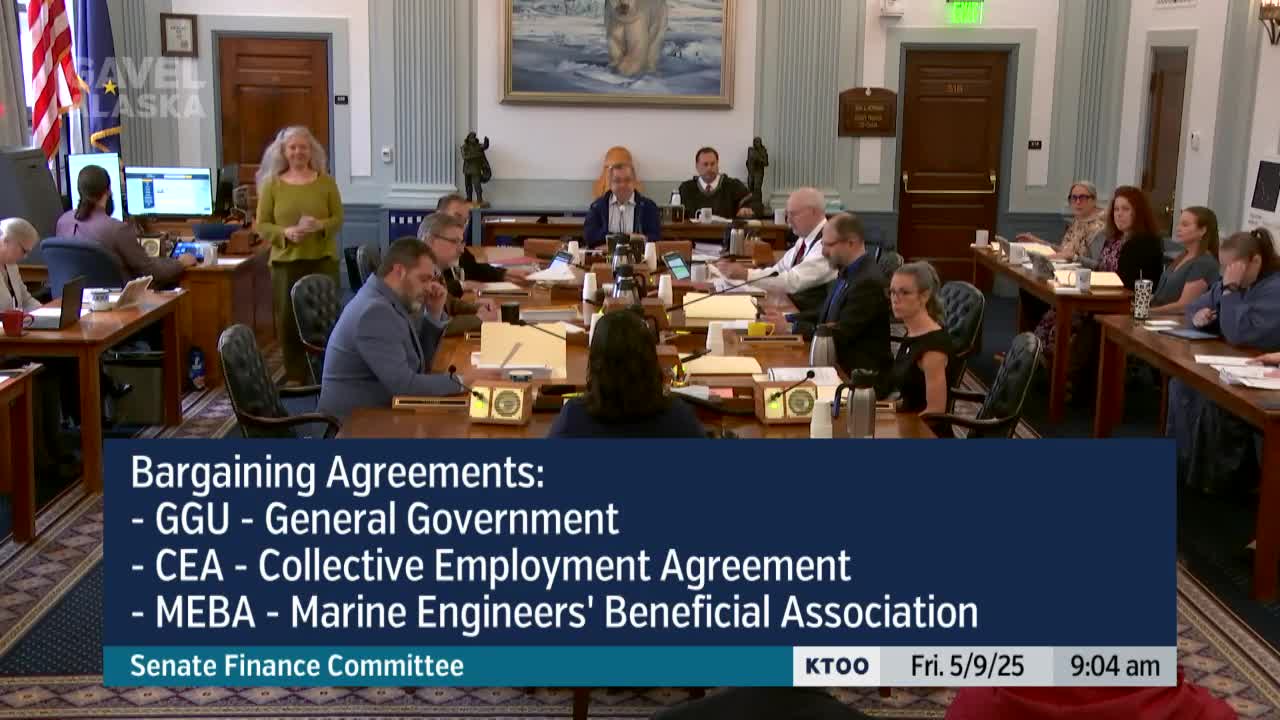
Summary
The Alaska Senate Finance Committee received presentations on FY26 budget amendments to cover recently negotiated collective-bargaining agreements with GGU, CEA and MEBA, including $84.5 million in all-funds and $35 million in unrestricted general funds; no formal appropriation vote was taken.
The Alaska Senate Finance Committee received a presentation on Tuesday on fiscal year 2026 budget amendments to implement recently negotiated collective-bargaining agreements between the state and three unions.
“These amendments represent the contractual bargaining agreements that were reached … between the state of Alaska and the following organizations,” Lacey Sanders, director of the Office of Management and Budget for the governor, told the committee as she summarized the transmitted FY26 operating and mental health budget amendments.
Sanders told the committee the three bargaining units in the transmittals were the Alaska State Employees Association (General Government Unit, GGU), the Confidential Employees Association (CEA) and the Marine Engineers’ Beneficial Association (MEBA). The amendments presented for FY26 total $84,500,000 in all funds, with $35,000,000 in unrestricted general funds (UGF). Sanders said the GGU submission was $80,500,000 (about $33,400,000 UGF) and the CEA and MEBA items totaled $4,000,000 (about $1,600,000 UGF).
Committee members pressed administration witnesses about what would happen if positions currently paid from non-UGF sources proved to be supported by “hollow receipts” during the fiscal year. Sanders said agencies develop a personal services module after the budget is adopted to align positions with funding sources; if federal or other receipts disappear, agencies would evaluate whether the functions continue or whether a supplemental appropriation would be needed in a later year. “If it was a federal receipt and that federal program is no longer being funded, that function may have to end,” she said.
Deputy Attorney General Corey Mills clarified a question about pay increases in the GGU agreement, saying the package’s lump-sum and base increases produce a practical overall pay increase of about 3 percent in the first year. Mills and Sanders both said the negotiated increases are distinct from a separate statewide salary study; Mills said the salary study was not used as the baseline for negotiations.
Senator Gary Stedman (Senator Stedman) and others asked whether the salary-study findings—cited by the committee as showing classes of employees with compensation below market—would prompt additional adjustments or future requests to the committee. Sanders said the salary study and labor negotiations are separate processes and that the administration will review the study and may return with recommendations at a later time; no further commitment was made.
No committee motion or vote on a budget appropriation occurred during the presentation; the item on the agenda was for transmittal of the bargaining amendments and committee questions and discussion. Committee members expressed concern about the overall fiscal outlook for FY27 and the potential that supplemental requests or future budget actions will be required to address positions whose funding sources become unavailable.
The committee then moved on to its next agenda item, Senate Bill 64 (elections).