
House committee hears push to protect international teachers amid rural shortages
Get AI-powered insights, summaries, and transcripts
Subscribe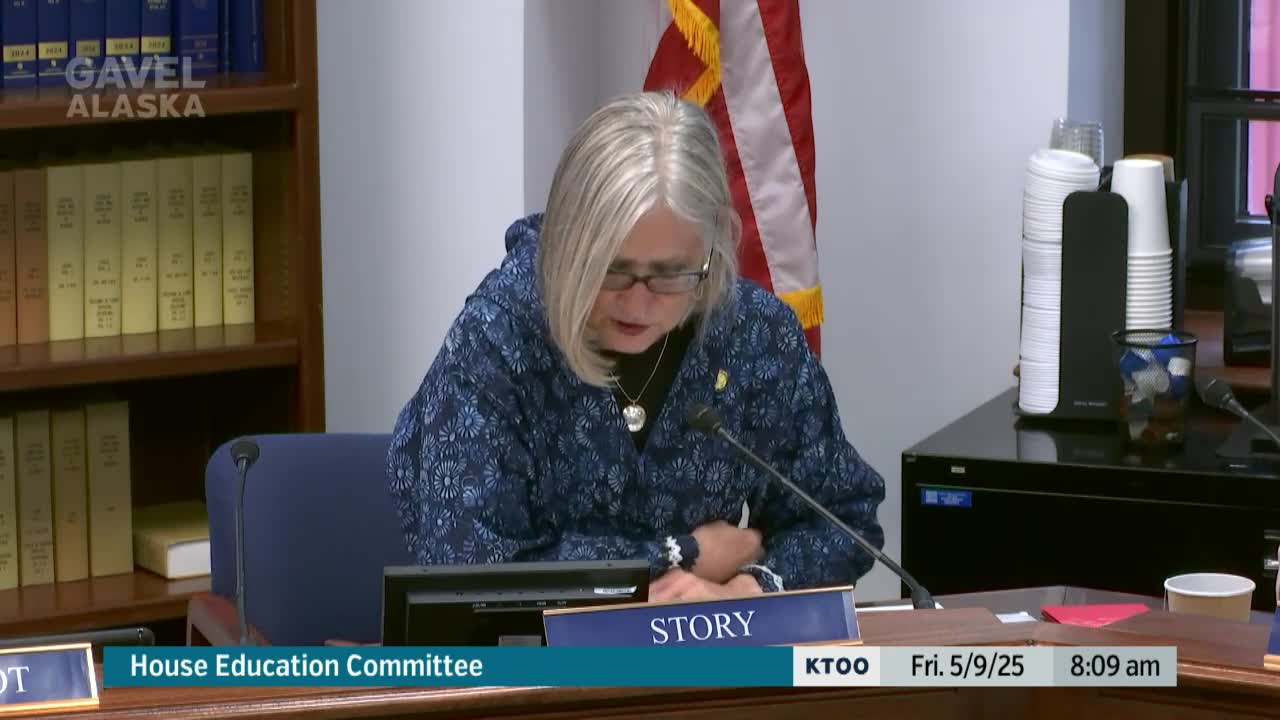
Summary
The House Education Committee heard testimony supporting House Joint Resolution 25, which urges policies to improve visa stability and retention for international educators serving Alaska’s rural districts; the committee held the measure over with an amendment deadline of May 12 at 3 p.m.
House Joint Resolution 25, which urges state leaders to support greater visa security and job flexibility for teachers on J-1 and H-1B visas, was presented May 9 to the Alaska House Education Committee and held over for further consideration. Representative Genevieve Mina of House District 19 introduced the measure and asked the committee to back policies that strengthen recruitment and retention of international educators in rural Alaska.
The resolution matters because many rural and remote districts rely heavily on teachers from abroad to keep classrooms staffed. "House joint resolution 25 calls on the legislature, school districts, higher education workforce," Representative Genevieve Mina said, "and it urges the creation of policies that support greater visa security, job flexibility, and long term stability for teachers on J-1 and H-1B visas." Supporters told the committee that without those hires, some districts could not operate.
Superintendent Madeline Aguilar of Cussbuck School District, who testified in person, described multiple years of heavy turnover and the district’s pivot to international recruitment. She said her district has averaged roughly 60% of teaching staff on J-1 or H-1B visas over the past four years and now depends on H-1B hires after J-1 sponsors stopped placing teachers off the road system. "Without international educators, our districts like mine, it wouldn't be possible to function at this point in time," Aguilar said, adding that visa-processing delays and limits on job mobility threaten school stability.
Other invited witnesses described the classroom and community contributions of international hires. Principal Mac Croweninho M. McDowell (transcript: reported name) said international teachers bring global perspectives and engage deeply with families; special-education teacher Dale Abkus told the committee his school will be staffed next year entirely by certified international teachers and that those educators lead extracurricular and community programs. "Next school year, our school will have a teaching staff composed of 100% certified international teachers," Abkus said.
The Alaska Council of School Administrators, through Executive Director Dr. Lisa Paradis and Jennifer Schmidt, director of the Alaska Educator Retention and Recruitment Center (ARC), described state efforts to support districts that hire internationally. ARC is developing recruitment, legal navigation, and professional-development supports tailored for incoming international teachers; officials said ARC aims to reduce the administrative burden on individual districts.
Committee members questioned how J-1 sponsorship shifted away from rural placements. Aguilar said sponsoring agencies raised concerns after an earlier review and collectively limited new sponsorships to the road system and railbelt, effectively blocking new J-1 placements in many remote districts despite documentation of local medical access and housing in some districts.
Discussion points recorded in the hearing included: the extent of reliance on international teachers (district examples cited up to 60% visa-holder staff), operational risks from federal visa-processing delays, differences between J-1 cultural-exchange and H-1B work visas, and district supports such as cohort hiring, PBIS (positive behavior interventions and supports), and special-education training to ease classroom transitions.
The committee took a procedural action at the end of the hearing. Chair Cochair Story said he would "hold HJR 25 over and set an amendment deadline for Sunday May 12 at 3 p.m.," leaving the resolution pending further committee work.
Supporters asked the committee to view HJR 25 as both an immediate measure to stabilize staffing and a complement to longer-term pipelines such as grow-your-own and residency programs. Testimony repeatedly separated discussion (descriptions of visa processes, training and retention strategies) from the committee’s formal action (holding the resolution over with an amendment deadline).
The record shows sustained interest from rural districts, school administrators and international teachers in formal policies that provide clearer paths to longer-term employment, reduced paperwork burden for districts, and predictable visa timelines for teachers. The committee will consider amendments and additional information before acting further on HJR 25.