
Alaska Senate Committee advances bill to expand pharmacists' patient-care authority, excludes abortion‑inducing drugs
Get AI-powered insights, summaries, and transcripts
Subscribe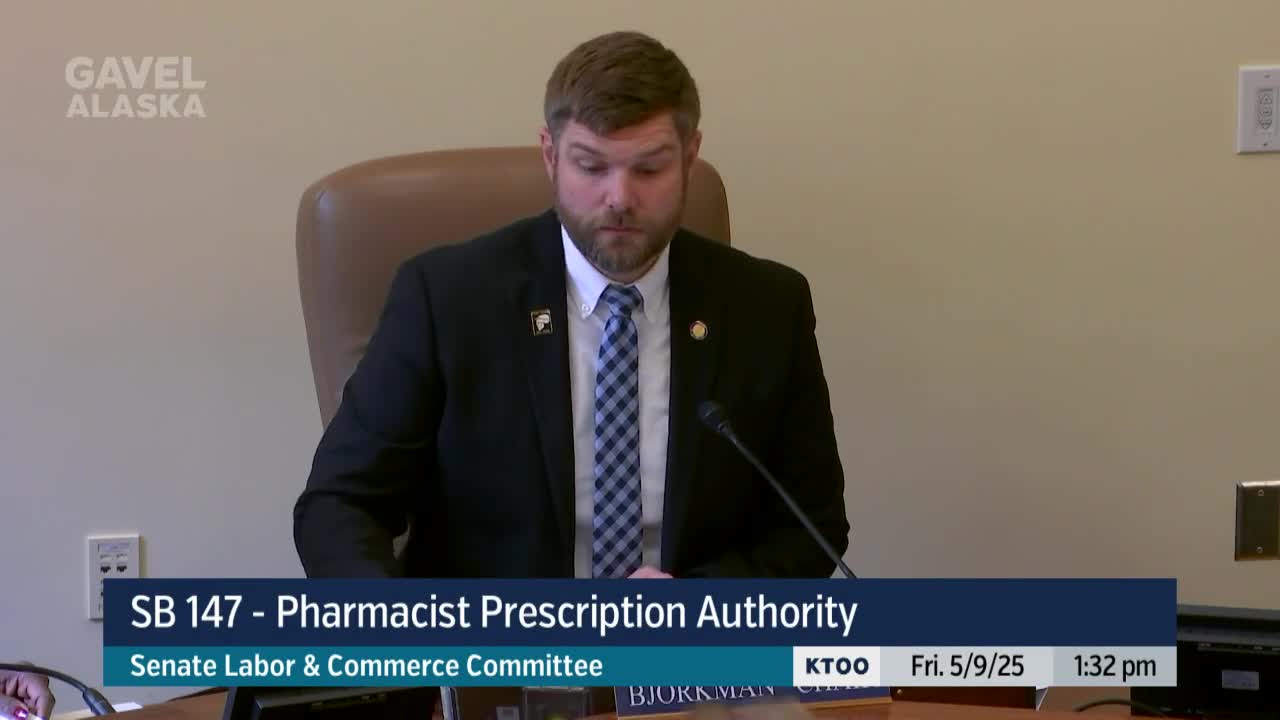
Summary
Senate Labor and Commerce Committee members advanced a revised measure that would let doctoral‑level pharmacists test, treat and prescribe within collaborative practice agreements while adding language that explicitly bars pharmacists from prescribing abortion‑inducing medication.
Senate Labor and Commerce Committee members on Friday advanced legislation to expand pharmacists' patient‑care authorities while explicitly excluding authorization to prescribe abortion‑inducing drugs.
Senate Bill 147, sponsored in the Senate by Senator Kathy Giesel (R–District E, Anchorage), would allow pharmacists with doctoral training to provide a broader set of patient‑care services — including testing, prescribing and administering certain medications within their education, training and experience — through collaborative practice agreements. "Pharmacists are highly qualified and trained health care professionals," Giesel said during the committee's second hearing on the bill.
The substitute adopted by the committee inserts language clarifying that "patient care services" do not include the pre‑prescription of an abortion‑inducing drug to a patient. Conrad Jackson, staff to Senator Bjorkman and the committee, explained the change on the record as an edit to section 6 (page 5) of the bill.
Supporters testified in favor of the bill as a workforce and access measure. Dan Nelson, identifying himself as director of pharmacy for the Canada Chiefs Conference, said SB 147 "will increase access to pharmacists providing patient care services, maximizing the professional capacity of Alaska's existing healthcare professionals." Multiple practicing pharmacists — including Linda Gutierrez Miller, Amity Winborg, Barry Christiansen, Britney Karnes, Amy Young and Ballard Saul — described experience working under collaborative practice agreements and said the bill would help expand access, especially in rural areas. "Patients these days have multiple chronic conditions," Gutierrez Miller said, adding that collaborative practice agreements improved chronic disease management.
Opponents raised patient safety concerns and cautioned against expanding prescribing authority without safeguards. Nicole Thomas, a registered nurse from Anchorage, said pharmacies are often busy and questioned whether pharmacists would have sufficient time for comprehensive assessments. Steven Pierce of the Citizens Commission on Human Rights urged restrictions on psychiatric drug prescribing, saying he feared expansion could increase psychiatric drug use without appropriate oversight. Pamela Samash (Nenana) and public witnesses opposed on the grounds of conscience and potential access to abortion drugs before the substitute clarified the bill's limits.
Committee members asked for clarifications during discussion. Brandy Cygno Martin (testifying for the Alaska Board of Pharmacy) and other witnesses noted statutory guardrails in current law limit pharmacist care to conditions that are minor, self‑limiting, or have clear diagnostic tests. "It wouldn't just be something that any random pharmacist in any setting would be providing," Cygno Martin said, describing settings in which board‑certified psychiatric pharmacists or clinic pharmacists might work under collaborative arrangements.
Procedural actions: the committee adopted the proposed committee substitute as a working document and, following public testimony and discussion, voted to report the committee substitute from committee with individual recommendations and an attached fiscal note. The committee record shows no recorded roll‑call vote; the motions were adopted "without objection."
What the bill does not change: witnesses and staff emphasized that the bill does not alter dispensing rules (pharmacists' routine dispensing of prescriptions) and does not change pharmacists' authority to fill a prescription written by a physician or other prescriber. Brandy Cygno Martin told the committee the bill "does not touch" dispensing functions; it concerns additional patient‑care services outside dispensing.
The committee will send the reported substitute forward with its recommendations and the attached fiscal note. Further amendments or floor action may follow as the bill advances.