Get Full Government Meeting Transcripts, Videos, & Alerts Forever!
Get email alerts on the Energy Policy topic
No spam. Unsubscribe anytime.
Senate Energy Committee questions nominees on NEPA timelines, EIA independence, DOE staffing and grid reliability
Summary
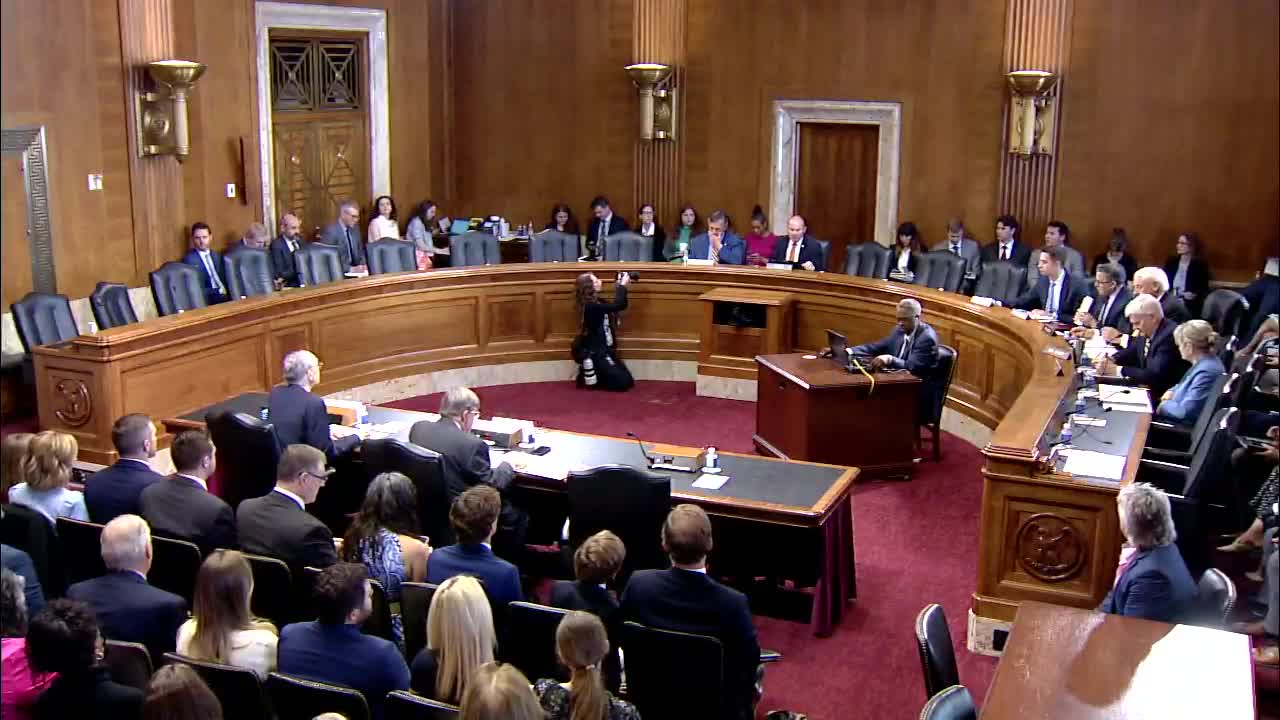
During a May 8 hearing, nominees for Department of the Interior solicitor and two Department of Energy assistant secretary positions answered questions about expedited NEPA timelines, recent staff losses at DOE and the Energy Information Administration's independence.
The Senate Committee on Energy and Natural Resources on May 8 questioned three presidential nominees about permitting timelines, the independence and recent actions of the Energy Information Administration, staffing losses at the Department of Energy, and policies to support grid reliability and fossil-energy research.
William Duffmeier, nominated to be Solicitor of the Department of the Interior; Catherine Jerezah, nominated to be Assistant Secretary of Energy for Electricity; and Kyle Haustfeit, nominated to be Assistant Secretary of Energy for Fossil Energy, each gave opening remarks and answered senators' questions about those topics. Senator Heinrich said he would withhold his support for the EIA administrator and explained his reasoning in the earlier business meeting vote: “So I will be voting no on this confirmation.”
In written and oral exchanges, senators pressed nominees on specific items. Chairman Lee asked whether Interior can meet aggressive permitting deadlines that would aim to complete environmental assessments in 14 days and environmental impact statements in 28 days; Duffmeier said he was "familiar with NEPA" and pledged to "work with the Department of Interior to make sure that we satisfy all the legal requirements during the time period allotted" but also warned against publishing a final EIS that had not performed the statute's required "hard look." Duffmeier told the committee: "It would do no good and would be counterproductive to publish a final EIS and a record of decision that did not entail the necessary hard look and what's required by the statute."
Senators also raised staffing and analytic capacity at DOE. Senator Hickenlooper noted that DOE had lost "more than 4,000 staff members this year so far, including over 70% of the people in the grid deployment office," and asked how nominees would respond. Catherine Jerezah, the electricity nominee, said she would work with the committee to "assess the situation to ensure that we have the staffing and the resources that we need to ensure that we are able to continue to meet our very, very important mission." She added, "If confirmed, I will work every day to advance US leadership in innovation, reduce costs for American families and strengthen grid reliability and security."
Ranking Member Heinrich pressed Duffmeier about the solicitor's role after a senior adviser at Interior purportedly reinstated a prior legal opinion that a federal district court had vacated relating to the Migratory Bird Treaty Act; Duffmeier replied, "The short answer is no. I do not believe that the solicitor can overrule, a federal district judge." He said the solicitor's opinions "look a lot like court opinions" and that he would seek to produce "opinions that are sound and durable and will stand up in court."
Senators questioned the fossil-energy nominee about carbon capture, direct-lithium-extraction and other technologies. Kyle Haustfeit described industry projects and DOE laboratory collaborations, committing to review existing DOE agreements if confirmed and saying that carbon dioxide can be used to recover remaining hydrocarbons: "CO2 is an incredible resource to do that." Haustfeit said he would "work to leverage the incredible talents within our DOE and national labs to drive forward cutting edge research and development."
Committee members also raised programmatic funding and appropriations. Senator Cortez Masto asked whether nominees would implement projects funded by Congress for resilient energy infrastructure in Puerto Rico; the senator noted Congress had appropriated $1 billion and DOE had previously announced $365 million in awards for community health centers. Jerezah said she would "assess" the projects and "comply with the law," and Duffmeier reiterated his commitment to provide legal advice consistent with statutes such as the Impoundment Control Act.
Several senators urged continued work on methane detection and reduction, battery and supply-chain work (including Nevada's lithium resources), and transmission improvements. On lithium and battery manufacturing, Haustfeit and Jerezah said they supported domestic development and public-private partnerships; Jerezah noted DOE storage research in the Office of Electricity and an existing cluster of work at the Pacific Northwest National Laboratory.
The committee swore the nominees, conducted five-minute rounds of questions, and left the record open for statements until 6 p.m. on Thursday, May 15. Chairman Lee set a deadline for questions for the record to be submitted by 6 p.m. the same day as the hearing.