Get Full Government Meeting Transcripts, Videos, & Alerts Forever!
Get email alerts on the Short Term Rentals Zoning topic
No spam. Unsubscribe anytime.
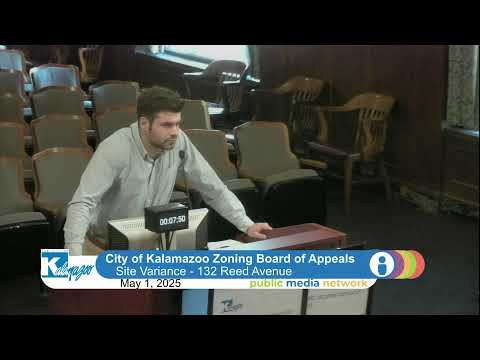
ZBA denies use variance to allow short-term rentals at 132 Reed Ave.
Summary
The City of Kalamazoo Zoning Board of Appeals on May 8, 2025 denied a request to reclassify three dwelling units at 132 Reed Ave. as short-term rentals, rejecting the applicant's claim that narrow stairwells make long-term occupancy impractical.
The City of Kalamazoo Zoning Board of Appeals on May 8, 2025 denied a use-variance request, by a 4-2 vote, that would have allowed three dwelling units at 132 Reed Avenue to operate as short-term rentals.
Applicant Christopher Patch told the board the building’s narrow, angled stairwell made moving standard furniture hazardous and that prefurnished short-term rentals would be a reasonable way to use the structure without altering its exterior. “It’s very difficult to move standard furniture like beds, couches, appliances, and this makes it functionally unsuitable for new people who move in,” Patch said.
City planning staff opposed the variance. Staff explained that short-term rentals are treated as lodging and are permitted in downtown and certain commercial and manufacturing zoning districts, but not in the R M 15 residential multiple-dwelling district where 132 Reed Avenue is located. “Staff did not indicate support for this variance this evening,” Pete said, noting the property has been used as three rental units for at least 25 years and that structural modification or unit reconfiguration are conforming alternatives.
The staff report also said the city mailed 94 notices of public hearing and received zero responses; no in-person or call-in comments were filed for or against the request. Patch told the board the property is certified as a three-unit rental and that he recently completed rental certification. He said prefurnished short-term rentals would reduce repeated furniture moves and could provide economic flexibility in the neighborhood.
Board members were split. Some members cited the staff findings that the ordinance does not deprive the owner of practical use because the building can continue as long-term rentals and because similarly aged buildings in the neighborhood have comparable stair configurations. Others argued for more housing flexibility during a housing shortage and indicated sympathy for the applicant’s circumstances.
When the motion to approve the variance failed by roll call (Sylvester: no; Work: no; Holder: no; Harrington: yes; McReynolds: yes; Chair: no), the board denied the request and the property’s use remains restricted by the R M 15 district rules. Planning staff told the applicant the city expects to start public conversations about short-term rental rules and residential zoning in 2026, which could affect future policy but does not change this decision.
Patch said he will pursue any appropriate administrative or planning options available, and staff noted the decision preserves the current zoning rules for short-term lodging in residential districts.