Get Full Government Meeting Transcripts, Videos, & Alerts Forever!
Get email alerts on the Municipal Budget topic
No spam. Unsubscribe anytime.
Simsbury officials present 2025–26 budget with modest mill-rate rise, debate use of reserves and capital priorities
Summary
The Board of Selectmen and town staff presented a $29,000,737 operating budget for fiscal 2025–26 and said it would produce a roughly 2.95% increase to town spending and an estimated mill-rate projection of about 33.01 mills (fire district excluded).
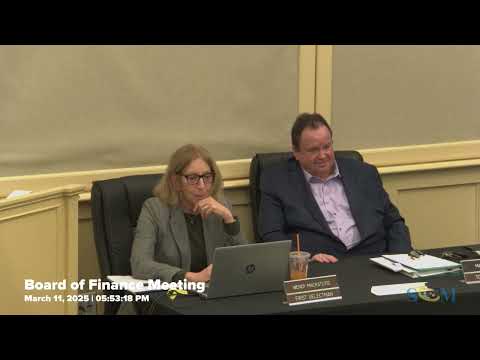
The Board of Selectmen and town staff presented a $29,000,737 operating budget for fiscal 2025–26 and said it would produce a roughly 2.95% increase to town spending and an estimated mill-rate projection of about 33.01 mills (fire district excluded). The presentation, given at the Board of Finance meeting on March 11, laid out the town operating request, capital and nonrecurring projects, and options the board will consider ahead of a public hearing on April 8 and a referendum later this spring.
Why this matters: The budget determines next year’s local tax burden and how the town will cover recurring costs, capital projects and one-time needs. Officials said they limited bonding, used a mix of reserves and revenue adjustments, and pursued cuts to meet a board guidance target below the Social Security cost-of-living adjustment.
Town staff and selectmen said the budget reduces the earlier projected increase (previously near 6.95%) through a combination of departmental cuts, additional state aid and use of reserves. Board member Wendy (board member) said the Selectmen pared about $157,000 in additional reductions after the town manager’s staff-level cuts and included a $450,000 mill-rate relief transfer from reserves to lower the voter-facing increase.
Officials highlighted revenue and capital items that factored into the plan. The presentation said ClearGov was used to publish line-item details and that the town expects a boost in building-permit revenue and a motor-vehicle depreciation schedule recently authorized by the state that will shift vehicle-tax calculations. The Selectmen also reported work to prioritize capital nonrecurring (CNR) requests and to limit new bonding; the draft CIP for the year totals about $47.424 million (most to be bonded), with some projects left unfunded.
Several policy and program items drew discussion:
- Ambulance funding: The town’s planned support for the Simsbury Volunteer Ambulance Association (SVAA) hinges in part on opioid-settlement funding. Town manager Mark Nelson and staff said discussions with the attorney general’s office and the town attorney were “positive” and that a short case-study-style summary will be drafted for state review. As a fallback the town could use capital or general reserves if settlement funding is not approved.
- Memorial Pool: Officials said roughly $90,000 in new revenues from Simsbury Farms user fees will be assigned to keep Memorial Pool open, making operation largely self‑sustaining this year; capital concerns for the pool remain.
- Police budget and overtime: The police budget accounts for a large portion of the year’s increase (staff and the chief identified roughly $270,000 tied to wages and other personnel costs among an overall $850,000 department increase). The chief and town staff said overtime is driven both by vacancies and by several officers on extended leave; the department has 41 sworn positions on the books with one vacancy and about five officers currently unavailable for duty. Officials said collective-bargaining changes (including new limits on prolonged position-holding for injuries and changes in sick-time treatment) should reduce long-term overtime but that monitoring and hiring will determine near-term results.
- Capital reserves and smoothing: The town’s unassigned capital-reserve balance was presented at about $4.6 million before the manager’s proposed use of roughly $883,000; after a pending property purchase the balance would be nearer $2.7 million. Staff and board members discussed using health‑benefit reserves (the board’s consultant recommends holding 20–25% of expected claims; current reserves were presented near 35%) as a one-time smoothing tool instead of dipping further into the general fund, and the board asked staff to model outcomes and potential “cliffs” in later years if reserves are used.
Process and next steps: The Board of Finance set a public hearing for April 8 at the Simsbury Public Library and will continue the budget review and CNR prioritization. Officials asked departments and the Board of Education to provide finalized CNR lists and prioritized bond resolutions so the boards can consider changes before the hearing and the referendum.
Public comment: Resident Joan Coe criticized the town’s overall tax burden and singled out expenditures she called excessive, including special-education support services, a comfort‑dog program funded with ARPA dollars, and support for a volunteer ambulance. “The board of finance should be the gatekeeper for excessive spending,” Joan Coe said during the public audience portion.
What remains unresolved: Final mill-rate calculation depends on any additional adjustments after the public hearing, final state motor-vehicle reimbursement figures, and the board’s decision whether to use health‑fund reserves or the proposed $450,000 general-reserve transfer for mill‑rate relief. The board asked town staff to return with more modeling on out‑year grand‑list projections, the personnel and overtime metrics, and finalized capital-reserve impacts prior to the referendum.
Ending: The Board of Finance approved the public‑hearing notice and later approved meeting minutes and adjourned; all procedural motions recorded in the transcript carried without recorded opposition and will be reflected in the posted minutes and hearing notices ahead of the April 8 hearing.