Get Full Government Meeting Transcripts, Videos, & Alerts Forever!
Get email alerts on the Charter Government Structure topic
No spam. Unsubscribe anytime.
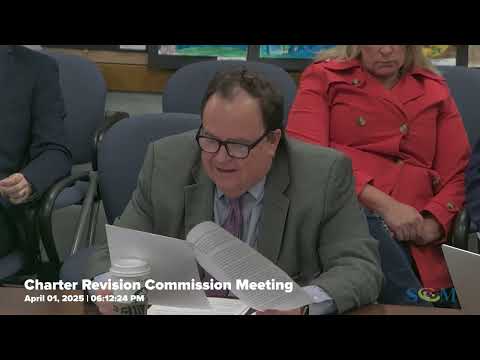
Simsbury town manager urges charter tweaks to clarify roles, streamline grants and budget process
Summary
Town Manager Mark Nelson told the Simsbury Charter Revision Commission on April 1 that the town’s hybrid post‑2017 government still contains remnants of the old system that make lines of authority unclear.
Town Manager Mark Nelson told the Simsbury Charter Revision Commission on April 1 that the town’s hybrid form of government created by the 2017 charter change still contains remnants of the old system that make lines of authority unclear.
Nelson, who said he was “grateful, to those, on the prior board that that, appointed me unanimously, to, what is a 3 year contract just wrapping up the first year,” urged the commission to consider targeted charter amendments to improve clarity and efficiency rather than a wholesale rollback of the town‑manager form.
The commission’s work matters because changes to the charter can reallocate policy and administrative authority across elected and appointed bodies. “The lack of clarity that has been referenced, a number of times before the commission is merely the result of the current charter not having sufficiently removed text from the former charter that predates the change in form of government,” Nelson said.
Nelson gave personnel oversight as an example. He said charter sections 4.02 and 4.11 still reflect a prior structure that allows a board personnel subcommittee to exercise detailed control over job descriptions and wage scales. Nelson told commissioners the board of selectmen already exercises budgetary and collective‑bargaining oversight and that the town created a Department of Human Resources in 2024 with a director now responsible for personnel matters.
On the budget process, Nelson suggested the commission consider adding a minimum turnout threshold for budget referenda, citing Avon’s charter provision that treats a referendum as approved if turnout is below 9 percent of registered electors. Nelson said a threshold recognizes that the town still must fund services and bonded debts even when turnout is very small.
On grants, Nelson described the current practice that requires selectmen approvals at three stages—application, acceptance and appropriation—and said it can bar staff from applying when deadlines are tight. He recommended the charter preserve the Board of Selectmen’s appropriation authority while authorizing the town manager or a delegate to submit grant applications to meet short deadlines.
Nelson also urged greater Board of Selectmen participation in litigation settlements that affect the town’s tax base, saying such matters can have multi‑decade fiscal impacts. Town Attorney Bob (surname not specified in the record) told the commission that zoning and planning are matters of statewide concern under Title 8 and therefore the charter’s normal settlement‑approval rule does not apply to zoning appeals unless the charter explicitly makes the legislative body the final zoning authority.
Discussion touched repeatedly on how the town’s Plan of Conservation and Development (POCD) and other policy documents should be communicated across boards, and on whether the board of selectmen should be explicitly elevated in the charter relative to other boards when state law does not preempt such authority. Nelson said he favored measured changes that preserve the town‑manager form while clarifying roles, not a wholesale shift to a town‑administrator or strong‑mayor model.
Commission members asked about related practical items: whether the Economic Development Commission should remain in the charter, the length and staggering of selectmen terms, and how to ensure timely information for the Board of Finance. Nelson said he favors four‑year, staggered selectmen terms for continuity, recommended keeping the EDC in the charter until an in‑house economic development department can be funded, and urged modest funding for EDC operations (he said the town has historically paid Main Street Partnership roughly $50,000 annually for outsourced economic work).
The meeting produced two formal, procedural votes and a scheduling/direction item. The commission approved the March 18, 2025 minutes by voice vote (all present responded “Aye”) and later voted to adjourn. Commissioners also directed staff to send a reminder request for written comments from chartered boards and commissions, and to invite Culture, Parks & Recreation and Open Space representatives to the commission’s next meeting; staff were asked to collect any outstanding written replies by April 15 for consideration as the commission begins section‑by‑section review.
Votes at a glance
• Approval of minutes (03/18/2025) — voice vote, approved (individual names not recorded in the public minutes).
• Motion to adjourn — voice vote, approved.
What was only discussion
Commissioners and staff debated broader policy options—whether to make the board of selectmen the final zoning authority (some other Connecticut charters provide that option), how to protect attorney‑client privilege during settlement discussions, and where collaboration mechanisms (for example, tri‑board meetings of selectmen, finance and education) should be described in charter or code. No charter language changes were adopted at the meeting; the session was for information, questions and to collect input for the commission’s drafting work.
Context and next steps
Nelson reminded commissioners this is the first charter revision cycle since the 2017 change and said experience in other communities shows that “it always seems to take 1 additional cycle of charter revision after a change in the form of government” to fine‑tune language. The Charter Revision Commission asked staff to gather exemplar charter language (including towns where the legislative body is final zoning authority) and to accept written comments from boards and commissions by April 15 before the commission begins its article‑by‑article drafting work.