Get Full Government Meeting Transcripts, Videos, & Alerts Forever!
Get email alerts on the Local Government Structure topic
No spam. Unsubscribe anytime.
Charter commission hears case for keeping town manager, recommends clearer roles and uniform public comment rules
Summary
A presenter who identified himself as a board member urged preserving the town-manager form of government while recommending staggered terms and electing the presiding officer from among selectmen; a resident urged uniform public audience rules, recorded meetings and hybrid access.
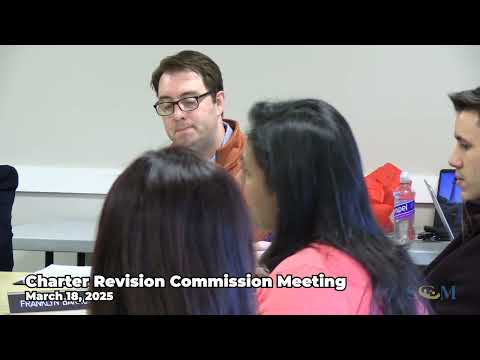
At a Simsbury Charter Revision Commission meeting, a board member identified as Eric argued the town should retain its town manager form of government but revise the charter to clarify roles, stagger terms and change how the presiding officer is chosen. Resident Helen Peterson urged uniform public-audience rules, consistent minutes and hybrid meeting access.
Why it matters: The commission is reviewing charter language that defines how Simsbury’s elected board and professional manager share authority. Changes could affect how residents reach officials, how the board supervises the manager and how continuity is preserved when many seats turn over simultaneously.
Eric told the commission the town-manager model provides professional administration that is difficult to duplicate with volunteer officials. “Having competent professional management in a complex environment like we have gives us access to somebody that can build a team and have the professional skills to administer the organization,” Eric said. He recommended two specific structural changes: stagger board terms or lengthen member terms to avoid wholesale turnover, and have the board elect its presiding officer from among its members rather than leaving the office of first selectman to a separate popular vote. Eric said electing a chair from among peers can build rapport and better define the relationship with the town manager.
Eric flagged statutory and practical constraints. He referenced state provisions that historically name the first selectman and said changing the charter to alter that arrangement requires explicit charter language. He also cautioned that embedding highly specific operational rules in the charter can make the document rigid and that some measures might be better placed in ordinance or board policy.
Resident Helen Peterson spoke during public audience and urged standardized public-participation practices: consistent notice requirements, uniform minutes that attach submitted letters, and hybrid meeting access so in-person and Zoom attendees can participate. She proposed an example format — a 20-minute public-audience block at the start of meetings with five minutes per speaker, reducible to three minutes if many people sign up — and noted the state’s hybrid-meeting expectations. “Public audience shall be uniformly offered at every meeting across the government. An example, 20 minutes at the beginning of each meeting with 5 minutes for each speaker,” Peterson said.
On accountability and board conduct, Eric recommended the Carver policy-governance approach — a governance model used by many nonprofits and corporate boards — to codify that the board sets policy and the town manager implements it within budget. He emphasized familiarizing board members and staff with existing charter and statutory provisions to reduce confusion over “who does what.”
Commissioners asked follow-up questions about the stipend historically paid to the first selectman, the mechanics by which change would affect unsuccessful candidates for first selectman, and the impact on the manager’s hire/fire provisions. Eric noted the charter already references a personnel director and that the town has developed an HR function; he suggested clarifying that language so delegation is explicit while preserving ultimate managerial accountability.
The commission did not take a formal vote on specific charter language at the meeting. Commissioners directed staff to include these points in the commission’s draft materials and to continue discussion at future meetings; the town manager and other stakeholders were suggested as invitees for upcoming sessions.
The commission will incorporate these recommendations and questions into its draft report for further review and public comment.