Get Full Government Meeting Transcripts, Videos, & Alerts Forever!
Get email alerts on the Zoning Regulations topic
No spam. Unsubscribe anytime.
Simsbury Zoning Commission sets priorities for ordinance updates, flags ridgeline, signs and EV rules
Summary
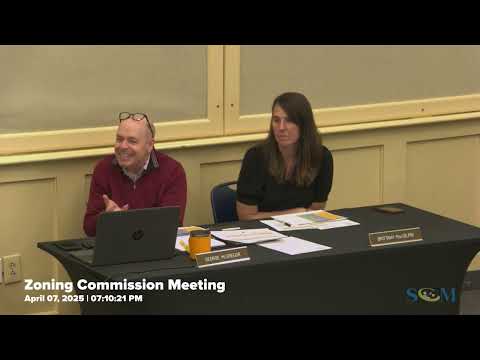
At its April meeting the Simsbury Zoning Commission reviewed a prioritized list of action items tied to the town's 2024 Plan of Conservation and Development and directed staff to begin work on several near-term zoning changes, including ridgeline protections, temporary-sign regulations and clarifying electric-vehicle infrastructure requirements.
At its April meeting the Simsbury Zoning Commission reviewed a prioritized list of action items tied to the town's 2024 Plan of Conservation and Development and directed staff to begin work on several near-term zoning changes, including ridgeline protections, temporary-sign regulations and clarifying electric-vehicle infrastructure requirements.
The commission said the items matter because they affect development clarity, public viewsheds and how the town meets new state requirements. Commissioners were told the town budget includes $25,000 (pending referendum) to start a townwide zoning regulation update; staff recommended using that consultant funding for the broader rewrite while the commission pursues selected, shorter-term fixes internally.
Commissioners and staff agreed to focus first on a short list of action items rather than waiting for a full rewrite that could take 12'18 months. Near-term priorities discussed included: - Ridgeline and viewshed protections: staff described crafting zoning standards (buffers, height or distance limits and view-shed considerations) for both east and west ridgelines, noting the POCD calls for visual protection. - Temporary sign rules and a full sign-code review: the group emphasized temporary signs (political, yard and event signs) cause most enforcement complaints; staff recommended separating temporary-sign rules from a full sign-code rewrite so the commission can address recurring problems sooner. - Dark-sky lighting standards: the Conservation Commission is preparing a draft dark-sky provision and staff said those recommendations will be presented soon for possible incorporation into zoning standards. - Nonconforming map cleanup: staff urged updating the zoning map to remove or reassign mapped districts that no longer correspond to current regulations to reduce confusion for owners, realtors and lenders. - Electric-vehicle infrastructure: commissioners asked whether the town should add the recently adopted state requirements into the zoning regulations so developers clearly see parking-related conduit or reserved-space requirements; staff said the state standard generally requires conduit for a set number of spaces (for lots over a threshold such as 30 spaces) and that the language could be incorporated directly. - Erosion and sediment-control/land-disturbance thresholds: staff recommended adopting a land-disturbance/erosion-and-sediment-control trigger (for example, when disturbance exceeds one acre) so large residential lots creating substantial soil movement would be subject to controls.
The commission also discussed several other items from the action list that staff will scope or bring back: reviewing the planned-area-development (PAD/PDD) approach, clarifying standards for accessory structures (for example, setbacks for propane tanks and small sheds), revisiting rules for residential reuse in commercial corridors, formalizing triggers and a third-party review process for fiscal and school-impact studies on large projects, and follow-up on Meadow Wood and state-owned parcels downtown (including the Iron Horse/commuter lot parcels identified in the POCD).
Staff noted the town requested funding for a full zoning regulation rewrite (the $25,000 consultant amount pending referendum) and said the rewrite would not likely include a deep rework of some form-based codes tied to ongoing appellate processes (for example, Hartford South) until appeals conclude. The commission asked staff to estimate effort and categorize each action item as easy, medium or hard to help set a work plan.
On project-specific updates, staff said Cambridge Crossing remains under foreclosure process with a developer moving the court process forward; about 79 units are approved there and roughly 34 exist as built to date. Staff also said a nearly $1 million brownfield grant application for the Wagner & Ford site was submitted (town signature required) and awards are not expected until late summer. Staff reported the town is preparing a reconsideration letter to the state for the moratorium application after the state requested more information.
Next steps: staff will return to the commission with a clearer, tiered workplan (easy/medium/hard) and a suggested short list of items staff will prepare in draft before the next meeting. Commissioners discussed using an interactive prioritization exercise (digital sticky-board or similar) at the next meeting so members can align priorities and see where they differ.
Votes at a glance: the commission approved the minutes of the March 17 meeting as submitted (motion, second; outcome: approved; tally noted in meeting as 5 yes, 0 no, 1 absent) and later moved and seconded to adjourn the meeting (motion passed).