Get Full Government Meeting Transcripts, Videos, & Alerts Forever!
Get email alerts on the Land Development topic
No spam. Unsubscribe anytime.
Simsbury commission keeps public hearing open on McLean’s 52-unit ‘Meadows’ plan after hours of expert testimony
Summary
After hours of expert testimony for and against McLean Affiliates Inc.’s proposal to add 52 residential units at its Great Pond Road campus, the Simsbury Conservation Commission voted to continue the public hearing to a special meeting May 7 to allow more documents and responses on stormwater, wildlife and wetlands impacts.
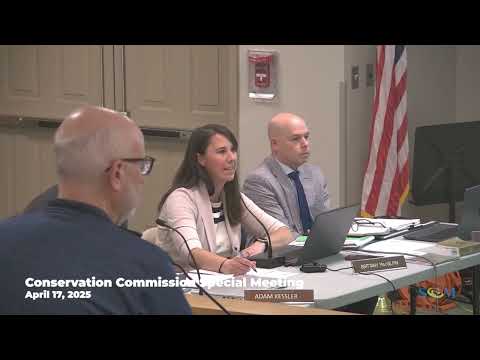
The Simsbury Conservation Commission voted April 17 to keep open the public hearing on McLean Affiliates Inc.’s application to build 52 residential units at 75 Great Pond Road and continued the hearing to a special meeting on May 7.
The decision followed more than four hours of testimony from the applicant’s legal and technical team, independent interveners’ experts and a long list of residents who spoke for and against the project, known in McLean’s materials as “The Meadows.” The applicant described design revisions it said reduce direct wetland impacts and improve stormwater performance; opponents and independent reviewers raised questions about infiltration testing, pollutant removal calculations and impacts to wildlife, including the eastern box turtle.
Why it matters: The application concerns wetlands and upland review areas on roughly a 110-acre McLean campus and touches state wetlands law, local conservation recommendations and neighborhood drainage concerns. The commission’s open hearing and its May 7 continuation give members time to review additional drainage plans, the applicant’s revised materials and supplemental letters from intervening parties.
What the applicant told the commission
Shipman & Goodwin attorney Joseph Williams framed the legal standard for the commission: an inland wetlands agency must find “substantial evidence of a likely adverse impact to wetlands or watercourses” before denying an application, and it may consider impacts from activities in the upland review area only where those activities are likely to affect the physical characteristics of the wetland (citing state law guidance). Williams said the applicant has redesigned crossings and reduced impacts to minimize wetlands disturbance.
Tom Daley, the civil engineer for SLR Consulting, described design changes since earlier hearings: the two wetland crossings were reworked from box culverts to what he called an 18-foot clear-span structure (a bridgelike precast unit) to minimize filled area in the wetlands. Daley said additional soil borings and infiltration testing performed for stormwater basins returned higher in-situ infiltration rates than earlier conservative assumptions and that the team added dry wells and perforated pipes between units to promote infiltration of roof runoff before it reaches basins.
Wetlands science and mitigation
Wetland scientist Megan Raymond (SLR) testified the property’s mapped wetlands total about 13 acres across the 110-acre parcel but that the wetlands in the immediate project area (Wetland 8) total about 1.3 acres. She said SLR’s recent field work and a floristic inventory show the southern portion of Wetland 8 contains a limited patch of tussock sedge (about 5,000 square feet, roughly 10% of Wetland 8), and that the applicant’s revised mitigation plan adds native shrubs and plantings to enhance wetlands functions near the crossings. Raymond said SLR’s professional opinion is that the proposed project, as revised, “will not adversely affect the physical characteristics of these wetlands.”
Box turtle study and mitigation
Dennis Quinn, a herpetologist, acknowledged eastern box turtles have been observed on and near the property and described the species’ seasonal habitat use. Quinn said box turtles are not a wetland-dependent species and use a mosaic of uplands, fields and forest; he recommended an exclusionary barrier to keep turtles from wandering into new development areas, habitat creation and a one-year radio-telemetry study to document local turtle movements and to inform long-term mitigation. Quinn said: “Box turtles are not a wetland dependent species.”
Concerns raised by interveners and residents
Interveners’ experts pressed the commission on stormwater and hydrology details. Engineer Steven Trinkas said the DEP stormwater manual is guidance but argued pollutant-removal calculations using published methods (for total suspended solids, total nitrogen and phosphorus) show the proposed system as designed would not meet the manual’s performance targets; he also urged deeper or larger forebays and questioned whether infiltration rates measured in test holes accurately represent long-term conditions where basins cut into variable soils.
Botanist Sigrin Gadwa and other interveners submitted mapped observations and multiple citizen photos and said the site supports a meaningful local population of box turtles that use meadow and transition zones as well as wetlands. Attorney John Parks, representing interveners, argued the applicant had not met the local regulation’s burden to demonstrate that feasible and prudent alternatives do not exist and urged denial on an incomplete record.
Public testimony reflected both positions
Residents who said they would use McLean housing or who praised McLean’s stewardship urged approval. Others, including neighbors downhill of the campus and Washburn Drive residents who recounted prior drainage problems after earlier campus work, urged caution and fuller independent review before any permit decision.
What the commission decided and next steps
After discussion the commission voted to continue the public hearing to a special meeting May 7 to permit filing and review of additional materials requested by staff and commissioners. The commission’s staff memo and comments cited the distinction between the commission’s wetlands jurisdiction (adverse effects on wetlands or watercourses or their physical characteristics) and the conservation commission’s advisory role on broader habitat and land-use questions.
The record remains open for written submissions identified by the commission, and the commission asked that the applicant and interveners file any materials early enough for staff and members to review before the May 7 session.
Closing note
The meeting included detailed technical exchanges on stormwater design, bridges vs. culverts for wetland crossings, wildlife mitigation and the difference between regulatory responsibility for wetlands impacts versus broader conservation recommendations. Commissioners said they want time to digest new late-day submissions and for intervening parties and staff to respond before reaching a decision.