Get Full Government Meeting Transcripts, Videos, & Alerts Forever!
Get email alerts on the Zoning Regulation Rewrite topic
No spam. Unsubscribe anytime.
Zoning commission prioritizes four rule changes and starts RFP for full regulation rewrite (FY26 funding)
Summary
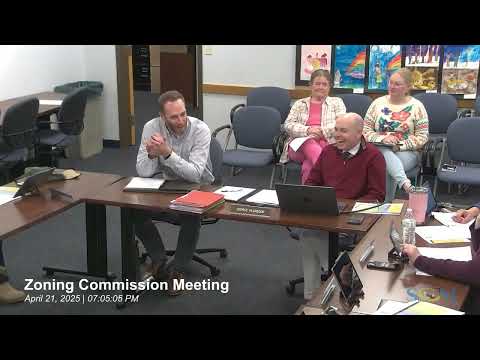
Simsbury Zoning Commission on April 21 prioritized four zoning changes from the town’s POCD and directed staff to prepare a consultant RFP for a full zoning-regulation rewrite funded in FY26.
Simsbury Zoning Commission members on April 21 reviewed a zoning-regulation prioritization worksheet and directed staff to begin work on four items drawn from the town’s Plan of Conservation and Development (POCD): ridgeline regulations, a requirement that significant projects submit a fiscal impact study (FIS), revisions to parking requirements to include electric-vehicle infrastructure, and erosion and sediment-control standards for larger lots.
Planning staff said many items on the worksheet could be handled in-house and estimated a range of about 60 to 180 days for the shorter items, with a full rewrite of the zoning regulations requiring a separate, consultant-supported process of roughly 12 to 18 months. "We have money in, in the in the budget for FY '26, so after July 1, to do a full zoning regulation rewrite and update," staff told commissioners, and staff said it would draft a request for proposals (RFP) to hire a consultant under that FY26 allocation.
Commissioners asked staff to identify 2–4 priority items they could reasonably complete in the near term. The commission agreed to start work on the four items listed above; commissioners and staff flagged ridgeline rules as the most complex of the four and likely to require more time and public engagement than the others.
On process, staff said the typical approach is to prepare a white paper for each topic, including options and model regulations from peer towns, then solicit public input and hold the formal public hearings required by the town’s regulations. For complex projects the commission may require third-party review; staff noted the town already has a "complex project" referral mechanism in code that allows the commission to engage third-party experts paid by applicants to review technical submissions.
Commissioners also discussed related implementation and referral processes: septic and public-sewer capacity reviews are performed by external agencies (Farmington Valley Health District for septic, and the Water Pollution Control Authority/Aquarion for public sewer), and staff said letters of service availability are required from those utilities for significant projects.
Staff said it would prepare an RFP for the full regulation rewrite and bring the draft RFP back to the commission. Budget authority for the rewrite was stated as $120,000 in the FY26 budget; staff said the rewrite is expected to be a 12–18 month effort once a consultant is selected.
The commission also received notice of two public hearings scheduled for its next regular meeting: a special-exception application for expansion of the Performing Arts Center (the project involves work in the floodplain) and a sign-request application on Hot Meadow Street seeking additional freestanding signage for a multi-tenant parcel.
No formal regulatory changes were adopted at the April 21 meeting; commissioners directed staff to begin drafting and public outreach work and to return with recommendations, draft text, and an RFP for consultant services.