Get Full Government Meeting Transcripts, Videos, & Alerts Forever!
Get email alerts on the Charter Revision Town Manager topic
No spam. Unsubscribe anytime.
Simsbury commission debates town manager duties, reporting and emergency authority
Summary
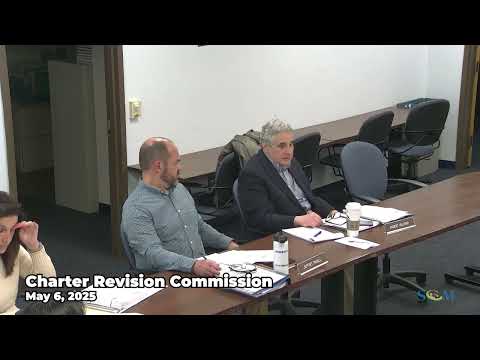
The Simsbury Charter Revision Commission on Tuesday focused its discussion on clarifying the town manager—s role, how and when the manager must provide information to elected boards, and the limits on emergency spending and hiring authority as the commission prepares charter language for public review.
The Simsbury Charter Revision Commission on Tuesday focused its discussion on clarifying the town manager—s role, how and when the manager must provide information to elected boards, and the limits on emergency spending and hiring authority as the commission prepares charter language for public review.
The issue matters locally because the charter sets who has administrative authority in town government and how elected boards get the information they need to make financial and policy decisions. Changes could affect transparency, budgeting, and which officials have authority in emergencies.
Commissioners and two members of the public opened the meeting with reminders about process and notice. Susan Masino told the commission, “first do no harm comments. You don't have to do anything. You should really think about what are unintended consequences of any changes that you make.” Former selectman Lisa Havner urged the group to prioritize transparency and consensus-building, saying, “process is really important for consensus building and to making sure that we're communicating, what we're doing.” The commission then turned to the charter text for the town manager (section 5.02 and related subsections) and a long legal review of how state law interacts with charter language.
Legal issues and nomenclature. A member identified as Bob walked commissioners through relevant state provisions and court authority, noting that the statutory options for a municipal chief officer mean "the nomenclature is really of no importance at all" and that charters can define the powers of local officers under Connecticut's Home Rule framework. Commissioners discussed Chapters 96 and 99 of the General Statutes and were told the commission—s choices will determine whether the town is governed by charter provisions or by the general statute for towns without a charter.
Reporting and transparency. Commissioners pressed for stronger language to ensure elected boards receive timely information. The group agreed to replace the word "periodic" in the town manager reporting clause with wording that makes frequency a matter for the Board of Selectmen to determine. Several commissioners and members of the Board of Finance described current practice: the finance director provides quarterly financial updates to the Board of Finance, and the town posts an annual comprehensive financial report online, but some elected boards said they do not always get the data they need when they need it. The commission asked staff to draft a provision that the town manager must provide "such resources, analysis, staffing and support to all elected boards and commissions as such boards and commissions require to fulfill their duties under state law and the charter and to meet state-mandated filing deadlines." The commission directed that language be added as a new subsection in the town manager duties.
Emergency spending and appropriations. Commissioners raised concerns that the existing charter language allowing the town manager to "expend the necessary funds" in an emergency could be read to permit unilateral, large appropriations without board oversight. Participants referenced section 8.10 (emergency appropriations) and asked staff to cross-reference or otherwise tie any town-manager emergency authority to the charter's emergency-appropriations checks and balances. The commission asked for a drafting approach that preserves the ability to meet immediate life-safety needs while making clear there must be subsequent appropriation or ratification by the elected bodies.
Definitions, position description and job descriptions. Commissioners confirmed a position description exists for the town manager (listed in the packet with a 11/30/2017 date) and discussed whether the charter should require the position description be reviewed on a schedule. They agreed it is reasonable to leave specifics about timing to Board of Selectmen policy, but asked staff to include a defined-terms glossary in the redline and to reference the existing position description where the charter assigns duties.
Other drafting decisions. The commission reached several drafting decisions during the meeting: - Add a town-manager duty that requires providing staff, analysis and support to elected boards to meet their statutory and charter duties (the commission referred to it as a new item to be inserted in the list of duties). - Replace "periodic reports" language with "reports to the Board of Selectmen, frequency to be determined by the Board of Selectmen." Commissioners noted that leaving frequency to the board preserves flexibility while removing vagueness. - Remove the phrase "including economic development" from the clause about long-term goals, after commissioners agreed it inappropriately elevated one policy area in an otherwise general provision. - Replace the word "citizens" in one provision with "residents and taxpayers" to better reflect noncitizen residents and local stakeholders. - Move the catch-all duty ("other duties as assigned") to the end of the duties list and renumber items so that the catch-all remains last.
Process and next steps. The commission asked Franklin (staff) to post public comments to the meeting record and to add the agreed drafting changes in blue for review. Commissioners asked Bob or town counsel to pull Connecticut Supreme Court decisions (including cases the transcript named as the "Wyndham case" and "Caulfield v. Noble") that clarify the charter/statute boundary for the commission—s next session. Members agreed to revisit how to define the town manager's reporting relationship (both in the town-manager article and in the sections that define the first selectperson and Board of Selectmen) so the charter presents consistent language in both places.
A motion recorded near the end of the session was made to adopt the immediate drafting change on a specific subsection (recorded in the transcript as "I move 50 or 3"); the motion was seconded and the chair called the vote, with members responding "Aye." The commission scheduled follow-up work on the town-manager section and indicated the group will return to the first-selectperson text and the emergency-authority drafting at the next meeting.