Get Full Government Meeting Transcripts, Videos, & Alerts Forever!
Get email alerts on the Pension Investments Governance topic
No spam. Unsubscribe anytime.
Retirement subcommittee reaffirms policy, hears mixed Q1 market report; portfolios near actuarial expectations
Summary
At its May 6 subcommittee meeting, Simsbury’s retirement plan advisers told the Retirement Plan Subcommittee that policy statements require no edits, first-quarter markets were mixed—U.S. large caps lagged while international equities outperformed—and plan portfolios remain broadly in line with actuarial targets.
Simsbury’s Retirement Plan Subcommittee on May 6 heard an investment update that affirmed the subcommittee’s policy statements and described mixed results across markets in the first quarter, with the town’s pension and OPEB portfolios generally tracking actuarial expectations.
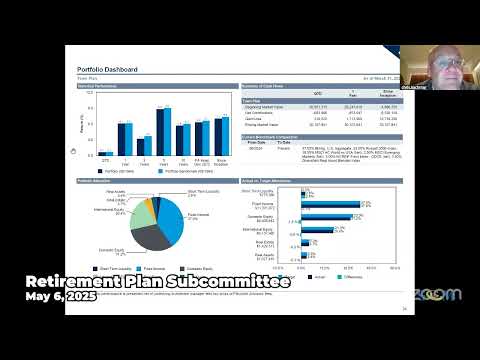
The consulting team told the subcommittee that the plan policy statements do not require edits at this time and that the portfolios are “in good working order.” The advisers reported that the town pension plan was up roughly 0.7% for the quarter and that longer-term returns put the plans near actuarial assumptions.
The consultants framed the quarter around three cross-currents: trade-policy headlines and tariff announcements that introduced volatility, “sticky” inflation remaining above the Fed’s 2% target, and divergent returns between U.S. equities (hurt by a pullback in the largest technology names) and international equities, which outperformed year-to-date. “The policy statements are in good functioning order. We don't have any recommendations to commit the committee to make changes,” said Chris, an investment presenter, during the meeting.
Why it matters: the subcommittee oversees roughly $30.1 million in town plan assets and related trusts; quarterly performance and strategic allocation decisions feed into actuarial reporting and will be used when the advisers report to the Board of Finance in September. The committee was told the town pension portfolio holds about $30,100,000 in invested assets; the police pension about $22,400,000; and the OPEB trust roughly $25,100,000.
Details and debate: the consulting team highlighted a sharp year-to-date gap between U.S. and international equity returns—international equities were up in double digits year-to-date at the time of presentation while the S&P 500 was down—and noted that this pattern altered short-term active-manager performance. “Those big 7…can influence things in the other direction as well,” the consultant said, referring to the largest U.S. technology names that concentrated returns in recent years.
Committee members asked whether the plans remain on track to meet investment assumptions. The consultants said fiscal-year-to-date numbers (the nine months ending in March) were running at a level that could accrete to actuarial expectations but cautioned the committee the final fiscal-quarter results through June would determine the year outcome.
OPEB and indexing vs. active management: advisers described the OPEB trust as an “all indexed approach” that has produced returns similar to the pensions while noting the OPEB uses certain iShares ETFs acquired under a legacy structure. The consultants proposed bringing a fuller analysis back to the committee at a subsequent meeting to examine whether (1) lower-cost indexed fund alternatives exist and (2) whether a controlled introduction of active management is appropriate for the $25 million OPEB trust. “We could drive those fees even a bit lower, using a more traditional index funds, versus these ETFs,” Chris said, and suggested a cautious, gradual approach if the committee wanted to introduce active management.
Other governance notes: the advisers affirmed the committee’s governance practices—regular meetings, credentialed oversight, and periodic manager underwriting—and had no immediate concerns with the manager roster. The presenters also said they would prepare a fuller comparative package of active-manager net-of-fee performance for the committee for discussion in the autumn.
What’s next: Chris agreed to present a full report to the Board of Finance in September. The subcommittee scheduled its next regular meeting for the second business day after Labor Day and asked staff and advisers to return with the requested detail on OPEB structure and manager comparisons.
Ending: No formal policy changes or votes were taken on investment structure at the May 6 meeting; the advisers’ recommendation was limited to a reaffirmation of the policy statement and a request for further analysis on the OPEB indexing/active-management question.