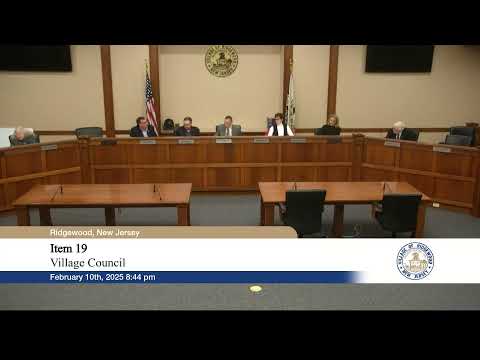
Ridgewood residents and council spar over artificial turf, contamination and remediation at Schedler property
Loading...
Summary
Residents urged a moratorium on turf installation at the Schedler property, citing contaminated soil and tree removal; council members defended turf for field use, cited studies and said no final council vote occurred at Tuesday’s meeting.
Residents and some council members clashed Tuesday night at the Village of Ridgewood council meeting over plans to install artificial turf at the Schedler property and the village’s response to recent soil contamination there.
At issue was both the health and environmental safety of artificial turf and the village’s handling of contaminated soil that residents said was used to build a berm at Schedler. Several speakers asked the council to halt further work until a full investigation and a restoration plan are completed; council members and other speakers pushed back, saying turf is needed to support heavy field use and pointing to studies they said show low risk.
Amy McCambridge, a Ridgewood resident, told the council that contamination discovered at Schedler had been placed in the berm and that the village only acknowledged the problem after the New Jersey Department of Environmental Protection became involved. McCambridge said the village had already spent roughly $2,600,000 on the property and warned that the proposed remediation plan — which she described as tearing up trees and replacing vegetated areas with artificial turf — would “replace a living, breathing ecosystem with plastic and rubber.” She asked the council to impose a moratorium on all work at the site, to conduct an internal investigation to identify who placed contaminated soil across the seven-acre site, and to pursue “true restoration” including replanting native trees.
Cynthia O’Keefe, who said she attends Board of Education meetings, relayed remarks by Ridgewood schools Superintendent/Board of Education member Dr. Schwartz that the BOE was seeking a “science-based approach” to turf and said that much of the BOE’s educational material referenced work by Dr. Sarah Evans and a Mount Sinai letter. O’Keefe asked the council to keep an open mind, consider expert presentations, and emphasized health concerns raised about artificial turf materials.
Several council members defended the turf plan and the process. Council member Frank said federal agencies and European governments are among the sources his research relies on and argued that athletic participation is widespread in Ridgewood; he urged accuracy when opponents label sports participants a “special interest.” Council member Paul (first name only in the record) and others said prior studies and consultant work supported turf as a way to accommodate high hours of field use without unsafe deterioration of grass fields. Paul noted that the turf the village is considering uses an engineered subbase and underdrain (a pervious undercarriage) rather than a fully impervious surface, and Pam (Council member) said the village is considering non-crumb-rubber infill materials such as cork and coconut rather than tire-derived “crumb rubber,” and she argued that those materials have different risk profiles.
The council and residents also disagreed about how settled the science is. Some residents and speakers cited European studies and academic concerns about microplastics and chemical exposure, and Pam and others noted that many published studies focus on crumb rubber infill; Pam emphasized that the village’s selected infill differs from crumb rubber and has not been studied as comprehensively.
Procedurally, council members said the topic has been discussed previously and that the council previously took votes on related approvals; several members said the issue will continue to move through the State Historic Preservation Office (SHPO) review and the village’s committees. No new ordinance or final vote to authorize turf installation occurred during the meeting. Council members asked staff and residents to share timestamps and documentation (for example, a BOE meeting comment by Dr. Schwartz) so committees can review primary sources and consider a joint panel of experts. Several speakers urged the council to consider a citizen-requested panel that would include independent scientists and medical professionals before proceeding.
Why it matters: The debate touches on public health, environmental restoration after contamination, and competing community priorities — maximizing field availability for youth and adult sports while protecting trees, pollinators and long-term soil health. The Schedler site is also subject to SHPO review and NJDEP oversight, which could affect timing and permitted remediation techniques.
Next steps: Council members said they will forward Dr. Schwartz’s BOE remarks to the fields committee and consider a separate expert presentation; the Schedler project and its SHPO review will remain on the village’s project timeline. No formal moratorium or directive was adopted at Tuesday’s meeting.
"The cleanup should not be a gateway to another project that disregards nature," Amy McCambridge said during public comment, urging the council to halt further work until the contamination and its full impacts are assessed. Council member Frank said he would continue to review the scientific literature and listen to residents’ concerns.
No formal motions or votes to authorize turf installation were taken at the meeting.