Legislative committee asks staff to draft bill tightening public records rules, expanding ombudsman authority
Summary
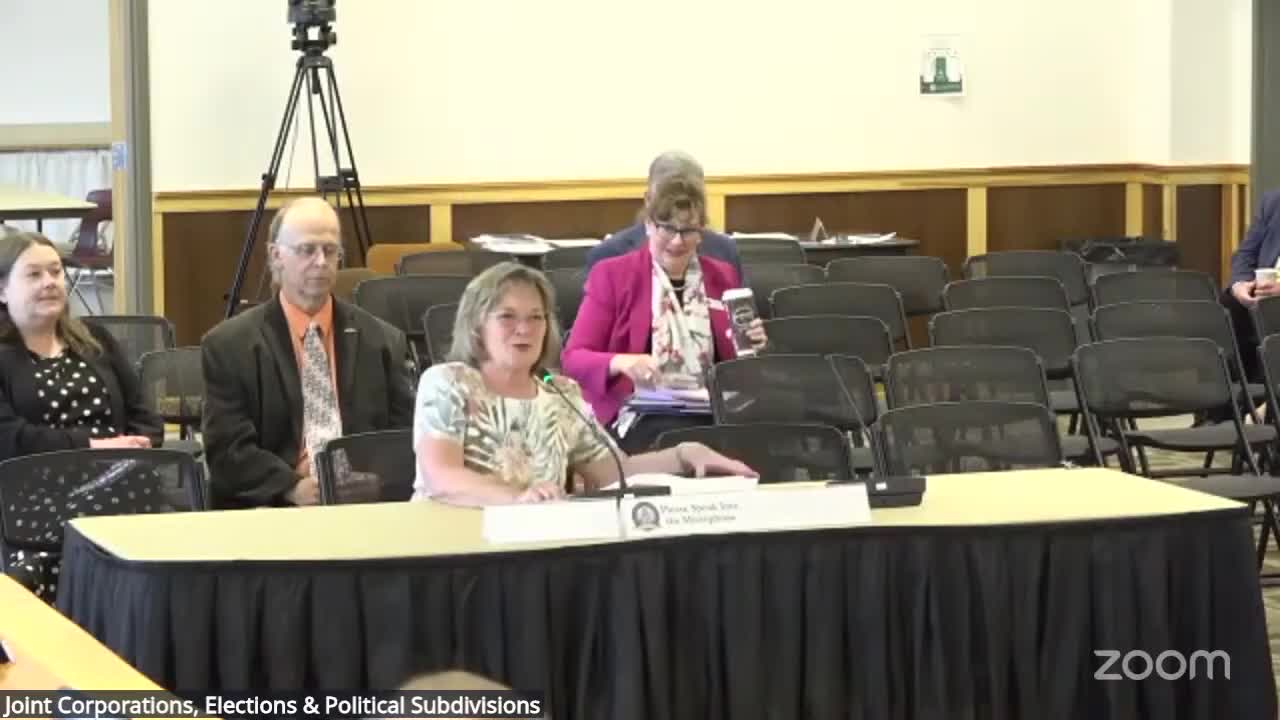
The Corporations, Elections & Political Subdivisions interim committee asked staff to draft legislation to shorten response times for public-records requests, standardize fees, and give the state ombudsman stronger authority to review fees and levy penalties, after hours of testimony from journalists, county attorneys and local officials.
The Corporations, Elections & Political Subdivisions interim committee voted to ask staff to draft legislation aimed at tightening Wyoming’s public-records and open-meetings processes and strengthening the state ombudsman’s role, after hours of testimony from journalists, county officials and members of the public.
Committee members said they want quicker statutory timelines, a standard fee framework and stronger enforcement powers for the ombudsman to reduce litigation and improve transparency across counties and municipalities.
The committee’s interest grew out of repeated testimony that local governments vary widely in how they handle requests and in the penalties for violations. Proponents said that as written the state’s law gives local bodies room to delay or deny requests and that the ombudsman lacks “teeth.” Opponents and some local officials urged balance, citing the workload on small offices and the rise of data-mining requests.
Bob Bonner, owner and publisher of the Newsletter Journal in Newcastle, described long-running local battles over records access and enforcement. “The ombudsman’s office really has no teeth,” Bonner said, arguing the 2019 statutory changes created loopholes that local officials exploit. He urged reversing language requiring requesters to prove officials acted “willfully and knowingly” and recommended reducing the statutory production period from 30 days back toward 10 days with a three-day acknowledgement requirement.
Representative Pepper Ottman, House District 34, urged a statewide framework to standardize redaction practices, time and page limits, and fee schedules so that small towns with one part-time clerk are not treated the same as larger, fully staffed jurisdictions. “If there could be a framework … standardized form that they can put on their official websites,” Ottman said, “that would help.”
Mayor Patrick Collins of Cheyenne described recurring monthly data-mining requests that impose heavy burdens on staff, listing examples that seek complete building-permit or purchasing records going back years. “It’s a lot to ask for,” Collins said, explaining his city uses software to track requests and sometimes charges for very large productions that include proprietary information.
County Attorney Joe Baron explained the practical trade-offs local officials face: large requests often require redaction of private data and extensive staff time. He noted county attorneys represent the county and its officers, and that charging fees or prioritizing records production is part of balancing statutory duties and daily operations.
Several witnesses proposed specific changes that the committee asked staff to draft. Suggestions included: - Require an acknowledgement of a public-records request within three business days and production within 10 business days unless the ombudsman grants an extension (a 30-day maximum was discussed as the extended standard). - Adopt the ANI fee schedule as a statewide baseline, with any local entity required to obtain ombudsman approval to exceed those fees. - Give the ombudsman authority to require governments to seek ombudsman approval before charging any fee and to levy civil penalties for violations; consider enlarging the existing $750 penalty and authorizing recovery of attorney fees for prevailing requesters.
The committee’s co-chair, Senator Case, proposed the draft “straw man” that combined those elements and invited witnesses to submit additional written material. After discussion, the committee voted by voice to request a draft bill so members could review language before the next meeting; a roll-call tally was not recorded on the transcript.
Supporters told the committee that stronger enforcement and clearer timeframes would push local governments to post routine records online, reducing the need for individual requests. Critics — including some county and municipal officials — warned that modern data-mining tools and commercial requesters impose heavy, recurring burdens on small offices that can disrupt other public services and urged protections against “fishing expeditions.”
The committee directed staff to prepare draft legislation and to circulate proposals before the next meeting so members and stakeholders can respond in writing and at a future hearing.
The committee also asked for written cost and enforcement analysis, and for models used in other states (witnesses referenced Colorado’s higher fine and its effect on compliance). The committee did not vote on any final statutory text at this meeting.