Get Full Government Meeting Transcripts, Videos, & Alerts Forever!
Get email alerts on the Government Associations topic
No spam. Unsubscribe anytime.
Lawmakers to continue review after hours of testimony on taxpayer-funded local government associations
Summary
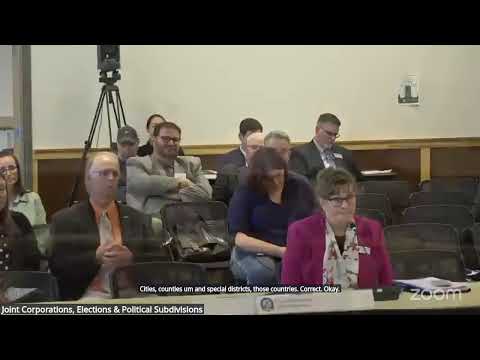
Lawmakers on the Corporations, Elections & Political Subdivisions interim committee in Lander on May 9, 2025, heard hours of testimony on whether taxpayer dollars should fund municipal and county associations and voted to continue the review at a future meeting.
LANDER, Wyo. — Lawmakers on the Corporations, Elections & Political Subdivisions interim committee spent the morning of May 9, 2025, hearing testimony on whether local governments should use taxpayer dollars to pay dues and expenses for municipal and county associations and decided to continue the review at a future meeting.
The committee heard presentations from the Wyoming County Commissioners Association (WCCA), the Wyoming Association of Municipalities (WAM) and the Wyoming Association of County Officers (WACO), plus public comment both for and against the practice.
Natalia Macker, president of the Wyoming County Commissioners Association and a Teton County commissioner, told the committee that the WCCA “exists to strengthen Wyoming Wyoming's counties through a program of networking, education, and unified action,” and described the group as a resource that gathers local data for county budgeting, the consensus revenue process and legislative analysis. Macker cited Wyoming statute “18 dash 3 dash 5 2 2” while describing the association’s role in helping counties respond to federal land-management decisions, tax transitions and other policy matters.
Washoe County Commissioner Terry Wolf, a former WCCA president, and Weston County Commissioner Ed Wagner described WCCA services as technical assistance, development of memoranda of understanding with federal land agencies, revenue manuals and training for newly elected county officials. Wagner said WCCA produces a “revenue estimating manual each spring, which counties and others utilized to develop annual budgets.”
Carter Napier, president of the Wyoming Association of Municipalities, said WAM represents all 99 Wyoming municipalities and provides training, data and legal support. “We are very fortunate to be able to say that, we represent all 99 municipalities,” Napier said. He told the committee WAM’s roughly $1,100,000 budget includes about $450,000 in dues and that dues scale with city size: he cited the city of Casper’s roughly $55,000 annual payment and “a few hundred dollars” for very small towns.
Mayors who testified said the associations save money and staff time for small governments. Matt Murdock, mayor of Pinedale and a WAM board member, said the association offers practical, nonpartisan training and gives small towns access to legal and budget expertise they lack. Ray Pacheco, mayor of Casper, said the associations are “about local control” and help municipalities comply with changing state and federal requirements.
Representatives of WACO and other county officer groups described low dues for some associations and said their annual meetings provide required training. Loretta Howison Callis, president of WACO and Big Horn County attorney, said WACO charges $400 per county for membership and an additional participant fee for its annual meeting to cover presenters and facilities.
Not all testimony favored continued taxpayer funding. Representative Scott Brady, who said his concern is representing taxpayers, argued publicly funded association activity can amount to paid lobbying and urged the committee to curb public funding of associations’ lobbying. Public commenters and a legislator questioned the transparency and scale of association budgets and travel expenses.
After several hours of testimony and public comment, Representative Mike Lucas moved that the committee review prior legislation on the topic, including 2021’s Senate File 144. Representative Weber seconded the motion. The committee voted by voice to continue the topic and directed staff to collect and present past bills and related materials at the next meeting for further study.
What happened next: the committee scheduled follow-up work on the topic, asking Legislative Service Office staff to compile prior bills and financial summaries for associations so members can evaluate statutory options. No statutory change was adopted at the May 9 meeting.
Why it matters: counties and municipalities across Wyoming vary greatly in staff and budget capacity. Association leaders argued that pooled resources let small governments meet training, legal and technical needs they otherwise could not afford; critics said public dollars should not subsidize association lobbying and called for greater transparency and limits.
The committee left the record open for additional written submissions and will revisit the issue at a subsequent interim meeting, directing staff to provide a legislative history and any cross‑state comparisons available.