
Weston County post‑election review prompts calls for clearer audit and hand‑count rules
Get AI-powered insights, summaries, and transcripts
Subscribe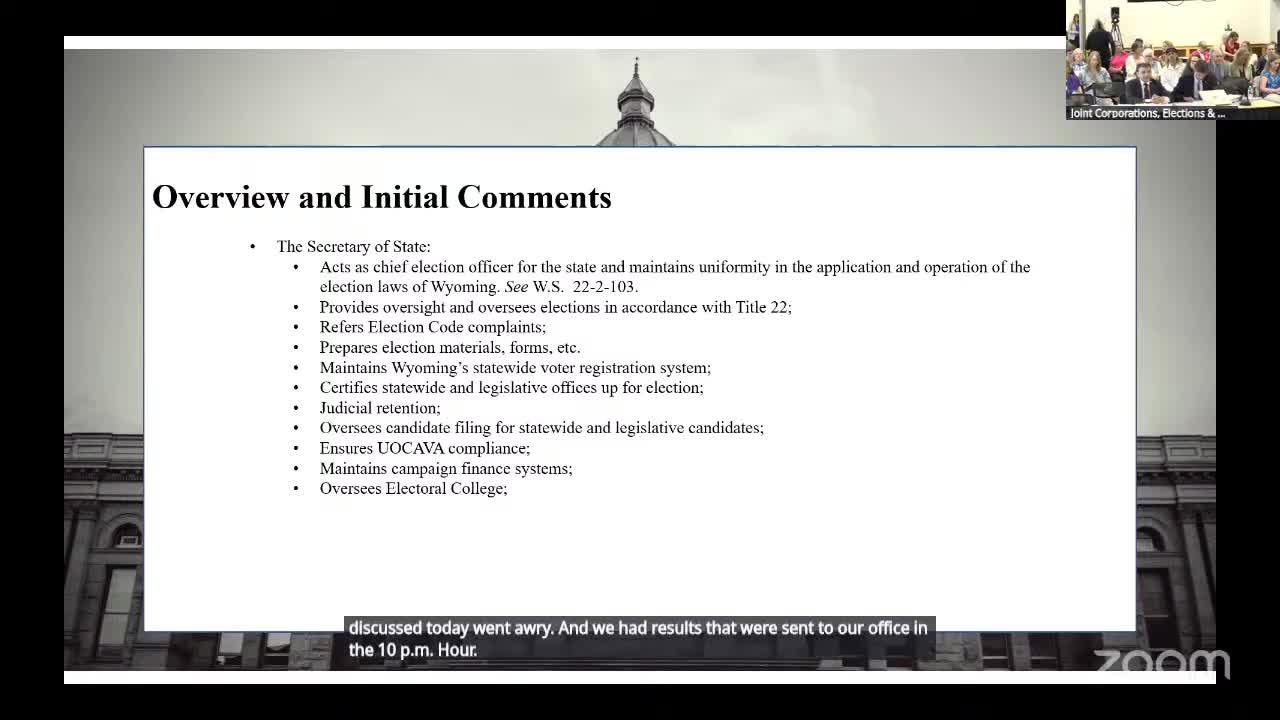
Summary
The Secretary of State described irregular results in Weston County that were later confirmed by a hand examination; lawmakers and public commenters pressed for clearer statutory audit procedures, vendor transparency and the ability to conduct hand counts in defined circumstances.
The secretary’s office and county clerks described developments tied to a contested set of results in Weston County, and the episode drew renewed calls from legislators and the public for clearer auditing rules and statutory authority to conduct hand counts in specified circumstances.
The Secretary of State told the committee that the office received results on election night that did not appear credible—an unusually high undervote in a race with an unopposed candidate—and that attempts to reach the county clerk that night were difficult. The office and county officials then coordinated a review the next day; the secretary said a former draft ballot had been used in some locations, creating a ballot alignment error that produced incorrect tallies in at least two contests. A subsequent hand examination by the county canvassing board confirmed misalignments in the cast‑vote records.
"We had a thesis on that first call as to what had occurred," the secretary said. He told the committee the county initially reported no audit findings, but later submitted an amended post‑election audit after the hand examination. The secretary said he has forwarded his findings to the governor and has referred complaints received to appropriate prosecutorial officials for review.
Several legislators and public commenters pressed for explicit statutory authority and procedures to require hand recounts or expanded audits when machine results and audits conflict. "When we look forward to possible hand recounts for audits...we need to have...adjudication statutes," said Julie Friess, Fremont County clerk, urging the committee to consider rules for adjudicating ambiguous ballots and when a hand count is required. Representative Johnson and others asked whether a machine‑based recount or a hand count should be the default when a dispute arises; clerks explained Montana‑style or statute‑based audit regimes vary by state and that Wyoming’s code currently emphasizes tabulation and post‑election audits rather than routine hand counts.
Multiple public commenters urged the committee to authorize procedures that make paper ballots the primary audit trail and to expand statutory access for hand audits. Pete Kapp, a technologist who addressed the committee remotely, said the vote‑compilation step (the offline computer that aggregates USB reports) is a vulnerability if that computer and its antivirus or software are out of date. Several commenters said the Weston County episode showed that a hand examination was necessary to detect a ballot alignment error; clerks and the secretary said they will work with the committee on potential statutory clarifications.
Why this matters: committee members face a balance between (1) preserving voter privacy in small precincts when showing individual ballots and (2) enabling transparency that can detect ballot alignment or tabulation errors. The secretary of state’s office said it will supply additional written information; the committee indicated it will consider interim work on auditing and adjudication procedures.
Sources: Secretary of State presentation and committee Q&A, May 8, 2025; clerk statements during demonstration; public comments at the May 8 meeting.