
Wyoming county clerks demonstrate logic-and-accuracy testing, chain-of-custody and post-election audits
Get AI-powered insights, summaries, and transcripts
Subscribe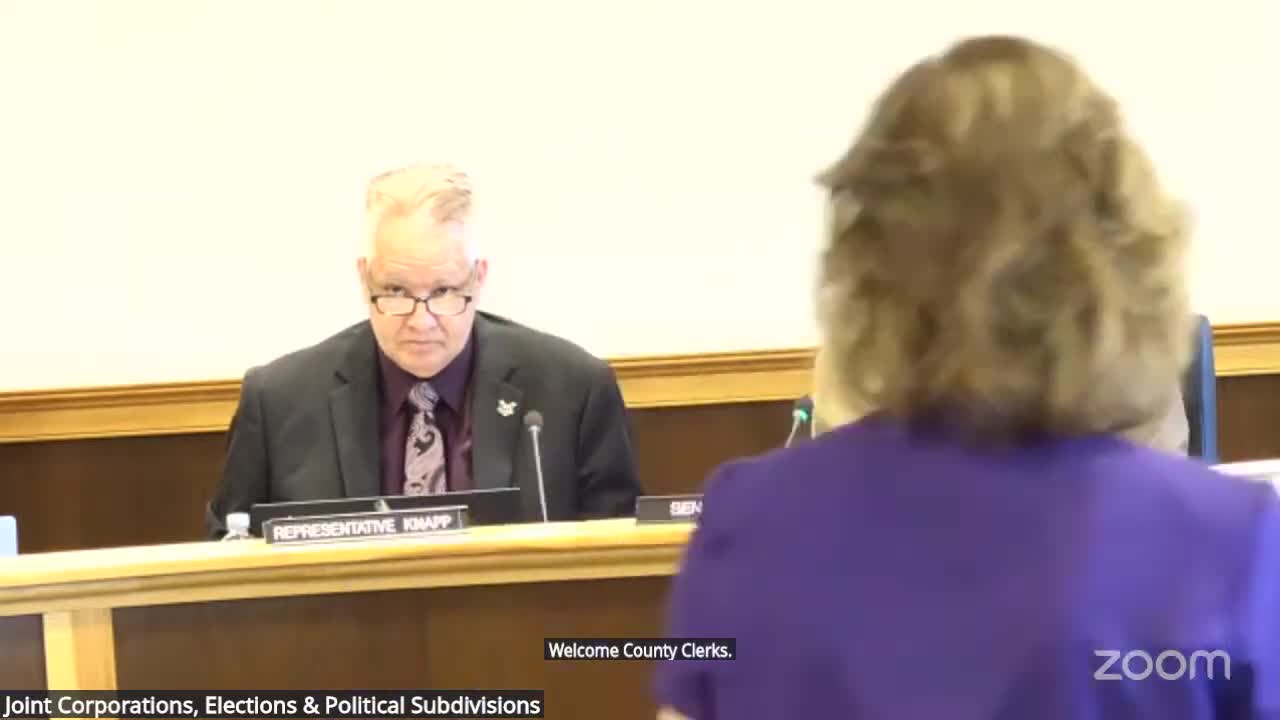
Summary
County clerks from across Wyoming gave a daylong demonstration of how they run logic-and-accuracy tests, seal equipment, handle USBs and perform post-election audits, saying the procedures are designed to protect ballots and voter privacy while acknowledging room for statutory and procedural improvements.
County clerks from multiple Wyoming counties gave the Joint Corporations, Elections & Political Subdivisions Committee a step-by-step demonstration on May 8 of how they test voting systems, move equipment to polling places and perform post-election audits.
Clerks said the demonstrations are intended to inform legislators considering interim election topics, not to advocate for specific machines or statutory language. "We have no intention of swaying your opinions about electronic voting systems or to sell you on anything," said Malcolm Irvin, Platte County clerk, at the start of the presentation.
The demonstration focused on three core areas: pre‑election logic-and-accuracy (L&A) testing, chain-of-custody and sealing procedures for equipment, and post‑election audits. Julie Friess, Fremont County clerk, said L&A tests use actual election data and sample ballots to verify three objectives: "verify that election specific data and ballots include every contest, candidate, and precinct; ensure all components of the voting system are functional; [and] verify the voting system can interpret voter markings and record and report vote totals accurately." Friess ran legislators through a small public test of equipment programmed for a Baldwin Creek Elementary school election, showing how ballots are cast, how the tabulator rejects double-feeds and how the public zero tape is generated and signed.
Clerks described specific safeguards and timelines they use: sample ballots are proofed before printing; ballots for overseas military voters are mailed 45 days before election day and other absentee ballots 28 days before; L&A tests occur in a public demonstration after internal checks; machines and test ballots are sealed and stored until a post-election audit within 30 days after the county canvass. Friess said Fremont County’s general‑election test deck in 2024 was 1,185 ballots and that the smaller school demo used 23 ballots. She described battery backups that are rated for roughly six hours, auxiliary bins for emergency paper ballot deposits and procedures to replace a tabulator that fails on election day.
Clerks emphasized handling of the removable media used to compile results. Friess described two kinds of USB sticks: encrypted, vendor‑provided sticks that she said are “the only USBs made in United States” for that vendor and are treated as single‑use in her county; and off‑the‑shelf sanitized sticks that some counties temporarily use to move reports from a hardened, offline results computer to an internet‑connected office computer to transmit to the secretary of state. "That USB can never come back," Friess said of the report stick used to send results to the state.
On audits, clerks described a layered approach. County staff run internal L&A tests and public demonstrations before the election, then a post‑election audit of a sample of ballots after the county canvass; state rules and clerks’ association guidance also require a 5% machine audit within 30 days of the canvass in some counties. Margie Irvine, Fremont County chief deputy, and Sarah McQuain, election deputy, demonstrated a post‑election review of scanned ballot images and the cast‑vote record (CVR) on a hardened, offline system; clerks explained they do not show handwritten write‑ins to the general public during audits to protect voter privacy in small precincts.
Committee members asked about technical details that clerks do not control—such as vendor encryption, USB procurement and whether report files are hashed. Clerks said some technical questions require follow‑up and offered to supply written answers. They also noted county‑to‑county differences in procedures: "Because there are differences in voting in counties, I might be doing something a little bit different than maybe what you've seen in other counties," Friess said while encouraging the committee to consider uniform testing practices.
Why this matters: clerks said the processes are intended to make votes auditable and protect ballots and chain of custody, while several legislators and public commenters pressed for statutory changes on audits, hand counts and vendor transparency. Clerks requested more time in the interim to bring specific language or suggestions to the committee.
The committee agreed to collect written follow‑up questions from members; clerks prepared a form for legislators to record technical questions that county offices will answer over the interim. A formal vote this morning adopted the committee’s interim rules by motion of Senator Dockstader, seconded by Senator Landon.
Clarifying details from the demonstration included: public L&A for the demo used 23 ballots; Fremont County reported a 1,185‑ballot test deck in its 2024 general election; military/overseas ballots go out 45 days before an election and other absentee ballots 28 days before. County clerks said they use a combination of vendor‑provided encrypted USBs (treated as single‑use in some counties) and off‑the‑shelf sanitized sticks to move files from an offline results system to an internet‑connected office computer for secure transmission.
Committee staff will collect the written questions clerks requested and clerks said they will follow up in writing. Clerks also asked the session to consider interim work on four topics they previously filed with the committee: testing and auditing procedures, voter list maintenance, physical election security and absentee ballot security.
Sources: county clerks’ demonstration and Q&A before the Joint Corporations, Elections & Political Subdivisions Committee on May 8, 2025.