Get Full Government Meeting Transcripts, Videos, & Alerts Forever!
Get email alerts on the School Finance topic
No spam. Unsubscribe anytime.
Arrowhead presenter: Wisconsin school finance is a ‘puzzle,’ revenue limits control most district funding
Summary
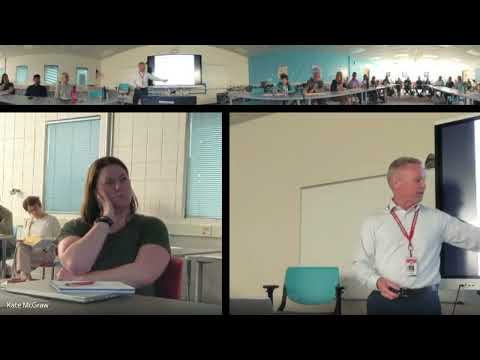
Jeff Gross, Arrowhead UHS School District director of business services, gave a plain-language briefing on Wisconsin public school finance, explaining how revenue limits, membership counts and state equalization aid shape local tax levies, fund accounting and district budgets.
Jeff Gross, director of business services at Arrowhead UHS School District, told a community audience that Wisconsin public school finance is complicated but governed by a few core rules that local boards must understand. Gross summarized how a district’s revenue limit, the statewide equalization aid formula and membership counts determine how much a district can raise and how much of that total must come from local property taxes.
Gross said the presentation was intended to “enhance awareness and basic understanding of the Wisconsin Public School Finance system” so board members can better explain budgets to residents. He called it “the school finance puzzle” and repeated that much of a district’s operating revenue is set by state rules: in his words, “they control the 80%. We’re running the 20%.”
The nut of Gross’s briefing: a district’s revenue-limit authority (he said Arrowhead’s was “just over $24,000,000” for the current budget) is computed by multiplying a membership count by a per‑member revenue amount established under state formulas. Membership is not the same as daily enrollment; Gross described membership as resident students (a rolling three‑year average) and gave Arrowhead’s resident count this September as 1,848. He explained the longstanding disparities across districts by showing per‑pupil revenue limits that vary widely (his slides compared Arrowhead’s per‑pupil figure to higher “unit high” districts such as Nicolet). The result, he said, is that similarly sized student bodies can produce very different revenue-limit totals because the per‑pupil base differs by district.
Gross walked through how districts use fund accounting (general fund, special education fund, food service, capital project funds and debt service) and why some buckets are required to balance each year. He described fund balance as a cash‑flow and credit metric: “On June 30, the fund balance is for us, it’s about 39% right now. But by December … it’s almost 0. So we need to manage cash flow until we get our tax receipts,” Gross said, noting Arrowhead’s tax receipts typically arrive in mid‑January.
He reviewed state categorical aid that is paid outside the revenue limit (special education categorical aid, transportation aid, per‑pupil aid and federal Title grants), and how those interact with a district’s tax levy. Gross said Arrowhead’s share of state aid is roughly 24% of its revenue picture and described equalization aid as a multi‑tier guarantee that reduces property tax burdens for property‑poor districts.
On school vouchers and open enrollment, Gross said public schools receive roughly $9,000 per regular open‑enrollment student and about $14,000 for a public special‑education student; he contrasted that to private‑school voucher payments, which he said are higher on the voucher side (Gross noted private vouchers can be “just under $13,000” for regular education and “over $15,000” for special education, as described in his slides). He cautioned that voucher payments reduce state aid and that, in practice, the voucher expansions are partly funded through property tax shifts.
Gross offered practical next steps for board members: monitor membership counts closely, understand how nonrecurring exemptions (declining‑enrollment exemptions, harmless aids) adjust revenue limits, and use fund 46/40/41 options strategically for capital planning. He also offered to share his slide deck after the meeting: attendees were told he could email the materials to anyone who supplied an address.
Ending: Gross closed by encouraging board members to use the material when speaking with constituents and to treat revenue‑limit math and aid formulas as the key drivers when the district plans budgets or considers referendums. He said he would distribute slides by request so board members could take specific figures back to their districts.
(Quotes in this article come from Jeff Gross, director of business services, and from an unnamed resident who spoke during Q&A.)