
Parker planning commission recommends uniform code for camping in floodplain
Get AI-powered insights, summaries, and transcripts
Subscribe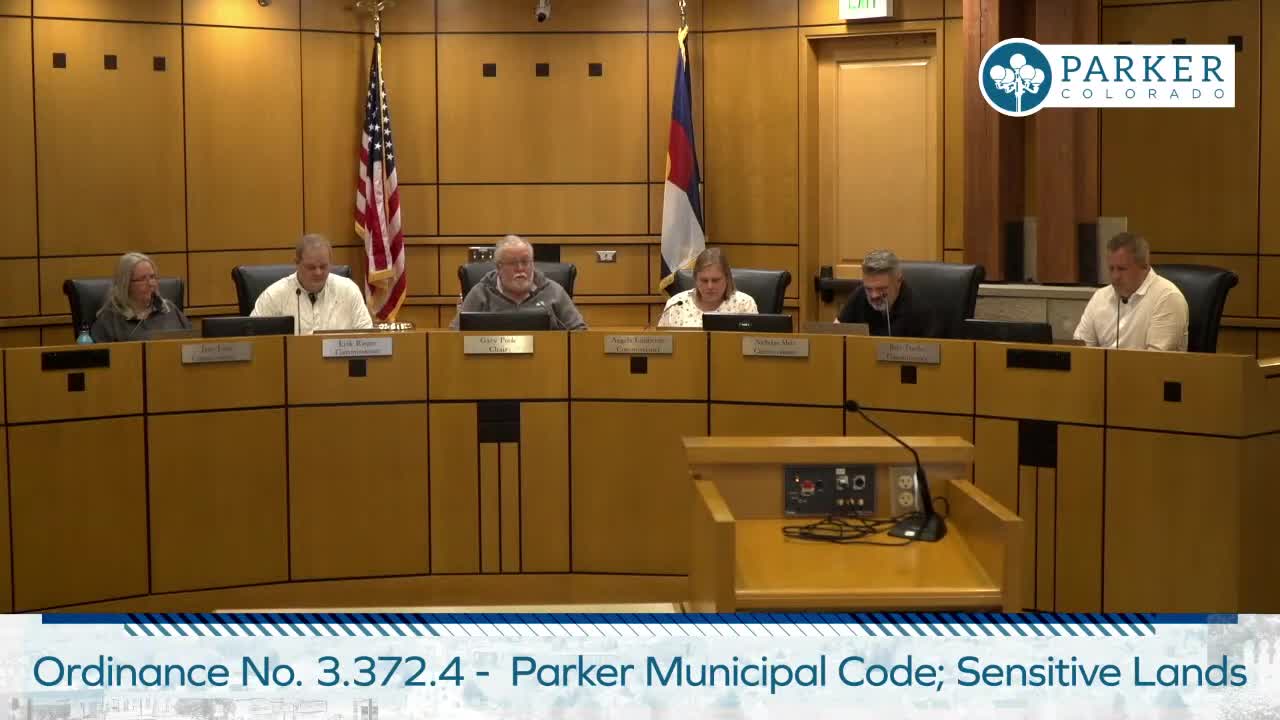
Summary
The Parker Planning Commission voted 6-0 May 8 to recommend that the Town Council approve an ordinance amending the Parker Municipal Code to align how the town treats camping in sensitive lands, including the floodplain, town staff said.
The Parker Planning Commission voted 6-0 May 8 to recommend that the Town Council approve an ordinance amending the Parker Municipal Code to align how the town treats camping in sensitive lands, including the floodplain, town staff said.
The change would revise Title 13, Section 13.08040 (sensitive lands avoidance) so that abatement procedures refer back to the town’s existing Title 8 camping prohibition and to a separate council policy on how recovered personal property is handled. The measure keeps a 72-hour notice requirement before routine abatement and requires the police department to store recovered property for 30 days, but it adds an explicit exception allowing immediate abatement in emergent situations such as imminent flash floods or fires, staff said.
Staff member Kelsey, presenting the item to the commission, said, “What we are trying to do tonight is make sure that camping is all treated the same.” Kelsey told commissioners the ordinance removes duplicated abatement language from the sensitive-lands code and instead cross-references Title 8 so enforcement and property-handling are consistent townwide. Kelsey also said the draft keeps the 72-hour notice requirement and that “property that’s been recovered must be stored by the police department for 30 days.”
The draft ordinance also directs the town to develop a council-level policy to clarify which recovered items will be retained, which will be discarded, and which will be turned over to police. Kelsey described the policy as drawing lines between “essential personal property, regular property, and then anything else that would be considered more trash or waste,” and said storage capacity limits mean the police will retain only items about the size of a backpack or smaller when they qualify as essential personal property (examples given: government-issued IDs, medication, glasses, electronics).
Officer Joe Degenhardt of the Parker Police Department answered commissioners’ questions about enforcement and frequency. “I don’t have an exact number. But recently, we have two that need to be cleaned up this month. So it’s been roughly, I think last year, roughly, is about six,” Degenhardt said. He said most encampments addressed by the town are along the Cherry Creek corridor and near bridges, and cited a recent site on Park Road.
Regarding how abatements begin, commissioners were told enforcement is complaint-driven and often involves the town’s parks or public works staff. Kelsey said the code requires that resources be offered before enforcement action is taken; the town partners with the Douglas County HEART team to offer services, and its Crisis Response Team (CRT) is used for mental-health concerns.
Commissioners spoke in favor of the change, saying a single, consistent approach would reduce ad hoc decisions in the field. Chair Brett and other commissioners praised the clearer size and storage limits and the template for staff to follow rather than making individual judgment calls on site. Commissioner comments noted that enforcement activity typically rises in summer months.
With a motion moved by Brett and seconded by Angela, the commission voted unanimously to recommend Town Council approve the ordinance. There were no public speakers at the hearing.
The ordinance will next be considered by the Parker Town Council, which will determine whether to adopt the code change and the related council policy on recovered property.