Tag approves cleanup of Appendix A default-assembly tables, directs reference to ASHRAE 90.1
May 10, 2025 | Building Code Council, Governor's Office - Boards & Commissions, Executive, Washington
This article was created by AI summarizing key points discussed. AI makes mistakes, so for full details and context, please refer to the video of the full meeting. Please report any errors so we can fix them. Report an error »
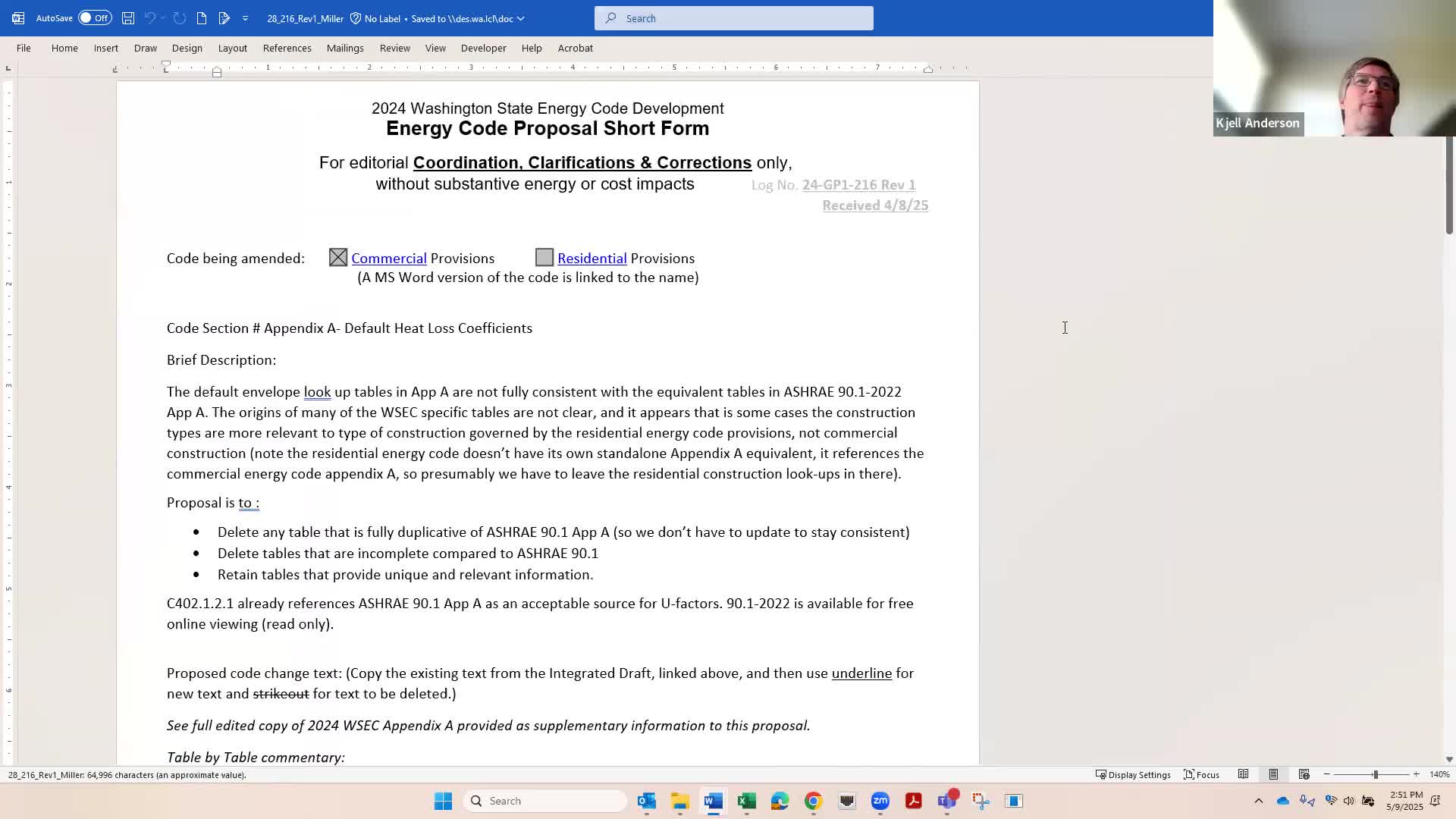
Background: Appendix A historically contained a mixture of Washington-specific assembly tables and a number of entries that duplicated or conflicted with ASHRAE 90.1 tables, sometimes because ASHRAE has updated tables and the state appendix had not been revised in step. Nathan Miller led a work-group review and proposed retaining only those tables that are unique to Washington or that add information not found in ASHRAE 90.1. The proposal removes redundant tables and adds a clear statement that where an assembly is not listed in Appendix A, users may rely on ASHRAE 90.1 normative Appendix A, ASHRAE fundamentals, or other accepted methods to determine U-factors; the text also kept pathways for jurisdictions to accept alternate calculations.
Why this matters: Appendix A is used by designers and plan reviewers as a convenient source of default assembly performance values when owners or designers do not model assemblies. The cleanup reduces the risk of conflicting tables and points users to a single maintained source for default assemblies, while preserving Washington-unique entries.
The tag approved the cleanup and asked staff to (1) merge the cleanup into the code text, (2) add a clear pointer to ASHRAE 90.1 normative Appendix A and ASHRAE Fundamentals where appropriate, and (3) preserve any Washington-unique assemblies that are not in 90.1. The tag also asked proponents to verify that deletion of specific legacy tables does not inadvertently remove entries used commonly by local practitioners (ACCA/manual-j users raised the issue in the meeting) and to provide a short guidance note for plan reviewers about acceptable alternate methods (ACCA/Manual-J and other recognized tools).
Speakers: Nathan Miller introduced the review and explained the rationale; jurisdiction representatives supported the cleanup but asked for a short guidance note for local reviewers. The tag approved the work-group recommendation.
View the Full Meeting & All Its Details
This article offers just a summary. Unlock complete video, transcripts, and insights as a Founder Member.
30-day money-back guarantee
Sponsors
Proudly supported by sponsors who keep Washington articles free in 2025

