Get Full Government Meeting Transcripts, Videos, & Alerts Forever!
Get email alerts on the Public Works Budget Cip topic
No spam. Unsubscribe anytime.
Seal Beach public works outlines $46.7 million program, reiterates lifeguard headquarters priority
Summary
Public Works presented a $46.7 million operations and capital program that prioritizes beach and coastal assets, alley repaving seed money and a phased approach to a lifeguard headquarters while warning of $200 million in unfunded needs.
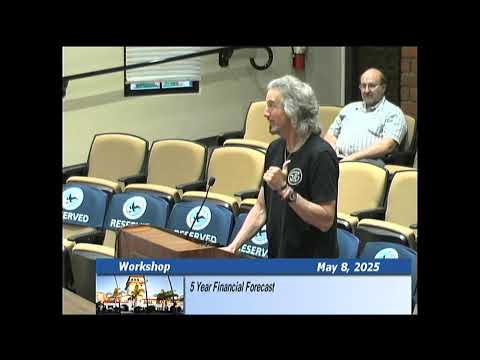
Seal Beach public works staff told the City Council at the May 8 budget workshop that the department’s proposed operations and capital budget totals $46.7 million and emphasizes coastal infrastructure, deferred maintenance and grant-seeking to stretch limited local dollars.
The presentation flagged three near-term priorities: (1) continuing storm drain CCTV and cleaning efforts, (2) starting alley repaving with seed money, and (3) advancing planning for a new lifeguard headquarters that the department says is beyond its useful life. Director Lee said the capital and outlay portion of the department’s budget accounts for about $27.8 million, or roughly 59% of the public works total, while operation and maintenance is proposed at $13.1 million.
The budget matters because Seal Beach owns and maintains beach, pier, water and sewer systems in addition to typical street and parks infrastructure, making the city’s needs larger and more specialized than many noncoastal municipalities. Staff repeatedly stressed that much of the work depends on external funding and multi‑year efforts and that city dollars cannot cover all deferred projects at once.
Public Works highlighted recent and ongoing work: about 2,600 trees trimmed year‑to‑date; roughly 40,000 linear feet of sewer pipeline cleaned last year (staff noted an apparent reporting difference for this year); more than 14,000 linear feet of striping and signage refreshed; and completion or carryover of several grant‑funded capital projects including a Lampson Avenue bike lane gap closure and Heather Park playground upgrades funded by Prop. 68 per‑capita dollars.
On alley repaving, staff proposed a $150,000 “seed” allocation to start a multiyear effort. Lee explained alleys are not eligible for restricted roadway formula funds (gas tax, SB 1 RMRA, OCTA M2 local fair share) because they are not part of the state/region roadway system, so work must rely on general fund or discretionary funds.
On beach and pier work, the presentation noted a planned structural assessment and a phase‑2 rehabilitation for the concrete pier and a focus on sand replenishment project Stage 14 (Surfside/Sunset area). Lee said the Army Corps of Engineers is the primary implementer for federal beach renourishment projects but that federal funding and dredge availability determine how much sand arrives in any given cycle.
Director Lee referenced an ADA transition plan prepared a few years ago that estimated roughly $40 million in programmatic and infrastructure costs to bring city facilities and sidewalks into compliance; she cautioned that inflation likely has raised that figure since it was produced.
Lifeguard headquarters and the pool: staff reiterated that a lifeguard headquarters needs assessment was completed and that prior council direction and dedicated revitalization funds had seeded early work. Councilmembers and public commenters pressed for quicker action. Resident James (public comment) said laterals and “what’s inside” the system—household sewer connections—deserve attention when the city repairs main lines. Public commenter Catherine Showalter urged the council to restore pool‑dedicated funds if possible, saying the community raised them for a tangible facility.
Staff emphasized a holistic approach: the city is developing a “Greater Pier/Main Street vision plan” to align lifeguard headquarters design with parking, downtown activation, and coastal access rather than designing the building in isolation. Lee said existing revitalization allocations have been spent on high‑priority needs (police and lifeguard emergency vehicles and other items) and that most remaining revitalization funds will be reviewed as part of midyear budget adjustments.
Grants, outside funding and carryovers: the presentation listed pursued and awarded external funds—Safe Streets for All (SS4A), Surface Transportation Block Grant (STBG), CalRecycle City/County Payment Program (CCPP), Community Development Block Grant (CDBG), OCTA environmental cleanup program (ECP), OCWD loans—and noted more than $36 million in targeted funding pursuits. Staff said carryover balances often reflect multiyear projects or awaiting closeouts rather than unstarted work.
Staff cautioned the council that public works faces roughly $200 million in unfunded capital needs across storm drain, facilities, parks, sand replenishment and other categories and that buying power is shrinking with inflation. Director Lee said staff will continue to prioritize projects, leverage cooperative procurement and pursue outside grants where feasible.
A final staff note: Public Works proposed a modest $75,000 programmatic allocation for storm drain CCTV/cleaning in the coming year—“not a whole‑city program,” Lee said, but a start at chipping away at the problem.
Looking ahead, staff said the council will see more detailed project scoping, grant pursuit updates and the Greater Pier/Main Street vision plan as those efforts are fleshed out and as carryovers and grant awards are finalized.