Get Full Government Meeting Transcripts, Videos, & Alerts Forever!
Get email alerts on the Urban Forest Monitoring topic
No spam. Unsubscribe anytime.
University researcher urges regular canopy monitoring after Athens canopy-history analysis
Summary
A preliminary historical analysis presented to the Shade Tree Commission found episodic tree recruitment but steady mortality and recommended more frequent canopy monitoring and continuous replanting.
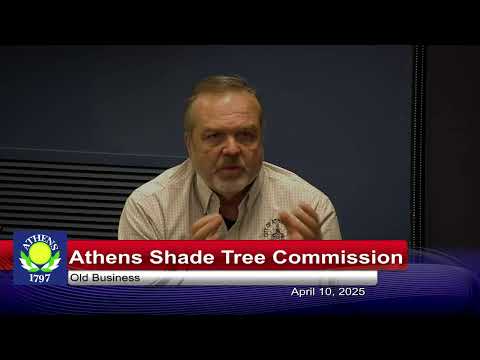
Glenn Matlak, who identifies himself as an instructor in plant ecology at the university, presented preliminary results April 10 from a multi-decade analysis of Athens’ tree canopy and urged the commission to adopt regular monitoring and steady replanting rather than episodic plantings.
Matlak told the commission that historical aerial imagery — available for Athens back to 1939 — shows recruitment in distinct episodes while tree mortality follows a steady, near-linear decline across cohorts. “Recruitment is strongly episodic,” he said. “Mortality seems to be pretty much consistent.” He recommended five- or 10-year monitoring cycles using satellite and aerial imagery and more continuous replanting to achieve an even-age distribution of urban trees.
Matlak outlined differences among city zones: the urban core and flood plain saw conversion from lawn or pasture to pavement between roughly 1960 and 1980, while slopes north of town experienced ecological succession from old fields to increased tree cover. He said that the city’s current canopy is around 32 percent in his 2014 measurement and cautioned that an updated 2025 estimate is in progress.
Commissioners and attendees discussed how the research could inform where to plant. A commissioner asked whether mortality correlated with proximity to pavement; Matlak said the study can measure distance to pavement and combining that with a ground-level street-tree inventory would produce actionable guidance about likely survivability. “They are going to do better the farther away from pavement they are,” Matlak said, while also noting the city needs trees near pavement to mitigate heat islands.
Why it matters: The presentation frames planting strategy and monitoring as key tools for preserving and increasing urban canopy, especially given development pressures and episodic planting patterns tied to grant cycles.
Next steps: Matlak said his team will produce updated canopy figures for 2025 and is conducting a parallel street-level inventory. Commissioners said the data would be useful for grant applications and for targeting public education and private-landowner outreach.
The presentation and discussion occurred during the commission’s regular meeting; commissioners later referenced Matlak’s findings when reviewing a development application that proposes far fewer on-site trees than the commission’s requirement.