Get Full Government Meeting Transcripts, Videos, & Alerts Forever!
Get email alerts on the Economic Development topic
No spam. Unsubscribe anytime.
Rochester officials outline plan to acquire parcels around 161 South Main; residents press for transparency and fiscal caution
Summary
Rochester’s economic development director presented a plan April 15 to acquire five parcels around 161 South Main Street — the former Care Pharmacy site — and assemble them with city‑owned land to create a larger redevelopment parcel aimed at mixed‑use housing and street‑front commercial space.
Rochester’s economic development director presented a plan April 15 to acquire five parcels around 161 South Main Street — the former Care Pharmacy site — and assemble them with city‑owned land to create a larger redevelopment parcel aimed at mixed‑use housing and street‑front commercial space.
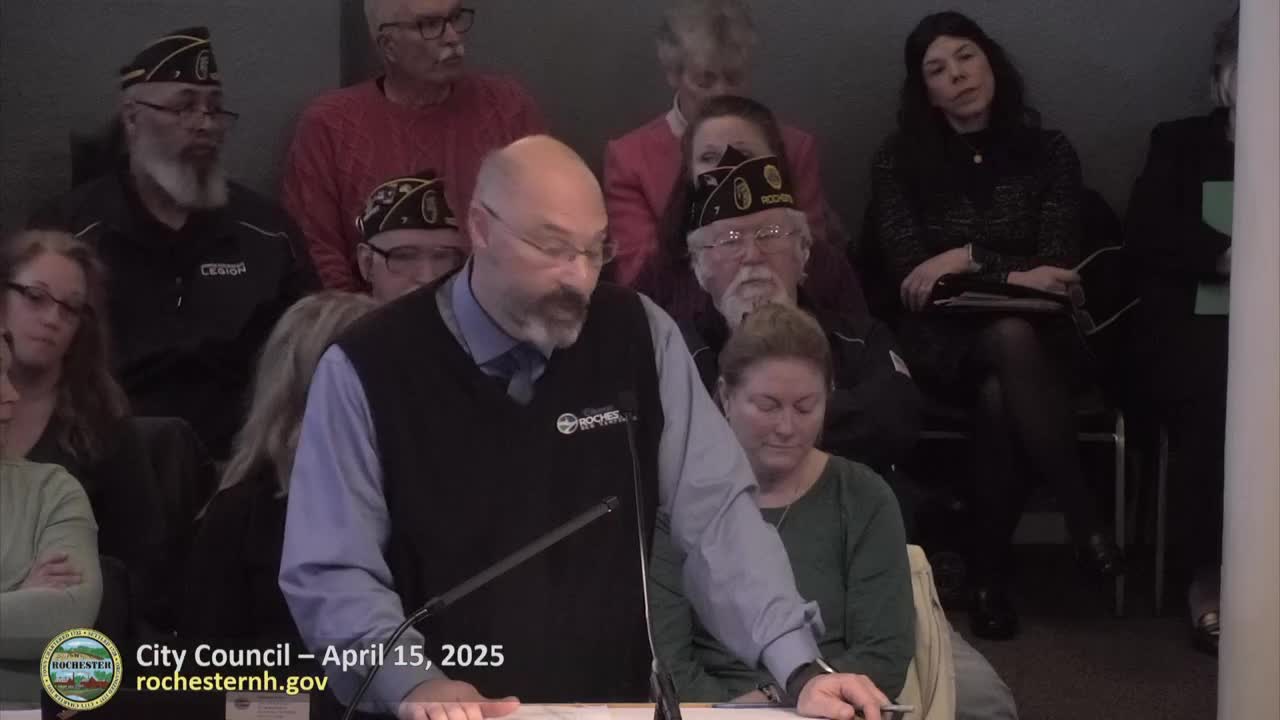
The presentation, delivered by Mr. Scowler, director of economic development, said the city would combine privately owned lots and nearby city acreage to make a saleable downtown development site. “Rochester still has a 1% or below vacancy rate when it should be 4%,” Mr. Scowler told the council, arguing that municipal involvement and tax‑exemption tools have helped draw private investment downtown.
The plan proposes using municipal tools such as the 79‑E property tax program and direct acquisition to influence what is built on the site. Mark Sullivan, the city’s director of finance, told the council the request would be the single largest use of the unassigned fund balance for an economic development project in recent years and described the city’s current balances and constraints: the city reported a FY24 unassigned fund balance of about $29,000,000, an audit hold of roughly $5,000,000 related to water and sewer cash deficits, and an estimated available balance of about $24,000,000 after accounting for the hold; the FY25 budget already commits roughly $7,900,000 from reserves.
Why it matters: council goals and policy tools
Mr. Scowler framed the acquisition as consistent with council goals to attract housing and encourage downtown mixed‑use development. He cited prior municipal interventions — including the Scenic Salinger and Hoffman projects and the city’s purchase and cleanup of other downtown properties — as precedents for public investment to unlock private development. He called the state 79‑E program “one of the most important tools” the city can offer developers, noting it helped stimulate about $26,000,000 in local investment, according to slides shown during the presentation.
Council and staff cautioned that nothing is final and that any major development on the site will require conventional due diligence. Planning and Development Director Seth Creighton said the Brook behind the parcels sits in a FEMA flood zone designated as Zone A, meaning there are limits and building standards for structures in that area and that federal sign‑off is part of the process for certain flood‑plain development.
Public concern: reserve funds, transparency and displacement
Dozens of residents turned out to the public hearing and most speakers urged caution or opposed using reserve funds to buy the land. State Representative Tom Kosinski told the council the proposal represented “Soviet style central planning” and criticized the use of reserves instead of leaving the market to set prices. Susan Rice, a longtime critic of nonpublic city real‑estate discussions, called the acquisition and related transfers a “Callahan Shuffle,” urging more transparency and asking the council to “bring the phantom Rochester Realty Trust into the light.”
Other residents raised questions about who would benefit, whether long‑running downtown small businesses would be displaced and whether the city had fully explored alternatives for the money. Councilor Fontenot noted the presence of an operating business, Golic’s ice cream, on one of the parcels; Mr. Scowler said the ice‑cream business would become the city’s tenant if the city purchased the property and that the city would work to find space for the operator if plans required relocation.
Financial and procedural questions
Finance Director Mark Sullivan urged careful vetting of any developer partner and recommended a rigorous RFP and due‑diligence process. Sullivan described the city’s usual practice of investing unassigned fund balance in safe securities to generate budgetary income and reiterated that the city uses reserves every year to stabilize taxes. He said the proposed use would be sizeable but potentially justified if the project realizes new assessed value: Mr. Scowler suggested the assembled site could eventually yield “$30,000,000 in assessed value” and said that, depending on final development, the city could see increased tax receipts over time.
Multiple speakers asked for specific cost estimates (purchase price, demolition or remediation, and the cost of any required flood‑plain mitigation) and for the council to require stronger contingencies in any purchase and sale agreement. Commenters also demanded a clear public accounting of any transfers to the Rochester Economic Development Fund and asked the council to consider the tax‑cap and timing relative to the city’s FY26 budget calendar.
Next steps and council action
After public comment, Mayor Paul Callahan closed the hearing; no council vote on acquisition was taken at the meeting. City staff said any major development would require traffic, water and sewer studies and other standard third‑party reviews submitted by a developer as part of permitting. Sullivan recommended, and staff repeated, that the city use a competitive solicitation and a development agreement to protect municipal objectives and, if awarded, to include robust reporting / reimbursement conditions before dispersing substantial municipal funds.
Community context and remaining questions
Speakers emphasized several themes for the council to address before any acquisition is finalized: a full cost estimate for purchase, cleanup and any flood‑plain work; explicit assurances about Golic’s and other existing businesses; clear financial contingencies and reporting if reserves are used; and a public timeline for developer selection and due diligence. Residents asked the council to consider alternatives for the unassigned fund balance, including capital projects and school needs, and several asked for the city to return some reserve dollars to taxpayers.
The record: the council closed the public hearing on the Care Pharmacy parcels; staff said proposals, due diligence and formal council action would follow before any property transfer or funding occurs.