Get Full Government Meeting Transcripts, Videos, & Alerts Forever!
Get email alerts on the Town Budget topic
No spam. Unsubscribe anytime.
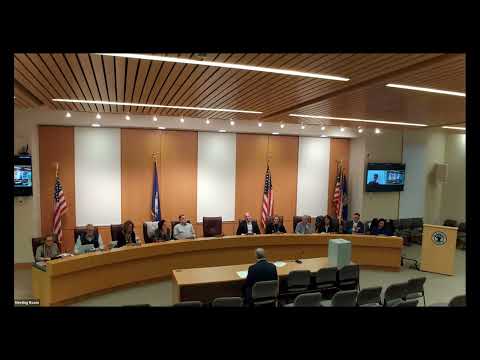
New Canaan council hears board of finance cuts that trim FY2026 tax raise and capital requests
Summary
The Board of Finance presented changes that reduce the proposed FY2026 tax increase and trim capital spending, including delaying some projects and reserving design funds for larger items; council members pressed for a long-range review of school spending.
Todd LaViere, chair of the Board of Finance, told the Town Council on March 13 that the board met three goals in reviewing the selectmen’s FY2026 budget: reduce the property tax levy, trim capital spending and cut taxpayer‑supported capital. LaViere said the board reduced the amount to be raised by taxation by $4,100,000, cut capital spending by $4,800,000 and reduced taxpayer‑supported capital by $1,200,000 compared with the selectmen’s proposal.
The reductions came as LaViere and finance staff described where savings were found and what the board left in the package. “We reduced the amount raised by taxation by $4,100,000,” LaViere said. He identified bond premium revenue, cuts to capital asks and a $300,000 reduction from the Board of Education among the contributors to the change. Josh Kaufman, who led the staff budget review for the presentation, said the consolidated budget now shows a 3.56% year‑over‑year increase in expenditures and that staff worked to “scrape” fund balances and reassign unspent prior appropriations to reduce next year’s ask.
Why it matters: the school budget represents two‑thirds of the town’s spending and accounts for more than 70% of the increase year over year, LaViere and other speakers said. Council members asked for a longer horizon on school spending and for work to find structural savings. Council Chair Mike Morrow and other members pressed the finance board to examine headcount and contractual obligations as drivers of long‑term cost growth.
Council discussion focused on tradeoffs and long‑term fiscal posture. LaViere noted the town’s strong financial markers — an overfunded pension and an 80% funded OPEB trust — and a recent Moody’s triple‑A rating, while saying the town’s unassigned fund balance sits on the low end of comparable guidelines. “We want to go on a little bit of a debt diet,” LaViere said, noting the town’s debt rose after recent capital projects and a new police station; he estimated total debt at about $35 million currently and described plans to manage that level downward over time.
LaViere and councilors also discussed capital priorities. The Board of Finance recommended not funding a $1.3 million repair request for the Erwin House and instead budgeting $400,000 for demolition and environmental work; LaViere said that estimate is preliminary and that the town still needs multiple bids. The board also deferred a $1.8 million Dunning Field traffic‑pattern project and left a smaller design allocation in this year’s capital plan so final construction can be pursued next year.
Councilors asked about use of outside reviews and long‑range planning. LaViere recommended forming an ad hoc committee to evaluate 10‑year school costs; several council members supported the idea of a targeted review or an independent efficiency study, while LaViere and staff cautioned that many fixed costs are driven by headcount and contractual obligations and that results may be limited.
Votes at a glance: the council approved the minutes of Feb. 26, 2025, unanimously; it also approved an amendment to the agenda to move a finance presentation earlier in the meeting (motion passed). At the meeting’s close Penny moved to adjourn, Christina seconded, and the motion passed unanimously.
Where this goes next: the council will continue budget review sessions with department heads and the Board of Education in the coming weeks. LaViere and staff said they will continue to monitor financial assumptions, surpluses and year‑end results before the final appropriation.
Ending note: councilors and finance staff repeatedly framed their work as balancing services with taxpayer expectations: maintaining top‑ranked schools, public safety and core infrastructure while controlling debt and minimizing near‑term tax increases.