Get Full Government Meeting Transcripts, Videos, & Alerts Forever!
Get email alerts on the School Budget topic
No spam. Unsubscribe anytime.
New Canaan council hears Board of Education budget review as members press on staffing, program costs
Summary
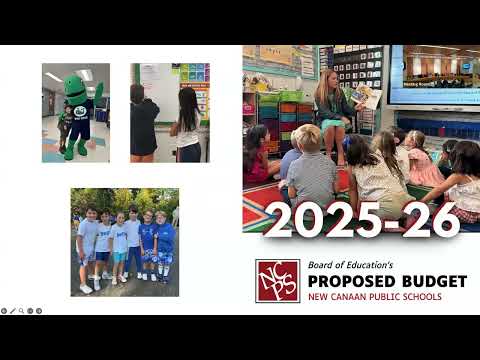
The New Canaan Town Council heard the Board of Education’s condensed fiscal 2026 budget presentation on March 18, with Superintendent Dr. Lutzky emphasizing student achievement and program investments while council members pressed the district to justify long-term staffing increases amid flat-to-declining enrollment.
New Canaan — The Town Council on March 18 heard a condensed presentation from the Board of Education on the proposed fiscal year 2026 school budget and questioned rising staff counts and long-term costs even as enrollment has fallen slightly.
Dr. Lutzky, superintendent of New Canaan Public Schools, opened the board’s 90-minute presentation by summarizing district priorities and recent results, saying the district’s students “outperformed all other students in the state” on the Smarter Balanced assessments in 2024 and pointing to growth in Advanced Placement participation and other programs.
The proposed budget seeks continued investments in student-facing programs and building security while funding operating needs. Lutzky and district staff described several items in the request: a new full-time classroom coach to expand a coaching pilot at elementary schools; a math interventionist at the high school to support students doubling up on math courses; continued funding for security upgrades and school resource officers; and ongoing investments intended to reduce out-of-district special-education placements over time.
Council members pressed the district on headcount and cost trends. One council member cited district figures showing enrollment of about 3,943 students for 2025–26 versus roughly 4,220 in 2015–16, while FTE staffing figures cited in the meeting were reported as higher now than a decade ago. That member said the numbers indicate enrollment down about 7% while staffing had increased by roughly 40%, and asked whether the district has a stopping point for adding positions.
Lutzky responded that staffing decisions are tied to student needs, special-education placements, insourced operations (for example, transportation and food service) and programmatic choices such as smaller elementary class sizes adopted after the pandemic. He said the district performs annual staff-utilization reviews, evaluates pilot programs, and tries to phase new positions in only where there is measurable impact. “I don’t believe that throwing more at something is the answer,” Lutzky said, adding that requests are meant to be incremental and tied to demonstrated results.
Special education and return-on-investment were recurring topics. The superintendent said about 19.8% of district expenditures go to special education and that, by developing in-district programs (including the literacy academy and other interventions), the district has reduced out-of-district placements and associated tuition costs. He and the assistant superintendent for pupil personnel cited a downward trend in unilateral out-of-district placements but acknowledged outplacement tuition rates continue to rise nationally.
The district also outlined efficiency efforts and line-item savings: switching bus fleets from diesel to propane (current net cost cited was about $0.69 per gallon after rebates), LED lighting retrofits and other energy measures that have reduced utility costs, and a self-insured employee health plan the district says has saved more than $10 million over seven years. Finance staff noted the district annually bids stop‑loss (reinsurance) contracts and monitors claims experience to set the internal services fund contribution.
On instructional measures, the board reported continued expansion of AP course offerings (29 AP courses in 2024 vs. 18 in 2011), an increase in AP tests administered (about 1,439 tests in 2024) and a large increase in the number of students taking at least one AP exam (559 students in 2024). District staff described coaching cycles that have worked with dozens of teachers per year and said coaching is intended as an in-class, job-embedded professional learning strategy, not a one-time workshop.
Council members raised implementation and cost questions about specific positions: campus monitors for building access and safety (district staff said these are largely retired police officers who control building entry and video monitoring), additional school-based coaches, and a proposed high-school math interventionist to replicate the writing-center model for math support. District staff said the interventionist pilot this year — an intern used to prove demand — attracted students and that a full-time FTE would allow more regular drop-in support and push-in small-group help in classrooms.
On federal and state funding, staff said federal grant appropriations for 2025 were largely secured by a continuing resolution in Congress, though Title II funding (professional development) was noted as the smaller line that carried some uncertainty (the district’s Title II allocation is roughly $70,000). State steps to shore up excess-cost reimbursement for special education were described as aligning the state grant base rather than adding a district-specific windfall.
Before the board’s presentation began, the council voted to table the Park Conservancy’s presentation to a later date. The motion to table was moved at the council’s request and passed unanimously.
The council did not take a final vote on the Board of Education budget during the meeting. Council members said they will continue follow-up questions and data requests; district staff offered to provide a written packet of additional responses and to meet with council members for detailed line-by-line review.
The meeting closed after additional capital and follow-up scheduling items were discussed.