Get Full Government Meeting Transcripts, Videos, & Alerts Forever!
Get email alerts on the Library Budget topic
No spam. Unsubscribe anytime.
Library officials tell council growth is straining operations; request 8% operating increase and long-term endowment strategy
Summary
Library leaders asked the Town Council for an 8% operating increase (about $291,000) for fiscal 2026, saying higher‑than‑expected visitation, more programs and staffing needs at the new McKinnon Library building are driving the request.
New Canaan Library leaders told the Town Council at its March 18 meeting that an unexpected, sustained rise in patron use and program demand has strained operations and prompted an $291,000 operating request — an 8% budget increase for fiscal 2026 — along with a continuing campaign to grow the library’s endowment.
“ We are, in a nutshell, victims of our own success,” Ellen Corvato, chief executive officer of the New Canaan Library, said during a 30‑minute budget presentation that expanded into more than an hour of council discussion. Corvato and Cheryl Capitani described sharply higher visitation and program demand at the new McKinnon Library building, and cited facilities and staff compensation as the primary drivers of the budget request.
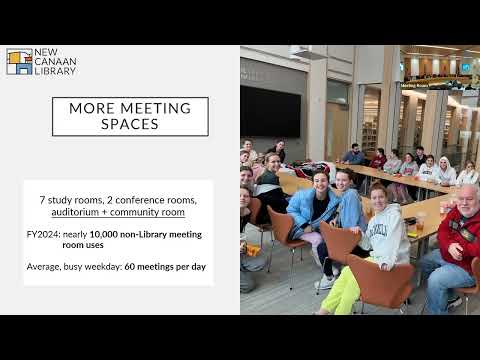
Library officials described recent usage metrics and program wait lists as evidence of the demand. Corvato said the new building is recording roughly 35,000 visitors per month — higher than peer libraries — and that children’s programming and meeting‑room demand have been especially strong. She told the council the library now operates 64 hours weekly and has 7 public meeting rooms and substantial open study space used by tutors and community groups.
Council members and trustees pressed library leaders on revenue opportunities, cost management and long‑term sustainability. Corvato said the library will continue to pursue philanthropy and growth of its endowment, calling the endowment the organization’s “answer” to sustained operating needs; the library completed a roughly $40 million capital campaign for the building and reported an outstanding line of credit reduced to approximately $1.7 million. “We need to have an endowment that throws off the kind of income that you're seeing at Darien and other places,” Corvato said.
The council and library explored several specific topics during the exchange:
- Digital collections: Library staff described the unusually high per‑title cost for ebooks and audiobooks under publisher licensing terms. “What would cost you $11 to buy on your Kindle costs us $60 to $75 for a single license that goes away in 2 years,” Corvato said, explaining that digital licenses are one license per user and often expire after a fixed number of circulations or two years. The library said some digital platforms charge per‑use subscriptions and that rising use has driven long wait lists.
- Program fees and room rentals: Council members asked whether the library should charge more for popular ticketed events and for recurring room use by tutors or small businesses. Library leaders described an existing rental policy, noted administrative overhead tied to rental operations, and said the library aims to keep meeting rooms accessible while enforcing a 90‑minute per‑day booking limit. “Keeping the spaces free and open…is appropriate,” Corvato said, adding the time limits reduce the likelihood that paid tutors could run full businesses from the rooms.
- Fundraising and endowment: Corvato and trustees said the board is focused on building an endowment large enough to produce sustainable operating income, with trustees citing endowment targets in the low eight‑figure range as a long‑term goal. The library reported it had increased philanthropic asks and that some programming is supported by restricted gifts; trustees and council members discussed the tradeoff between charging for events and preserving free access under state law.
- Parking and indirect economic impacts: Several council members noted that library events drive patronage downtown and noted potential knock‑on benefits to local businesses. Library leaders acknowledged both the economic benefit and the town’s interest in understanding longer‑term funding commitments.
No formal town council vote on the library budget occurred at this meeting. Council members from multiple bodies agreed to pursue a joint, six‑month review — involving the board of selectmen, board of finance, town council and the library trustees — to clarify expectations, funding assumptions and long‑term strategy. Robert Lowe, chairman of the library board, told the council he did not believe the library was “leaving money on the table” and described the organization as fiscally well managed.
The council closed the discussion by committing to continued, collaborative review of the library’s operating request and long‑range plan.