Get Full Government Meeting Transcripts, Videos, & Alerts Forever!
Get email alerts on the Wetlands Stormwater Subdivision Access topic
No spam. Unsubscribe anytime.
Applicant presses for shared-driveway plan; intervenors ask commission to treat subdivision as a ‘significant impact’ case
Summary
Brookwood Hills LLC on Monday presented revised plans for access, stormwater controls and wetland and buffer restoration tied to a proposed nine‑lot subdivision at Brookwood Lane while town staff and intervenors questioned whether the application should be treated as a “significant impact” filing that requires detailed alternatives analysis.
Brookwood Hills LLC on Monday presented revised plans for access, stormwater controls and wetland and buffer restoration tied to a proposed nine‑lot subdivision at Brookwood Lane while town staff and intervenors questioned whether the application should be treated as a “significant impact” filing that requires detailed alternatives analysis.
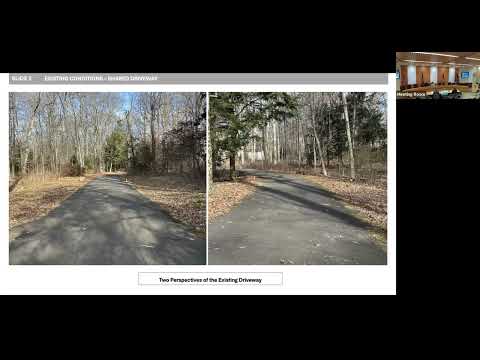
The applicant’s attorney, Amy Sabotakis of Ritchie Law Group, told the New Canaan Inland Wetlands Commission the submission relies on use of an existing 14‑foot paved driveway that would be widened in places and that the latest engineering revisions eliminate wetland loss. “We have 0 wetlands being removed and more than 17,000 square feet of wetlands being restored,” Sabotakis said, and the team later described additional restoration that raises the total above 20,000 square feet.
The commission opened a public hearing on the application (Inland Wetlands‑24‑43‑82, Brookwood Lane) and, after questions from members and intervenors, agreed to continue the public hearing to the commission’s regular meeting on April 7 so participants can review newly posted materials.
Why it matters
The application asks the wetlands commission to allow driveway improvements and related stormwater work that will serve five of the nine proposed lots. Intervenors contend the driveway and the subdivision are linked: the driveway’s approval would make construction of the nine houses more likely, and therefore the commission should consider the foreseeable impacts of the subdivision as a whole when deciding whether the regulated activities “may have a significant effect” under state and local wetlands law.
What the applicant presented
Attorney Amy Sabotakis led the applicant’s presentation and said the proposal uses the existing driveway and minimizes new disturbance. Project engineer Leonard DeAndrea described a revised layout dated March 14–18 that keeps most of the driveway at its present alignment, widens selected segments to 18 feet where needed for emergency access, narrows to 16 or 14 feet through tighter sections, and adds multiple stormwater treatment measures. DeAndrea said the design replaces most subsurface infiltration chambers with vegetated micropools, catch basins fitted with filter inserts, and vegetated swales to treat runoff along the entire driveway rather than only at widened sections.
Wetland scientist William (Bill) Kenny described habitat work in three main areas: restoration of a north‑site wooded wetland currently degraded by past debris disposal; removal of a piped watercourse and reestablishment of approximately 255 linear feet of open channel; and creation/vegetation of micropools and buffer meadow plantings adjacent to the drive. Kenny called the changes a net benefit to wetland function, saying the micropools are designed to infiltrate and “hold water for less than a day or 2,” and that, with maintenance, they should not convert to regulated wetlands.
Town staff and public‑safety input
Town Engineer Maria Coplett told the commission the revised drainage analysis meets New Canaan policy and that the micropools provide both pollutant control and habitat benefits. Coplett said catch‑basin inserts are an approved pretreatment measure and that the submission demonstrates adherence to the town’s standards.
Fire Marshal Paul Payne said the pond proposed as the source for a dry hydrant contains roughly 600,000 gallons and that, when drafted and piped to the roadway, the apparatus could pump “between a 1,500 gallons a minute.” After a site review, Payne said the fire department did not object to the proposal provided the turning and access arrangements meet the department’s needs.
Intervenors’ position and legal argument
A team led by SC Miner (Gigi Ma) and counsel Adam Blank and Patricia Sesto argued the commission should treat the filing as potentially a significant regulated activity. Blank summarized the legal framework for the commission: if an application “might” have a significant effect, the commission must treat it as a significant activity and require the applicant to demonstrate that there are no feasible and prudent alternatives or to submit feasible/prudent alternatives for the commission’s review. Blank urged the commission to consider future, reasonably related development (the nine proposed lots) when assessing cumulative impacts and alternatives.
SC Miner’s technical comments requested additional documentation and analysis that the intervenors said had arrived too recently for full review: (1) a written narrative to accompany the revised planting plan; (2) an ecological assessment of the revised drainage plan; (3) a wetlands assessment comparing the alternatives the applicant considered; and (4) a pollutant‑removal (pollutant‑remediation) analysis showing the stormwater measures’ performance. Patricia Sesto said the group could not complete a detailed review in the short time since the March 14 revised materials were posted and requested time to prepare written comments.
Items the commission and parties agreed to supply
- The applicant agreed to provide: (a) a clearer narrative of the planting/specification plan, (b) a written comparison of the alternatives considered, and (c) a pollutant‑removal summary for each proposed drainage measure. The applicant committed to post those materials for the record by March 31.
- The intervenors agreed to supply their detailed review of the current submission to the commission; intervenors indicated they would make a best effort to file substantive comments by March 31 (with revisions or supplements to follow as necessary) so the applicant and commission could receive comments before the April 7 meeting.
Commission process and next steps
Chair Angela Jameson said the commission expects the town attorney to attend the April 7 meeting to assist the commission in applying the statutory and regulatory decision tree for significant‑impact determinations. Commissioners and participants reiterated that the public hearing will remain open; the commission did not close or decide the application on Monday.
Votes at a glance
- Motion: Approve meeting agenda. Mover: Commissioner Beth Sanford; second: Commissioner Redden. Outcome: approved unanimously (all present voted aye).
- Motion: Approve minutes of the February 2025 meeting. Mover: Commissioner Philip Williams; second: Commissioner Redden. Outcome: approved (one abstention: Commissioner Katie Owsley; others in favor).
- Motion: Adjourn meeting. Mover: not specified in transcript; second: Commissioner Adam Ramirez. Outcome: approved unanimously.
What remains unresolved
Intervenors pressed the commission to apply the significant‑impact standard and to require clearer, written analyses comparing alternatives and quantifying pollutant removal. The applicant said it has reduced direct wetland impacts to zero on the driveway improvements and expanded wetland restoration; intervenors said more written documentation and time to review were needed before the commission could evaluate alternatives and cumulative effects. The commission set a continuation for April 7, 2025, so staff, parties and intervenors can exchange the requested materials and counsel from the town attorney can counsel the commission on the regulatory standard.
Ending
The public hearing remains open and will continue April 7; the applicant and intervenors agreed to upload additional materials and reviews before that hearing so the commission can consider written evidence and legal guidance alongside the technical testimony already given.