Get Full Government Meeting Transcripts, Videos, & Alerts Forever!
Get email alerts on the Community Power Withdrawal topic
No spam. Unsubscribe anytime.
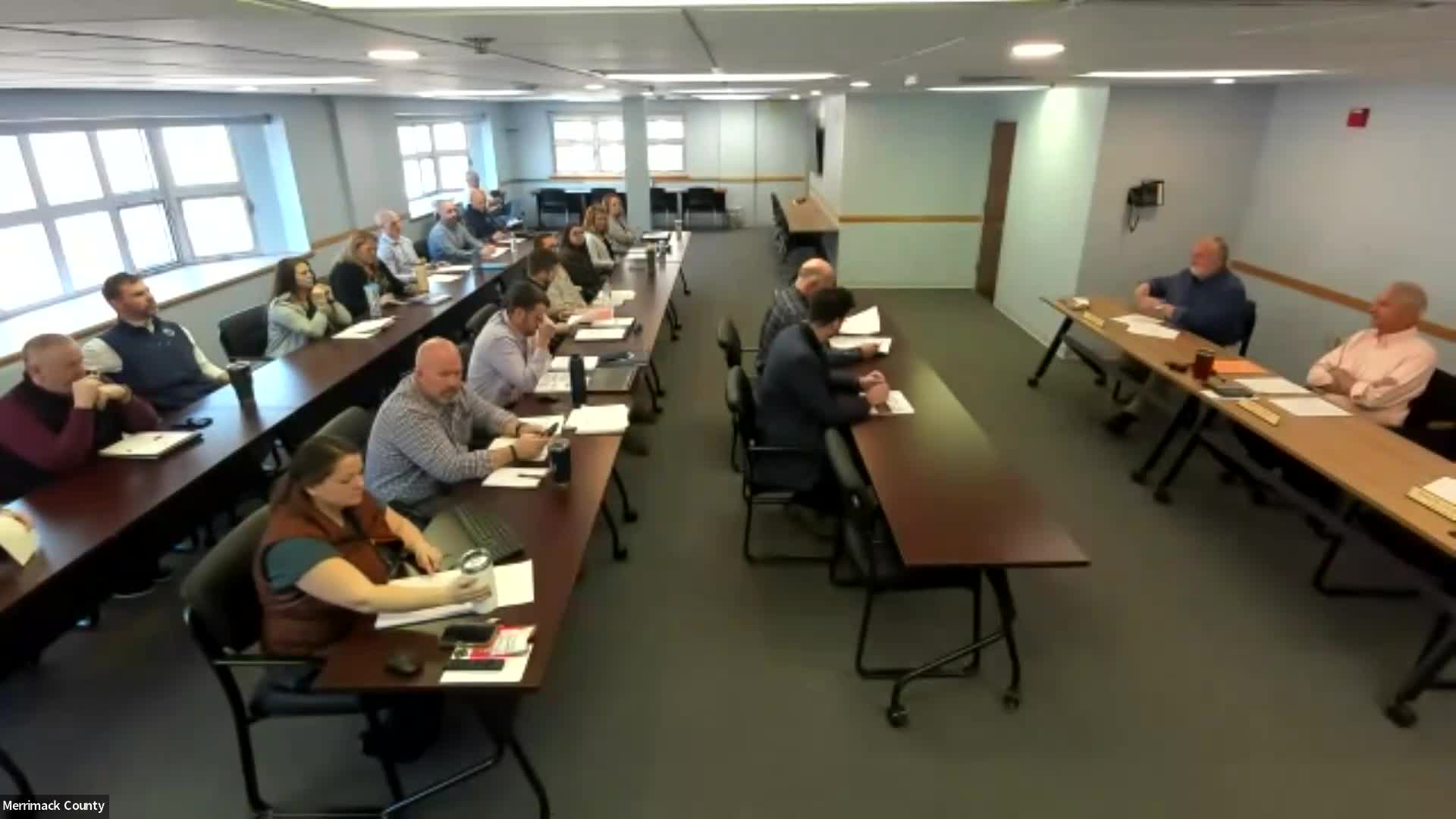
Merrimack County Commissioners approve Wilmots withdrawal from community power program
Summary
The county commissioners voted to approve a resolution directing Merrimack County Community Power (CPCNH/MCCP) to return Wilmot customers to utility default service after town voters approved withdrawal. Presenters from Merrimack County Community Power outlined timeline, customer counts and financial impacts.
Merrimack County Commissioners on a voice vote approved a resolution authorizing Merrimack County Community Power (MCCP/CPCNH) to process the withdrawal of the town of Wilmot and return Wilmot customers to their utility default service.
Community Power representatives Andrew (Community Power presenter) and Jackson (Community Power presenter) told the commissioners that Wilmot voters answered a warrant question at town meeting asking the select board to withdraw the town from default participation in Merrimack County Community Power, and the Wilmot select board subsequently requested withdrawal. The presenters said they had worked with Wilmot officials, including Town Administrator Megan Bowley, and that Wilmot had adopted a resolution directing the select board to notify the county.
The presenters outlined an expedited timeline they said would allow affected Wilmot accounts to be returned to the utilities for the June meter reading if the county moved quickly. They told the commissioners their preliminary customer counts were 632 New Hampshire Electric Co-op accounts and 27 Eversource accounts, which together corresponded to 571 unique service addresses. Andrew said MCCP had postcards ready to notify affected customers and that customers previously received an enrollment notice and had a prior opt‑out opportunity.
Presenters described winter weather and wholesale market volatility as the main cause of recent price pressure for community aggregation rates, noting co-op rate moves in March and a tight market following the second-coldest winter in 25 years. They said MCCP's rates reset every six months and that the next reset would take effect in August.
On the financial impact, presenters said Wilmot represented roughly 8% of MCCP accounts (659 of 8,779 in the coalition), and that the cost of withdrawal was modest and absorbable by MCCP operations. They said any net margin associated with Wilmot would be reallocated to remaining MCCP customers per the coalition's cost-sharing approach and that the exit would not change rates charged to participating Merrimack County customers.
County Administrator Cunningham and Community Power staff discussed next steps: if commissioners approved the resolution the county would instruct CPCNH to notify utilities (primarily NH Electric Co-op), finalize a list of active customers, and mail postcards to affected addresses. The Community Power presenters said they expected the co-op could reabsorb Wilmot customers for the June meter read if notices and utility coordination proceeded on the proposed schedule.
Commissioners moved and seconded the proposed resolution to allow Wilmot to withdraw from Merrimack County Community Power. The motion passed by voice vote; the minutes record a voice vote as "aye" with no roll-call tallies provided.
Commissioners and presenters also discussed related longer-term work: MCCP staff said they planned amendments to the electric aggregation plan to allow future participating municipalities more utility-selection optionality (for municipalities served by more than one utility) and that House Bill 760 — described by presenters as legislation related to this sector — had been tabled in the New Hampshire House at the time of the meeting.
The county's action authorizes MCCP to proceed with customer returns and with reallocating margins as specified in the CPCNH cost‑sharing/joint agreements cited by the presenters. The commissioners did not vote on any rate-setting changes; presenters said rate impacts to remaining participating communities would be negligible and that timeline and utility coordination would determine when customers move back to utility service.
Sources and caveats: presenters said some details (exact customer lists, final timing) would be finalized after the MCCP board of directors adopted the recommended steps; they repeatedly described the timeline as contingent on utility processes and timely adoption by MCCP's board of directors.
Ending: County staff and MCCP said they would proceed as directed and notify affected customers, and MCCP representatives left the meeting after the vote.