Get Full Government Meeting Transcripts, Videos, & Alerts Forever!
Get email alerts on the Emergency Medical Services topic
No spam. Unsubscribe anytime.
Emergency Medical Care Committee outlines EMS shortfalls, asks board for next‑step support
Summary
The EMCC identified recruitment/retention, training, communications and dispatch gaps in Inyo County’s EMS system and recommended subcommittees and county staff support to develop detailed plans and cost estimates for short‑, mid‑ and long‑term improvements.
An Emergency Medical Care Committee (EMCC) subcommittee presented a countywide needs assessment and initial recommendations to Inyo County supervisors, describing recruitment, training, communications, dispatch and equipment shortfalls across the county’s largely volunteer emergency‑medical system.
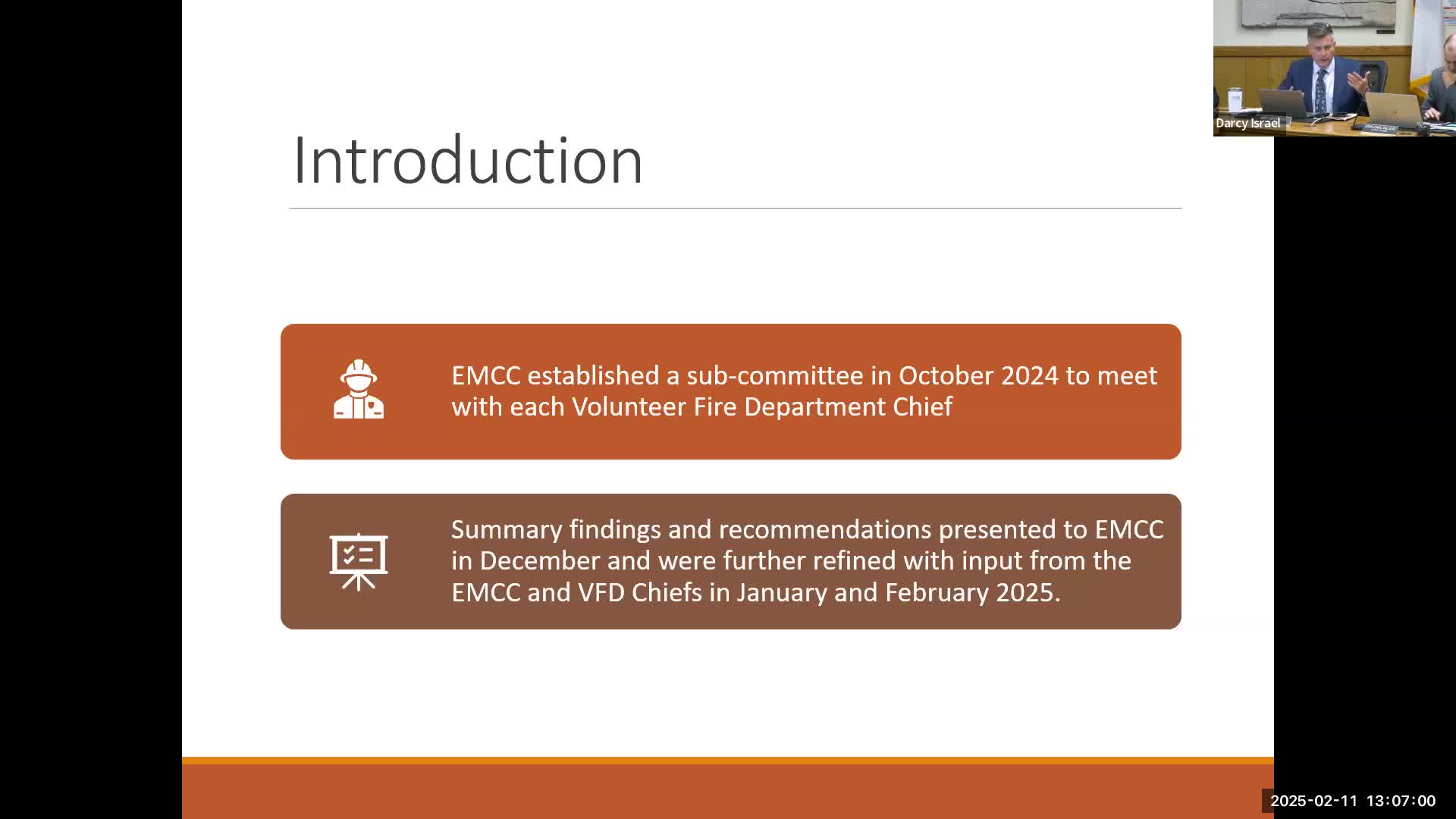
Anna Scott of Inyo County Health and Human Services introduced the workshop and said the EMCC had formed a subcommittee that met with fire and EMS chiefs to gather current status information. EMCC Chair Pete Schleaker (Big Pine volunteer fire) emphasized the county’s large geography—more than 10,000 square miles—and said most paramedics are concentrated in urban areas, leaving rural communities with limited advanced care.
Presenters from the EMCC and contracted ambulance providers described priority needs in three time horizons. Immediate and mid‑term needs (within one to three years) included increasing volunteer EMT recruitment and retention; adopting centralized credential tracking and charting platforms; implementing emergency‑medical‑dispatch (EMD) or contracting for EMD to triage calls and provide pre‑arrival instructions; improving mutual‑aid agreements; standardizing continuing education and clinical quality‑management (CQI) and ensuring biomedical equipment is inspected and documented. The committee also recommended looking at a quick‑response advanced life‑support vehicle for southern Owens Valley, generators and resilience upgrades at fire stations, and centralized scheduling and rev‑cycle/billing support to reduce administrative burdens on volunteers.
Lisa Davis and Mike Patterson, clinicians with Global Medical Response, emphasized training, clinical quality review and daily revenue‑cycle monitoring to make sure charting supports reimbursement and that volunteers receive ongoing education. Davis described her deployment to a recent North Carolina disaster response and said strong communications and EMD were vital there; she urged countywide attention to radios, EMD and sheltering plans for incoming mutual‑aid teams.
Chiefs and supervisors discussed immediate steps. Supervisors asked staff to help FACILITATE subcommittee work and recommended the EMCC produce clearer, prioritized options and cost estimates. Several supervisors urged the county to work on radio interoperability and dispatch improvements, noting the county has previously explored repeaters and trunked systems. EMCC members said some actions can be taken without large capital outlays—centralized virtual training, credential tracking and vendor‑provided rev‑cycle services were examples—while other items (countywide dispatch, sustained funding) would require broader political and financial planning.
The board asked staff to coordinate with the EMCC on next steps, create focused subcommittees, and bring more detailed implementation options and price estimates back to the board for funding and policy decisions. No formal action was taken at the workshop; staff and EMCC said they would return with proposals and clearer scopes for the board to consider.