
ACE Fund board outlines $5.65 million in near-term spending, names contractors and faces assembly questions about oversight
Get AI-powered insights, summaries, and transcripts
Subscribe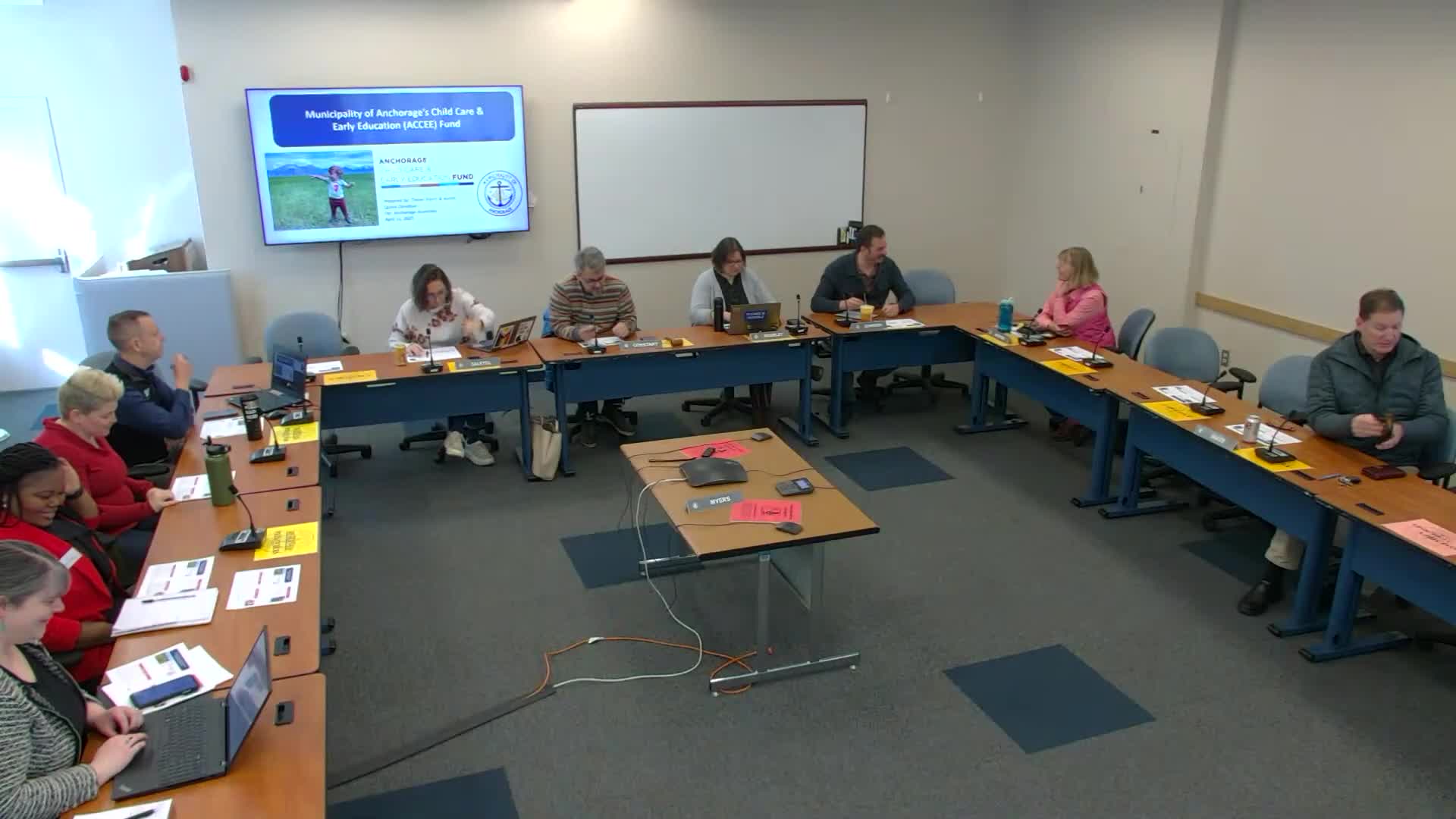
Summary
At a work session, the Anchorage Childcare and Early Education (ACE) Fund board described three near-term programs totaling about $5.65 million, identified lead contractors for two programs, and answered assembly questions about eligibility, contractor authority and a one-off capital award for Little Bear’s Playhouse.
The Anchorage ACE Fund board presented a status update to the Assembly on its first six to seven months of work, describing three discrete funding streams — early educator childcare subsidies ($1.25 million), operational assistance grants ($2.4 million) and pilot projects/capital grants ($2 million) — and naming contractors the board has selected to implement two of those programs.
The update matters because the ACE Fund will spend public dollars intended to stabilize Anchorage’s early-childhood workforce and expand child-care capacity, and Assembly members pressed the board and administration on contract terms, eligibility rules and how one capital award was advanced outside the board’s planned competitive process.
“These are public dollars. They have trusted us when they voted for this,” Trevor Storrs, chair of the ACE Fund board and a staff member at the Alaska Children’s Trust, said as he outlined the board’s work on program design, outreach and transparency. Storrs said the board meets monthly, is fully staffed with nine members and has prioritized getting money out quickly while planning a longer-term strategic investment strategy for the 2026 budget.
The board described three programs that were included in the municipal 2025 budget and are now moving toward implementation. Early educator childcare subsidies: the board reported a program allocation of $1,250,000, with about $1,027,000 estimated to be paid directly as subsidies and roughly 17–20% allowed for contractor administration, outreach and related personnel costs. The board said it issued a request for proposals and that the recommended contractor is Alaska Family Services; that recommendation has been forwarded to the Assembly but had not been approved by the Assembly at the time of the work session.
“This program actually isn't a grant program. It's providing childcare assistance, essentially, to individuals who work in the childcare sector,” municipal staff member Tamaya said, explaining that Alaska Family Services would pay providers on behalf of eligible workers and that eligibility rules will require recipients to work and reside in the municipality. Tamaya said the contract will require direct services to be available at Alaska Family Services’ Anchorage office even if some administrative work is performed from the MAT-SU area.
Operational assistance: the board said $2.4 million is allocated to operational assistance for providers and that the organization Thread was selected as the contractor to administer that program. The board described the operational assistance funding as intended to stabilize providers and support staff retention; selection of Thread, the board said, was based on the organization’s prior experience administering similar funds during COVID and for state programs.
Pilot projects and capital grants: the board identified $2 million as available for pilot projects and capital grants, with the split to be determined by proposals received. The board warned pilot projects may be difficult to execute this calendar year because of routine municipal budget timing and grant-expenditure deadlines.
Assembly members and administration officials raised several oversight questions. Assembly member Meg asked whether the board would offer policy recommendations in addition to funding allocations; Storrs said the board expects strategic planning to include policy work and to advise the Assembly and administration. Several assembly members expressed concern about a draft contract term described in the briefing that would let contractors design application and eligibility processes, and asked for clearer checkpoints between the board, administration and the Assembly before multiyear or open-ended contracts are finalized.
“I can't guarantee money,” an Assembly speaker said when the board discussed projects that would still need to go through competitive processes; the speaker emphasized that awards made through a competitive RFP cannot be stated as certain until the RFP is complete and the Assembly acts.
The administration explained why one capital award was advanced ahead of the board’s full process. Steve Paulsy, chief administrative officer for Anchorage Municipality, said an administration amendment proposed early funding for Little Bear’s Playhouse in Girdwood because the center has an “impending and real” capital need and that the administration believed the project would have scored highly in any RFP. Paulsy described the award as a one-time early edge allocation that the administration expects will be discussed as part of first-quarter budget revisions.
Board staffing and leadership: the board said it is proposing to extend a contract with Austin Quinn Davison, the current ACE Fund contractor and support staffer, for 12 months to serve as an interim executive director while the board completes strategic planning and develops a permanent executive-director job description. The extension would be a municipal contract subject to Assembly review and appropriation.
The board and administration committed to improve communications with the Assembly. The ACE Fund will offer regular calendar invites and quarterly briefings to the Assembly’s committees, and the board said the mayor will meet with the board at least annually ahead of budget season to coordinate priorities.
Next steps include the board’s strategic planning work, the administration’s presentation of any contract awards or first-quarter budget amendments to the Assembly, and the board’s planned development of eligibility criteria, monitoring and evaluation approaches for the subsidy program. Board members and staff said they expect to return to the Assembly with more detailed contract terms and performance metrics before multiyear commitments are made.
The ACE Fund board’s near-term allocations total about $5.65 million across the three programs described at the work session; larger decisions about how the full ACE Fund corpus will be invested and whether funding becomes recurring will be part of the 2026 budget and a forthcoming strategic plan, the board said.