Get Full Government Meeting Transcripts, Videos, & Alerts Forever!
Get email alerts on the Public Access topic
No spam. Unsubscribe anytime.
Walton Dunes beach access draws residents’ opposition and calls for ADA improvements; commissioners defer pending court opinion
Summary
Dozens of residents packed the Walton County Freeport Annex on March 25 to oppose conversion of Walton Dunes beach access into a larger regional access; county staff presented a plan with limited parking, a small bathhouse and ADA access, and commissioners deferred action pending a site visit and a court opinion.
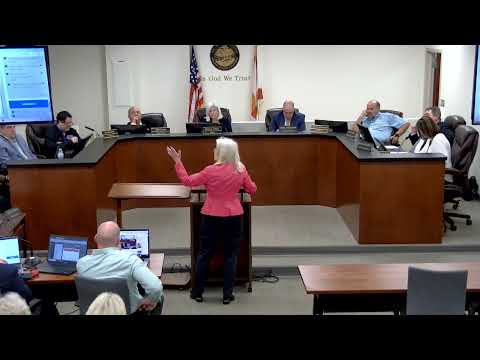
Walton County’s planned improvements at the Walton Dunes neighborhood beach access prompted extended public comment and a lengthy presentation by county beach operations staff at the March 25 Board of County Commissioners meeting. Residents and property owners urged the board to treat the site as a neighborhood access and not convert it into a larger “regional” beach access with expanded parking and amenities; others urged adding ADA access and a modest bathhouse to serve neighborhood needs.
Brian Kellenberger, Walton County director of beach operations, reviewed the most recent design concepts developed after multiple public meetings and reviews. The plan Kellenberger presented would place 11 parallel parking spaces and three handicap spaces along the roadway, an 11‑space low-speed-vehicle (LSV) lot, a bike-parking plaza (initially ~24 racks expandable to ~50), a small bathhouse with gendered fixtures and accessible stalls, and a mountable‑curb roundabout/turnaround so emergency vehicles can negotiate the dead‑end road. Kellenberger said the project footprint remains landward of the coastal construction control line (CCCL) and that the bathhouse and boardwalk were sited where dune degradation already had occurred. The county has begun BLM review because the parcel was conveyed by the Bureau of Land Management under a Recreational Public Purposes conveyance.
Many nearby residents opposed the plan’s scale and its potential effects on traffic, noise, and dune integrity. Speakers said the access functions primarily as a walk/bike access for a large neighborhood, they noted existing auxiliary county parking nearby, and they suggested alternatives: extend the existing sidewalk, add a dedicated ADA pathway and a modest drop‑off or enhanced ADA unloading area, or consider purchasing an adjacent flat lot that is for sale and sits between the auxiliary parking and the beach as a location for amenities and restrooms. Nursing‑home staff and family members urged special attention to emergency-vehicle access and pedestrian crossings because residents use wheelchairs and electric mobility devices.
The commission did not take a final action to alter the design. Several commissioners asked to visit the site and said they wanted to review the record and await a pending court opinion involving the access before making a decision. County counsel said an opinion from the circuit court on earlier DRI/ZBA litigation was outstanding; commissioners agreed to defer further board action until they had inspected the site and seen the judge’s ruling. The board directed staff to coordinate a site visit and to bring further materials back to a future meeting for deliberation.