Get Full Government Meeting Transcripts, Videos, & Alerts Forever!
Get email alerts on the Criminal Justice Coordinating Council topic
No spam. Unsubscribe anytime.
Yakima County commissioners consider restarting Criminal Justice Coordinating Council and seeking outside technical help
Summary
Commissioners discussed restarting a dormant local Criminal Justice Coordinating Council to improve system coordination, consider hiring a director, and ask the Law and Justice Committee to study technical-assistance options and possible 2026 budget funding.
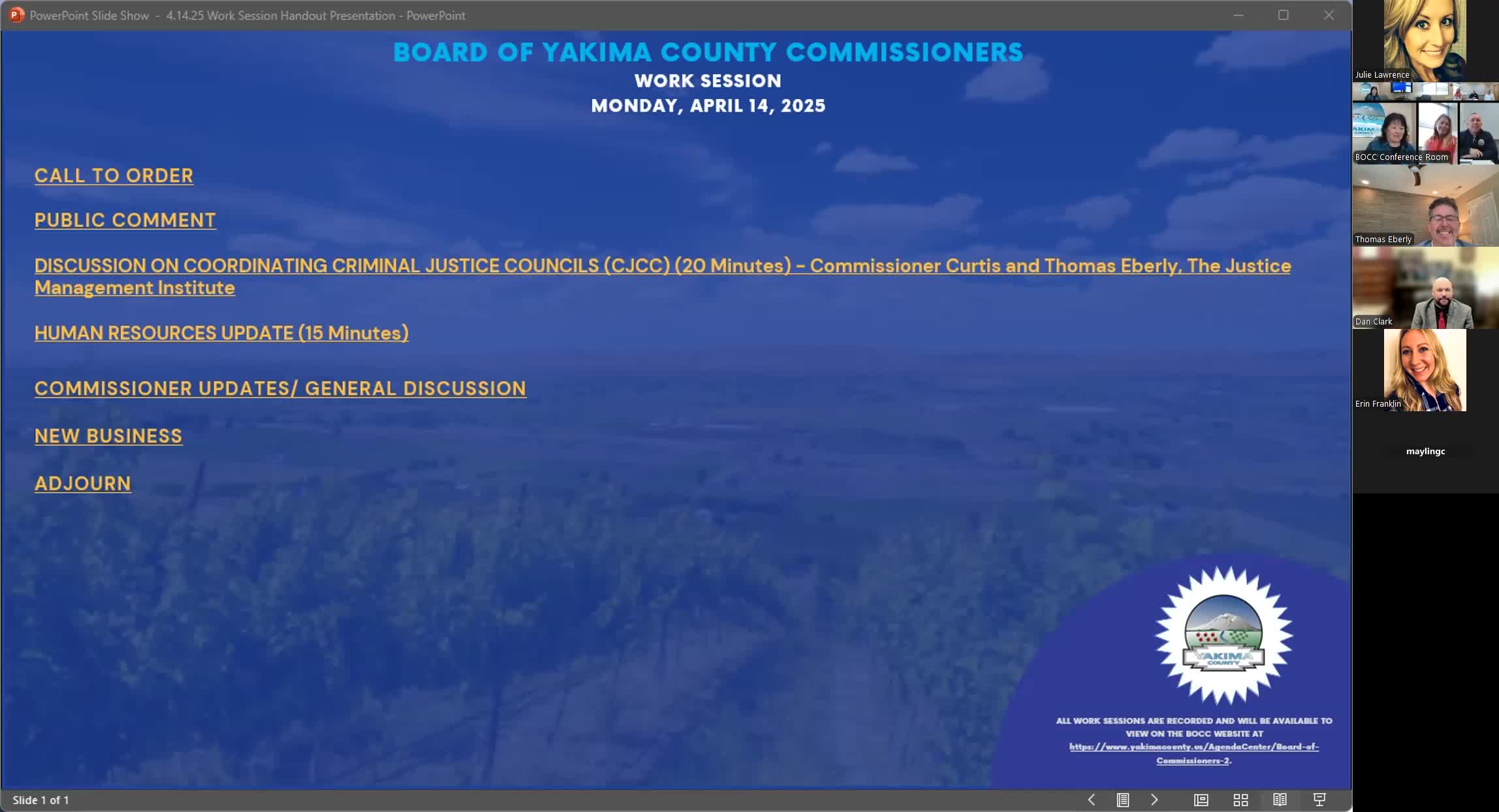
Commissioner Alicia Curtis asked the Yakima County Board of Commissioners on April 14 to ask the county’s Law and Justice Committee to review restarting the county’s local Criminal Justice Coordinating Council and to consider bringing in outside technical assistance and a dedicated staff director.
Curtis said the county’s enabling state statute (recorded in the presentation as “RCW 07/1100”) gives counties authority to establish a local law-and-justice council and appoint representatives. "It remains about 82%, 83% of our budget goes to law, justice, and public safety," Curtis said, arguing that a coordinating council could help identify efficiencies and coordinate work across agencies.
The request followed a presentation by Tom Eberle of the Justice Management Institute (JMI), who described national standards and a technical-support model JMI and the National Institute of Corrections have developed for high-performing CJCCs. Eberle said CJCCs are typically advisory bodies that bring together key justice decision-makers — for example, a sheriff, prosecutor, public defender, presiding judge, county commissioner and behavioral health director — to review data, identify priorities, and pursue system improvements. "A lot of these CJCCs don't have any power... it's really advisory," Eberle said, adding that the council’s value is in aligning leaders and identifying where limited local dollars should go.
Commissioners asked how a CJCC would operate given state law, and whether the council could feed policy recommendations to the state legislature. Eberle said the council could identify legislative objectives but emphasized its advisory role to elected county leaders: "Ultimately, it's advising the board of county commissioners," he said. Commissioner Lindy noted some overlap with the county’s existing internal Law and Justice Committee but said the CJCC would be broader: "The law and justice committee is strictly an internal one for the county, whereas [a CJCC] could be used to collaborate with other entities such as city police departments and jails," Lindy said.
Eberle described common CJCC outputs found nationwide: bylaws, a strategic plan based on data, committees/work groups focused on priorities (behavioral health, diversion, pretrial release, records management, etc.), and a paid director to staff and drive implementation. He said typical technical-assistance projects run roughly 12 months and argued a dedicated director was critical to prevent councils from "languishing." He cited survey results JMI collected that found high rates of perceived improvement in communication and system efficiency among council participants.
Commissioners said they were willing to refer Curtis’s proposal to the Law and Justice Committee for study. No formal board vote to hire a director or approve funding was recorded at the work session; Curtis asked that the Law and Justice Committee consider whether to recommend technical assistance and to, if appropriate, include funding in the county’s 2026 budget.
Commissioners also requested follow-up materials: JMI agreed to send the national standards, model bylaws and a list of network member counties for the board’s review.
The discussion was presented as an initial, exploratory step — the next formal action, if any, will come after the Law and Justice Committee reports back with recommendations.