Get Full Government Meeting Transcripts, Videos, & Alerts Forever!
Get email alerts on the Comp Plan Eastsound topic
No spam. Unsubscribe anytime.
Council hears land‑capacity analysis for Eastsound; planners propose rezones and UGA expansions to meet affordable‑housing targets
Summary
Consultants and county planners presented a land‑capacity analysis showing a 227‑unit shortfall in Eastsound for households at 0–80% area median income. The county proposed a mix of up‑zones and urban growth area expansions that together would create capacity to meet the target with a modest surplus.
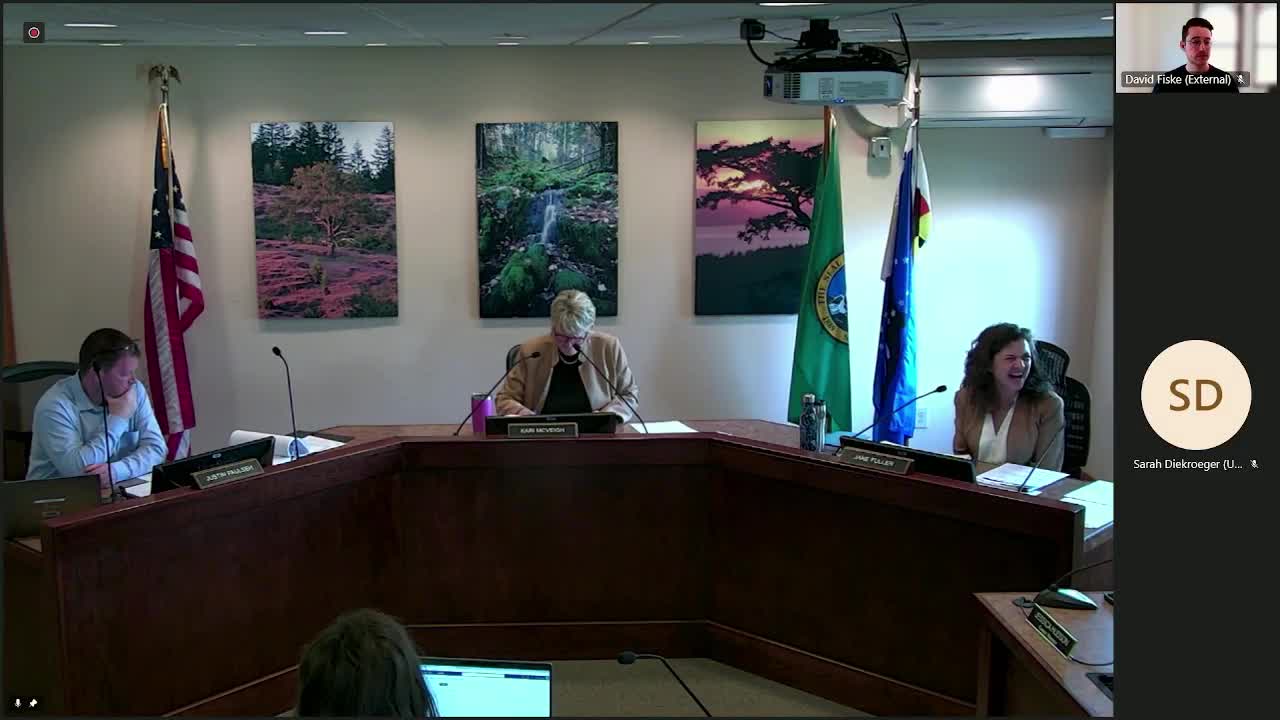
Sofia Kesem, long‑range planner in San Juan County’s Department of Community Development, and consultant David Fisk (Leland Consulting Group) briefed the County Council on draft land‑use amendments and official‑map updates tied to the comprehensive plan update.
Fisk summarized a county land capacity analysis that, he said, shows an adequate capacity countywide but a deficit within the Eastsound urban growth area (UGA). “There was a deficit of unit capacity for the lower income bands, that 0 to 80% area median income,” Fisk said, identifying the deficit as 227 units.
Why it matters: The Growth Management Act (GMA) and state guidance require counties to identify enough land and zoning capacity to meet locally assigned housing targets. For San Juan County the consultants concluded Eastsound cannot meet the lower‑income target through existing zoning alone; the county will need a combination of higher densities and UGA expansion to comply with its assigned targets.
Proposals and numbers: Fisk and staff explored three potential UGA expansion areas plus a series of targeted upzones inside the UGA. Their analysis used density assumptions informed by adjacent neighborhoods and a property owner in the northeast parcel (an affordable‑housing owner that may support housing outcomes). The draft capacity estimates presented to council were: - Northeast expansion area (Area A): estimated 107 units at 0–80% AMI using an assumed 6 units/acre density on sites with affordable‑housing potential. - Southern upzone (adjacent to an ER‑412 zone): additional capacity estimated at 39 low‑income units. - Village commercial density changes and selected parcel upzones (VC/VCL min density increases and specific parcels): an additional combined ~48 units (28 + 20 in separate proposals in the presentation). - West/Blanchard Road expansion (Area C) and a contiguous parcel (Area B) were also assessed; Area B was estimated at ~40 units and Area C at ~44 units under the upzone assumptions.
Combined outcome: Fisk reported that combining the proposed upzones and one or more expansion areas would meet the 227‑unit shortfall; the set of all proposed changes produced roughly 278 units of capacity in the consultant’s model, a surplus of about 51 units above the target.
Constraints and follow up: Consultants and staff noted several constraints that will require further study before any map or code changes are adopted. Those include transportation access and seasonal flooding on some roads, utilities capacity checks (Sofia said she had spoken preliminarily with Eastsound Sewer & Water and OPALCO and planned further follow‑up), and environmental constraints. Department staff said preliminary contacts indicated no immediate utility prohibitions for the proposed expansion parcels but that full confirmation is pending. Washington Department of Fish and Wildlife submitted a comment noting a possible great‑blue‑heron habitat mapped on one development parcel; Fisk said the habitat mapping is older and that further site study would be needed to determine development constraints.
Council direction and next steps: Council members asked detailed questions on infrastructure, the suitability of Lopez Village (consultants said Lopez would not help Eastsound’s targets because markets and geography operate separately), and timing. Council members generally supported further exploration of the northeast parcel (Area A) because of the owner's housing development potential, but also urged including Areas B and C to avoid putting “all eggs in one basket.” No formal map amendments were adopted at the meeting; staff and consultants left the council with recommended changes to carry forward for public review and planning‑commission hearings. Sofia Kesem said the planning timeline remains on track to finish edits and return revised drafts in May–June for further review.
Ending: David Fisk asked the council for direction on which map expansions and upzones to move forward for formal public hearings; council members signaled support for a package that includes the northeast parcel plus at least one other expansion or targeted upzone area, and asked staff to complete utilities and environmental follow‑up before the next formal docketing step.