Get Full Government Meeting Transcripts, Videos, & Alerts Forever!
Get email alerts on the Regional Wastewater topic
No spam. Unsubscribe anytime.
Nash County hears update on proposed Southern Nash regional wastewater system; PER underway
Summary
Brian Johnson of Wooten Company told the Nash County Board of Commissioners on March 24 that the preliminary engineering report for a proposed Southern Nash regional wastewater system is under way with $400,000 in state DWI planning funds and that a tentatively sized plant would be about 1.99 million gallons per day.
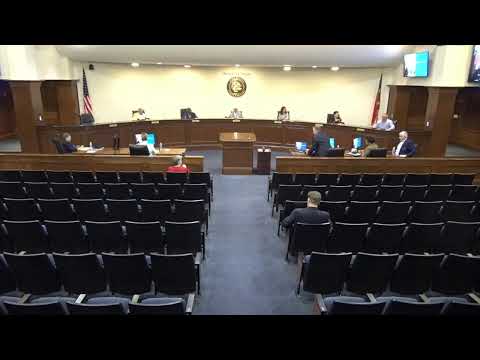
At a March 24 special meeting the Nash County Board of Commissioners received an informational update on the Southern Nash regional wastewater study. Brian Johnson of Wooten Company reviewed background, the preliminary engineering report (PER) work now under way, permitting and potential governance options, and warned the board the project will require large capital funding.
Johnson said the county received $400,000 in planning funds from the state Division of Water Infrastructure (DWI) to advance the PER. He described a tentative plant capacity of about 1,990,000 gallons per day and said the most recent capital estimate for the larger-capacity design is "we're in the neighborhood of 95 to a hundred and 15,000,000 right now is where things sit," reflecting inflation and the larger sizing compared with the prior 1.5 MGD study alternative.
The consultant described the preferred alternative from the earlier regionalization feasibility study: a new wastewater treatment plant along the Tar River serving the towns of Bailey and Middlesex, the Middlesex Corporate Park and potentially Spring Hope. Johnson said conveyance lines would pump wastewater from Middlesex to Bailey and then to the proposed plant along the Tar River; the scheme was presented as confined within Nash County boundaries.
Johnson outlined regulatory and technical constraints that must be resolved in the PER: nutrient load limits for the Tar-Pamlico River Basin (total nitrogen and phosphorus), the need to secure nutrient credits (ideally through the Tar-Pamlico River Basin Association), and an "interbasin transfer" limit of 2,000,000 gallons per day that influences the sizing decision (the proposed 1.99 MGD keeps the project under that threshold). He said Tar-Pamlico credits are available now but that the association's rules are being updated and that joining the association would likely require a formal vote by existing members and could include back charges.
Johnson presented two governance options the study is evaluating: forming a water and sewer authority under state law (requires resolutions by members and articles of incorporation) or creating a metropolitan sewerage district (which may require petitions and action by the Environmental Management Commission). He said both forms permit user rates, assessments and bonds; the district option can also assess taxes and issue general obligation bonds in some circumstances.
Board members pressed staff and the consultant on funding and allocation. Commissioners asked whether only the customer entities (Bailey, Middlesex, Spring Hope and the county/school) would pay directly and whether other Nash County taxpayers would be responsible for project debt. Johnson said the typical model is that the entity would charge wholesale/bulk rates to those customers and that nonusers in other parts of the county would not receive bills. He also said there remains a possibility of county seed money or other county participation that would affect broader fiscal exposure if the board chose to provide it.
Johnson also discussed an interim plan for a new school at the Middle School site: the existing small package plant (about 15,000 gpd) would be replaced by a larger interim package plant of roughly 30,000'40,000 gpd to serve the school until the regional plant is built. He said the state (DEQ) indicated permitting that interim plant should not be a problem.
Timeline items in the presentation called for finalizing preferred alternatives and component sizing in May, completing the financial analysis and a governance recommendation in June, and wrapping the PER in July for submission to DWI. Johnson said DWI review and concurrence could extend through fall 2025; construction, permitting and all steps could make an optimistic schedule 3 years and a longer schedule 5 years from approval.
Several commissioners voiced caution about committing county funds or signing resolutions before the PER's financial analysis is complete; Commissioner Davis said he would not support a resolution without clearer cost splits and consequences. Commissioner Howell and others emphasized the regional aspect and said the project is needed to lift a more-than-20-year moratorium in Bailey and support economic development at the Middlesex corporate park.
County staff and Johnson agreed to provide regular updates. The consultant and staff were asked to continue the PER work, refine cost and governance options, and return to the board with updated materials; the county's regional wastewater committee meets in April and the PER work will continue concurrently with funding and governance outreach.