Get Full Government Meeting Transcripts, Videos, & Alerts Forever!
Get email alerts on the Transit topic
No spam. Unsubscribe anytime.
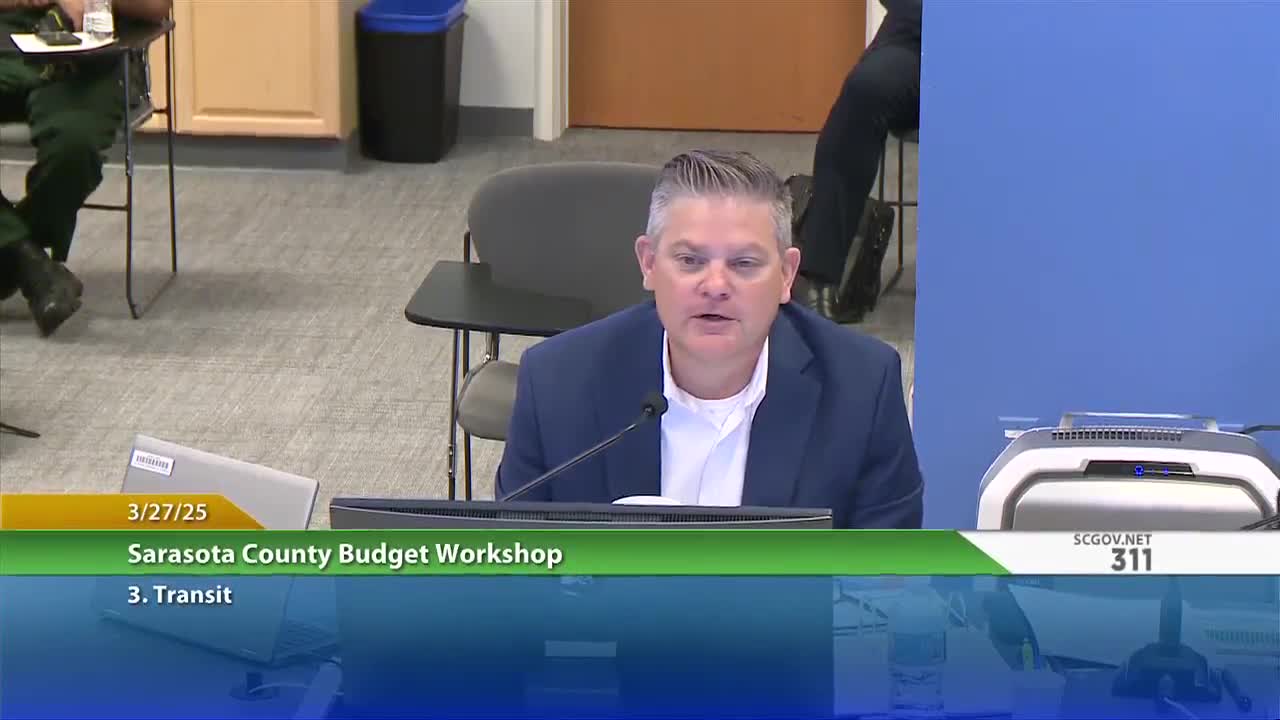
Board authorizes distance‑based on‑demand transit fares; sets $3 base fare and retains $1.50 TD discount
Summary
After staff presented several fare options and financial projections, the Board approved a distance‑based fare package with a $3 base fare, a mileage surcharge with a cap, and retained a $1.50 fare for transportation‑disadvantaged riders; staff will prepare the ordinance/resolution for advertisement and public hearing.
Sarasota County commissioners on March 27 voted unanimously to advance a fare plan for the county’s On‑Demand transit zones that combines a $3 base fare with a distance‑based surcharge and a capped maximum charge, and retains a $1.50 flat fare for riders certified as transportation‑disadvantaged.
Transit Director Jane Grogg told the board the on‑demand service has grown rapidly since its 2021 launch — ‘‘we have had wonderful growth in this service. Over a million rides served since we started in 2021’’ — and that the program’s diversity of riders includes many households at or below area median income. Grogg said staff analyzed roughly a dozen fare concepts and is proposing a hybrid distance‑pricing concept with incentives for shared trips and a small cap for very long rides.
Key elements adopted: the board directed staff to draft a resolution for advertisement reflecting a base fare of $3 (for general riders), a capped per‑mile surcharge after an initial distance threshold (staff modeled a cap near six miles), and a retained transportation‑disadvantaged (TD) flat fare of $1.50. The adopted direction also includes an add‑on discount for additional riders booked together (a companion fare) to encourage shared trips.
Financial context: staff reported current fare collections cover roughly 11–12% of On‑Demand operating costs (about $600,000 in fares in FY‑24). Staff modeled scenarios suggesting revenue could increase substantially under higher base fares and distance charges; one projection shown to the board estimated revenue in the $900,000 range under certain assumptions, though staff warned of rider elasticity (some riders may reduce trips if fares rise). Staff also noted federal COVID‑related grants have been used to subsidize transit and that grant funding is approaching exhaustion (roughly $1 million of COVID grant funds remain across programs).
Motion and vote: Commissioner Kutzinger moved to adopt the staff’s combined distance‑pricing and rider‑discount concept (the board labeled it Concept 4) with the modification that the base fare be set at $3; Commissioner Mast seconded. The motion passed unanimously (Commissioners Cuttsinger, Knight, Mast, Smith and Kutzinger voted yes). The board’s vote authorized staff to prepare the formal resolution and advertisement leading to a required public hearing before any fare change takes effect.
Operational notes: Grogg said the county and its contractor monitor availability metrics weekly and that transportation‑disadvantaged riders can prebook trips. Kim Radke added that some federal grants used to subsidize operations require matching funds and are fungible only within program rules, which affects how much ongoing subsidy the county can sustain after grant funds sunset.
Next steps: staff will draft the proposed resolution and the required advertisement for a public hearing; the board will have a chance to adjust rates at the advertised public hearing before any change is adopted.