Get Full Government Meeting Transcripts, Videos, & Alerts Forever!
Get email alerts on the County Budget topic
No spam. Unsubscribe anytime.
Sarasota County keeps millage assumption flat as state legislative changes threaten local revenues
Summary
County officials presented FY‑24 results and a preliminary fiscal‑year‑26 outlook, asking the Board to hold its millage‑rate assumption steady while staff watches multiple state proposals — including a proposed sales‑tax cut and study of property‑tax elimination — that could change county revenue projections.
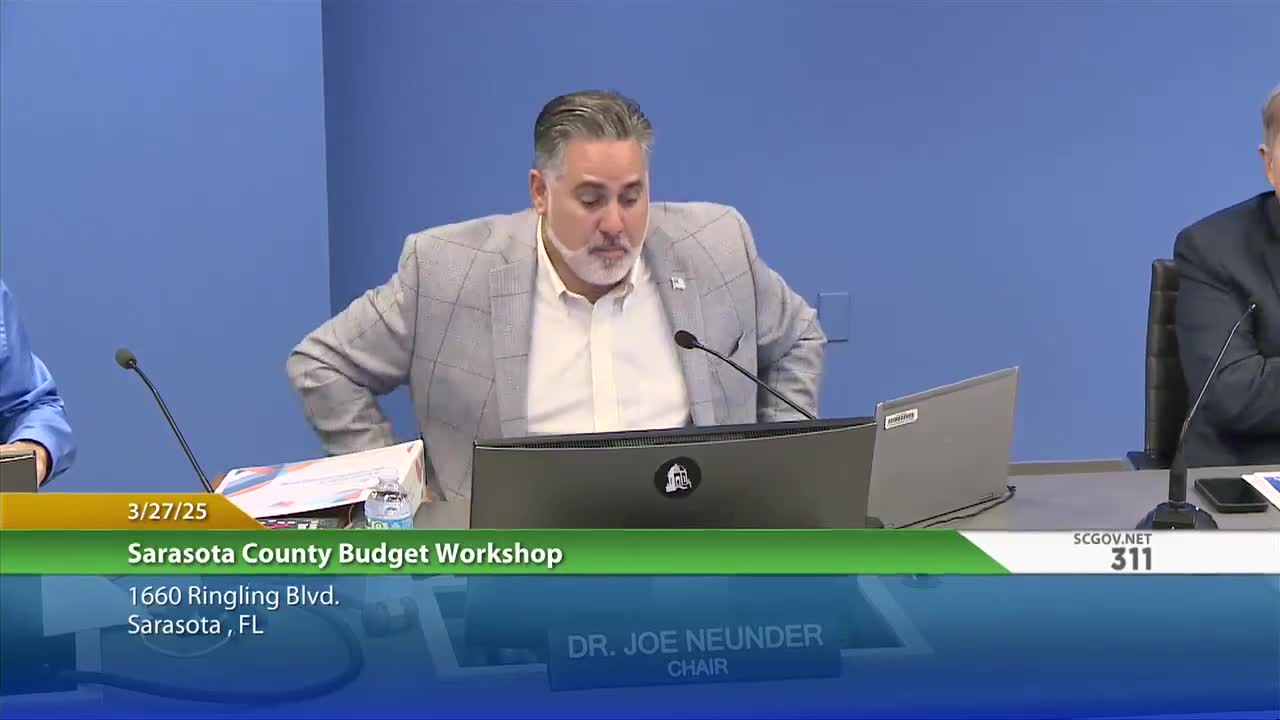
Sarasota County Administrator Rob Lewis told the Board of County Commissioners on March 27 that staff is building the FY‑26 budget on the assumption that the county will keep its millage rate flat and not add new broad‑based taxes, while continuing to plan for operating costs from planned capital projects.
That assumption, Lewis and Office of Financial Management Director Kim Radke said, is important because the county must advertise a not‑to‑exceed millage rate under the state Truth in Millage process; once advertised, the board can set a lower rate but generally cannot adopt a higher one without restarting the process.
The county’s budgeting framework also includes five‑year planning for operating costs tied to capital projects, Radke said. Staff is estimating operating costs for projects such as the Seventeenth Street Regional Park, the Longboat Key library opening and the Regional Fire Training Academy so those ongoing costs can be added in the right year.
Why it matters: Lewis and Kim Radke cautioned commissioners that several measures in the Florida Legislature could alter revenue available to counties, forcing policy choices before final FY‑26 numbers are known. Lewis identified several items the county is tracking, including Speaker Perez’s proposal to cut the state sales tax rate, separate bills that would change rollback‑rate calculations or cap annual millage increases, and a study request on eliminating property taxes that, if advanced, could reach voters in 2026.
Lewis said the sales‑tax proposal could have a multi‑billion‑dollar effect statewide and that other bills — for example, proposals that would reduce commercial rental taxes or adjust local‑option taxes — could carry direct fiscal consequences for Sarasota County. The county’s financial model already assumes lower state revenue growth than earlier estimates; Radke said state Economic and Demographic Research estimates for taxable‑value growth were reduced in recent quarters and that staff reduced major‑revenue assumptions by roughly $8 million per year in the model’s out years.
Commissioners asked for prioritization guidance. Commissioner Knight asked which bills the county should focus on; Lewis replied that staff coordinates weekly with the Florida Association of Counties and other local government partners to follow bills with “legs,” but that late‑session amendments can introduce impactful language with little warning and require rapid response. Lewis told the board staff will keep the commissioners updated and rely on the board’s legislative program for formal positions.
The county also flagged longer‑term budget pressures: changes in Florida Retirement System employer contribution rates adopted by the Legislature will add an estimated $1.8 million to the county budget and about $1.35 million to Fire/EMS funds next year, Lewis said. He also said past board decisions to add recurring reductions and to segregate funds (for example, behavioral‑health contracted services) affect flexibility in future budgets.
The Board gave staff direction to proceed with the budget process based on the stated assumptions — flat millage and no new county‑level service taxes — while continuing to monitor and report on legislative developments.
Ending: Staff outlined the schedule for the next budget steps: deeper CIP review and a financial update in May, preliminary and final property valuations in June and July, and two required Truth in Millage public hearings in September. Lewis urged continued commissioner engagement with the county’s delegation as state action develops.