Get Full Government Meeting Transcripts, Videos, & Alerts Forever!
Get email alerts on the Land Conservation topic
No spam. Unsubscribe anytime.
County highlights land-conservation gains, approves two property actions
Summary
Alachua County’s Land Conservation Board summarized fiscal 2024 accomplishments, and the County Commission voted to accept a 5-acre donation and to exercise an option to buy 68.5 acres near Watermelon Pond.
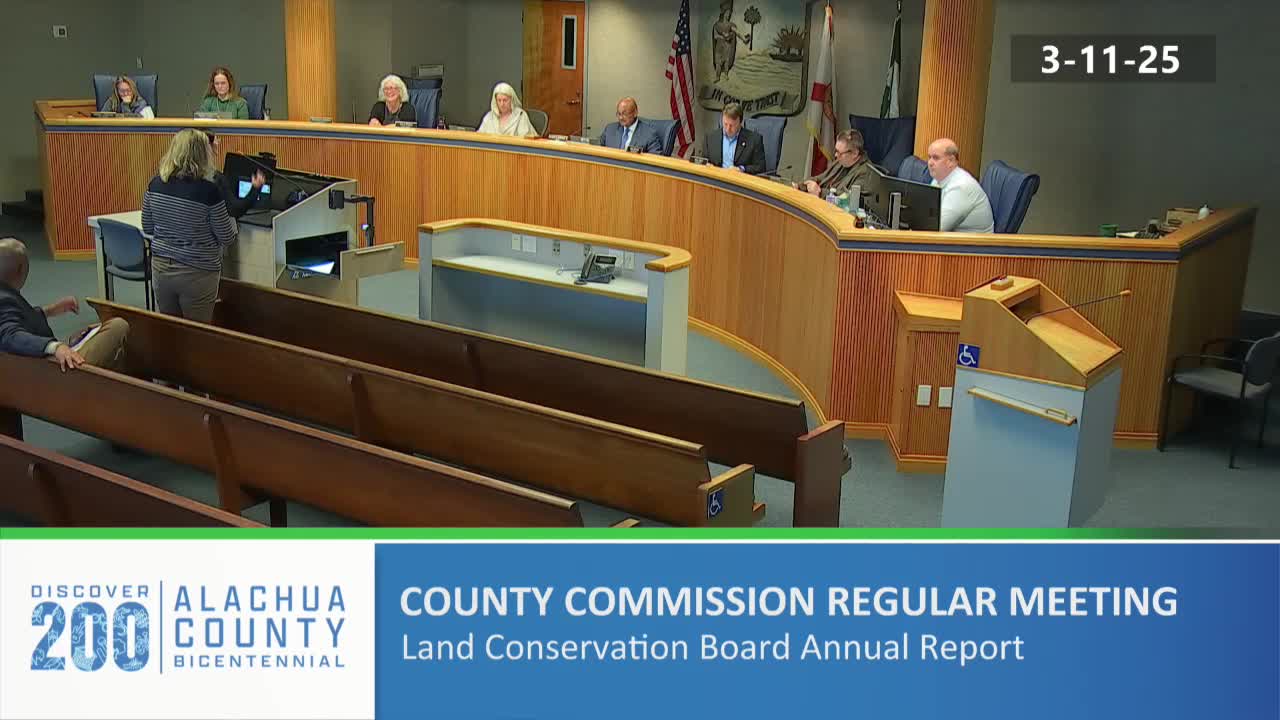
The Alachua County Board of County Commissioners on March 11 heard a fiscal year 2024 report from the Land Conservation Board (LCB) that outlined dozens of property reviews and several recent acquisitions, then approved two land-conservation actions: accepting a donated parcel on Mill Creek and exercising an option contract to buy a 68.5‑acre tract near Watermelon Pond.
The LCB’s secretary, Kristen Young, told commissioners the board reviewed 24 nominated properties in fiscal 2024 and added 21 to a priority pool; eight projects closed during 2024 and those acquisitions totaled “almost 1,500 acres,” she said. Young said the county’s Alachua County Forever program now protects “over 35,000 acres.”
The county later voted, without recorded roll-call names, to accept a donation from trustee Catherine R. Williams of a roughly 5‑acre parcel that includes Mill Creek frontage. Andy Christman, program manager for the Land Conservation Program, said the county would spend $14,190 on standard due‑diligence items for the donation and that annual operation costs would be “a little over $600,” primarily for monitoring and invasive‑plant control. The commission’s motion to accept the donation carried.
Christman also presented an option contract for a fee‑simple purchase of the 68.5‑acre Dumford (Dunford) parcel in the Watermelon Pond project area. He said the property scored 6.27 on the Alachua County Forever matrix, contains intact sandhill habitat and would connect to three parcels already under contract to create an approximately 138‑acre conservation footprint when combined. The purchase price shown in the agenda was $609,993, with estimated due diligence at $46,267 and a total expenditure request, including a 10% contingency, of about $721,886. The commission authorized staff to exercise the option and complete closing steps; the motion carried.
Why it matters: Commissioners and LCB members framed the acquisitions as part of a long‑running voter‑backed program—Wild Spaces Public Places—that uses county and partnership funding to preserve water resources, sandhill ecosystems, corridors for wildlife and springs recharge areas. Commissioners praised the LCB’s volunteer and staff work and marked the program’s 100th acquisition as a milestone.
The Land Conservation Board presentation listed multiple recently acquired parcels and their conservation values: protection of Lake Alto shoreline and associated wetlands, springs‑priority protections in the Mill Creek/Mill Creek Sink area, and preservation of globally imperiled sandhill ecosystems near Watermelon Pond. Christman said some purchases were funded through Wild Spaces Public Places dollars and grants, including a $1,000,000 Springs Protection Program award from the Florida Department of Environmental Protection and a Suwannee River Water Management District contribution on one acquisition.
Ending: Commissioners did not alter program priorities. Andy Christman said the Watermelon Pond closing was anticipated in July 2025 and recommended the manager be delegated authority to accept or reject specific title exceptions tied to historic access easements; the commission approved that delegation and budget amendments needed to complete the transactions.