Get Full Government Meeting Transcripts, Videos, & Alerts Forever!
Get email alerts on the Telecommunications topic
No spam. Unsubscribe anytime.
Walton County board approves conditional use for 245-foot Verizon cell tower near Goodwin Creek Road
Summary
The Walton County Zoning Board of Adjustment approved a conditional‑use permit for a 240‑foot telecommunications tower at 688 Goodwin Creek Road in Freeport, a developer said will be built for Verizon and designed to support additional carriers.
The Walton County Zoning Board of Adjustment approved a conditional‑use permit for a telecommunications tower proposed at 688 Goodwin Creek Road in Freeport, a 240‑foot self‑support tower with a 5‑foot lightning rod (245 feet overall) that developer Freebird Communications said is being built for Verizon Wireless and designed to accommodate additional carriers.
The board’s conditional‑use approval follows a presentation from the applicant and several public comments expressing concerns about property values, wetlands, electromagnetic radiation and whether the U.S. Air Force and other federal agencies would clear the site.
The tower would sit inside a 100‑by‑100‑foot compound, the developer said, and is engineered to allow three carriers on the structure. “We’re looking to construct a 240 foot cell tower with a 5 foot lightning rod self support structure,” Greg Spence said. Spence identified himself as representing Freebird Communications and as the developer for the Verizon site.
Why it matters: county staff and the developer said the tower will fill a coverage gap and support voice, data and emergency services in the Freeport area; neighbors said the site will be visible from nearby homes and could lower property values, harm wetlands habitat and raise long‑term health questions about radiofrequency emissions.
Details and discussion Greg Spence told the board the site meets setbacks and other requirements in the county’s approval process, and that the tower was engineered so it would “collapse upon itself” within its fall zone and would not endanger nearby structures. He said Freebird submitted paperwork showing the compound and lease area and that the structure will be built to support three carriers.
Spence said the Federal Aviation Administration issued “a determination of no air hazard” for the tower at the proposed location. He also told the board the site is adjacent to wetlands but “we’re not within the wetland” and that no wetland impacts are expected.
Board members and planning staff repeatedly said the tower requires a two‑step process: (1) conditional‑use approval from the board because of the site’s rural‑village zoning category, and (2) a separate county development order (DO). Planning staff told the board the DO would not be issued until federal reviews (including an Air Force frequency analysis requested by Eglin) were complete. Staff said the DO was scheduled for the county Technical Review Committee on April 2 and would be continued to allow Eglin to analyze the joint spectrum study.
Neighbors urged caution and asked for alternatives. “I absolutely think we need a cell phone tower somewhere,” said Brian Belew, who identified himself as building a house at 159 Clipper Cove near the proposed site. He said he was concerned that visible towers can reduce property values and told the board that “the National Realtor Realtor Association and all the research I’ve done will bring property debt values down anywhere from 2 to 10%,” with the highest losses within a quarter mile if the tower is visible.
Another neighbor, David Hewins, raised questions about health studies and radiation setbacks, saying many of the studies underlying federal limits are dated and that some advocates recommend larger buffers. Hewins pointed the board to a study he said recommends a 500‑meter setback to avoid potential health risks; he acknowledged that his own house lies outside that radius but urged caution and further analysis.
Several board members pushed back on claims that the county could block the project if the site met local code. Planning staff and the county attorney explained that federal preemption and county code limits the board’s discretion; if the development order does not receive necessary federal or DO approvals, the project cannot proceed. Planning staff said they had received no neighbor comments in the formal record at the time of the hearing.
Federal and military review Spence and staff said Verizon operates on the same frequency bands in the area and that the county has requested a joint spectrum analysis to show the proposed site will not introduce new frequencies or conflicts. Planning staff said Eglin Air Force Base had raised concerns about interference and had requested a technical study that could be forwarded to the Air Force’s technical reviewers in Maryland for analysis. The developer said the carrier will not construct the tower until those frequency issues and the DO are resolved.
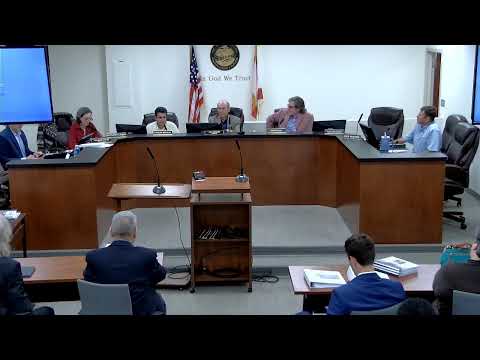
Board action and next steps After discussion the board approved the conditional use. The transcript records the motion, a second and the board’s approval; the recorded roll call in the meeting audio is limited in the transcript but shows one dissenting vote. The developer and planning staff emphasized the DO and federal frequency approvals remain required before construction.
What the decision does and does not do The conditional‑use vote permits the tower to move forward through Walton County’s local permitting process; it does not authorize construction. The developer must secure the development order and federal clearances, and the carrier must complete the joint spectrum and any Air Force coordination. Planning staff said the tower also must meet all development‑order conditions before building would begin.
A resident who lives roughly 1,100 feet from the proposed site asked the board whether landscaping, camouflage designs or a shorter tower could be required. Spence and planning staff said engineers have set the tower height to meet the carrier’s propagation requirements and that camouflage towers of the requested height are not structurally feasible. Planning staff said the selected height was the “minimum criteria that Verizon’s engineers have stated they have to have” for this site.
The board’s conditional‑use approval moves the project to the DO review and to required federal coordination; construction cannot begin until those subsequent approvals are obtained.